

Apple & Almond Puff Pastry Tart
TIER 1
Apple & Almond Puff Pastry Tart
In Tier 1 we’re mastering the essential technique of laminating inverse puff pastry. This is trickier as the dough is wrapped in a butter block which means it can get a little sticky, but the resulting pastry melts in the mouth. We’ve covered laminating a few times so if you’ve tried those classes, you will be really confident heading into this. Once the dough has rested, we cut it into discs, fill it with an almond cream and finally add some sliced apples. After your first bite, you’ll want to eat the whole tray!

6
TARTS
Ingredients
Makes 6 Individual Tarts
Inverse Puff Pastry
Butter Block
100g Plain/All-Purpose Flour
300g Unsalted Butter, Room Temperature
Dough
200g Plain/All-Purpose Flour
4g Fine Sea Salt
120g Double/Heavy Cream
20g Cold Water
5g White Vinegar
Almond Cream
55g Unsalted Butter, Soft
55g Icing Sugar
130g Ground Almonds
10g Cornstarch/Cornflour
45g Whole Eggs, Room Temperature
2-3 Pink Lady Apples
Egg Wash
35g Egg Yolk
30g Double/Heavy Cream
Icing/Powdered Sugar To Decorate
Special equipment
Stand mixer
Digital thermometer
12cm cookie cutter
Piping bag
Method
Inverse Puff Pastry
Butter Block
1. Add the soft butter and flour into a stand mixer fitted with a paddle attachment. Beat for 1-2 minutes on a medium speed until smooth, scraping down the bowl as needed.
- 100g Plain/All-Purpose Flour
- 300g Unsalted Butter, Room Temperature
2. Trace a rectangle 35 x 20 cm/14 x 8 inches in the centre of a large sheet of parchment paper or acetate, then flip it over. Place the butter mixture into the centre, folding over the edges of the paper and taping them in place if needed.
3. Use a rolling pin to roll it into a rectangle with even thickness. Chill for 3 hours in the fridge or overnight.
Dough
1. For the dough, add all the ingredients to a large bowl and stir together until there are no more dry ingredients. It can help to squeeze it together with your hands.
- 200g Plain/All-Purpose Flour
- 4g Fine Sea Salt
- 120g Double Cream
- 20g Cold Water
- 5g White Vinegar
2. Tip the mixture onto a lightly floured work surface and knead it for 1–2 minutes. Initially, it will be quite dry, but as you continue to work it, it will become smooth and gain some very slight elasticity.
3. Trace a rectangle 17.5 x 20cm into the centre of a large sheet of baking parchment or acetate and flip it over. Place the dough in the centre and fold over the edges of the parchment, taping it in place if needed. Roll the dough to the edges until you have an even block. Refrigerate for 3 hours, or ideally overnight. A longer chill is preferable to relax the gluten.
4. Once both have chilled, remove the butter block from the fridge, it needs to be 9–10°C (48–50°F) before using. Once it is close to temperature, remove the dough from the fridge; this needs to be at 6–7°C (43–45°F).
5. Place the dough block in the centre of the butter and fold the butter over, sealing the seam with your fingers. Be quite generous with flouring the work surface and the dough here, or the butter will stick.
6. Rotate the dough 90 degrees so the seam is facing you horizontally, and use a sharp knife to score the edges of the dough where it is folded over the butter. This will release tension and make it easier to roll.
7. Lightly roll the dough to give it some slight width, then rotate the dough 90 degrees again so the seam is now vertically in line with your body.
8. Roll the dough lengthways into a long rectangle, being liberal with the flour so that it doesn’t stick, until it reaches a thickness of about 5–7mm. Use a sharp knife to trim off any wonky ends and dust off any excess flour.
9. Perform a double fold, folding one side of the dough up about 1/5th of the way, bringing the opposite side over to meet it, and then folding the whole piece in half. Wrap the dough tightly in cling film, and place it in the freezer for 15 minutes, then into the fridge for 10 minutes.
10. Remove the dough from the fridge, and with the open seam facing you (i.e if you were looking at the dough straight on, you would be able to see where it has been folded over itself), use a sharp knife again, to score the edges of the dough where it is folded.
11. Turn the dough 90 degrees so the open seam is now horizontal to you and give the dough a quick roll, to give it a little bit of width.
12. Turn the dough 90 degrees again so the open seam is facing you again and begin to roll the dough. Roll the dough into a long even rectangle, very very lightly flouring it, just as we did in step 8.
13. Perform another double fold, and place it in the freezer for 15 minutes, then into the fridge for 10 minutes.
14. Repeat this process one more time, but finishing with a single fold rather than a double fold. To do this, take one-third of the dough and fold it up, then take the other third of dough and fold this over the top.
15. Wrap the dough tightly in clingfilm and refrigerate, ideally overnight. Again, a longer chill helps to relax the gluten.
Almond Cream
1. Into a stand mixer fitted with a paddle attachment, beat the butter and icing sugar on a medium-low speed until smooth, 1-2 minutes.
- 55g Unsalted Butter, Soft
- 55g Icing Sugar
2. Scrape down the sides and add the ground almonds and cornstarch, then mix again just until combined.
- 130g Ground Almonds
- 10g Cornstarch/Cornflour
3. Finally pour in the eggs and beat until it is evenly combined.
- 45g Whole Eggs, Room Temperature
4. Cover this and set it to one side at room temperature.
Assembly
1. Preheat the oven to180C/355F Non-Fan assisted (165C/330 Fan).
2. Remove the puff pastry from the fridge and lightly flouring it, roll it into a rough square shape, around 3-4mm thick.
3. Using a 12cm/4.5” cookie cutter, cut 6 discs of pastry and lift these onto a baking tray lined with a silicon baking mat (or a perforated tray lined with a perforated baking mat). Cut more discs if you have enough dough.
4. Add the pistachio cream into a piping bag, and pipe and even layer into the centre of the puff pastry, leaving about a 1.5cm/0.6” border around the outside.
5. Take the apples and core them, then cut them in half. Next, thinly slice them with a knife or a mandolin.
6. Stack the apple slices together, fanning them apart just slightly and place enough into the tart to cover the pistachio cream, but avoid going over the border of puff pastry.
7. Whisk the egg wash ingredients together and with a pastry brush, very lightly brush the border of puff pastry. You can sprinkle some coarse brown/demerara sugar over the top too for some added crunch, or even toasted flaked almonds.
- 35g Egg Yolks
- 30g Double/Heavy Cream
8. Place these into the centre of the oven and bake for around 35-40 minutes, or until a golden brown colour.
9. Remove them from the oven and lift them onto a wire rack to cool for 15 minutes, then serve. They can be eaten warm or you can allow them to cool completely. Before serving, add a dusting of icing/powdered sugar to finish.
Shop the Equipment


Apple Crumble
TIER 1
Apple Crumble
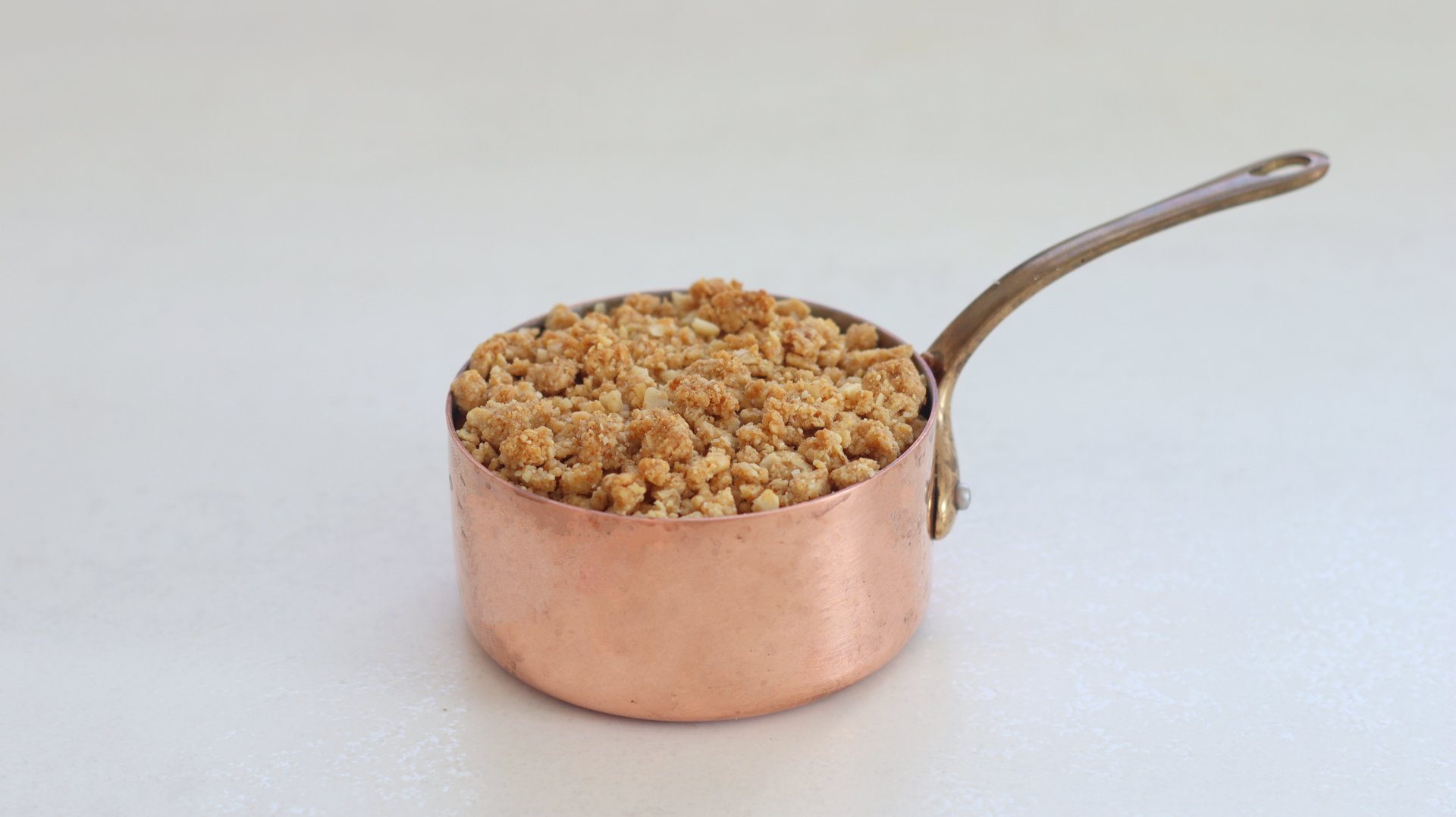
I like to call this my ‘restaurant crumble’ – not quite your simple butter, flour, sugar mixture as this crumble topping has oats, nuts and muscovado sugar. It’s a bit fancy but I love all the textures. The base of an apple crumble is a great apple filling and this is the fundamental thing we are learning here which we take through to Tier 2. It’s rich with spices and has a lovely soft, almost caramel like sauce wrapping around the apples. Serve with custard (and ice cream!).
4
INDIVIDUAL CRUMBLES
Ingredients
Makes 4 Individual Crumbles
Crumble
125g Plain/All-Purpose Flour
85g Unsalted Butter, Cold & Cubed
15g Oats
30g Whole Hazelnuts, Skinned
60g Ground Almonds
40g Muscovado Sugar
Pinch of Flakey Salt
Apple Filling
35g Unsalted Butter
600g Braeburn Apples (About 12 Apples)
55g Dark Muscovado Sugar
10g Caster/White Sugar
14g Cornstarch/Corn flour
½ Tsp Ground Cinnamon
¼ Tsp Ground Ginger
½ Tsp Vanilla Bean Paste
Freshly Grated Nutmeg
75-100g water (adjust based on desired consistency)
Lemon Juice
Flakey Sea Salt
Special equipment
Food processor
Ramekins
Method
Apple Filling
1. Peel and core the apples, then cut them into cubes – 1x1cm as a guide.
2. Toss them in a bowl with a squeeze of lemon juice once chopped, to prevent them from browning.
3. Into a medium saucepan, add the butter and place it over a medium heat.
4. Stir it until the butter begins to brown slightly and smells nutty.
5. Add in the apples, and stir, cooking over a medium heat for 2 minutes.
6. Add in the sugars, and continue to cook for 5 minutes, to release some of the moisture from the apples.
7. Reduce the heat to medium low, and add in the spices, cook for 30 seconds, then add in the cornflour and cook for a minute.
8. Stir in the water, starting with about half, until you have a sauce that is thick and glossy – the consistency of a runny caramel. If you prefer a crumble with a saucier consistency, then you can add more water.
9. Finally, stir through a pinch of flaky sea salt.
10. Pour the mixture onto a baking tray, and cover the surface with clingfilm. Refrigerate for 1 hour.
Crumble
1. Into a food processor, add all of the ingredients for the crumble.
2. Pulse the mixture until the butter has broken down into pea size pieces.
3. Tip it out onto a large tray and use your hands to squeeze it together until it clumps up.
4. Then rub it between your hands to form a crumble-like mixture. Spread it evenly across your baking tray.
5. Place the tray in the freezer for 30 minutes.
6. Meanwhile, pre-heat the oven to 175C/345F non-fan assisted.
7. Once the crumble has chilled, bake it in the oven for 12 minutes. No need to stir it, just remove it from the oven and let it cool for about 15 minutes. Leave the oven on.
Assembly
1. Remove the chilled apple filling from the fridge.
2. Take 4 ramekins or individual saucepans (I used small copper pots) and fill them up about ¾ of the way with the apple filling.
3. Take the cooled crumble and scoop it on top, filling it to the top of the ramekin.
4. Place the ramekins on a baking tray and bake for around 25-30 minutes, or until the crumble is a deep golden brown colour.
5. Remove them from the oven and serve immediately with ice cream or custard!
Shop the Equipment


Apple Pie
TIER 2
Apple Pie
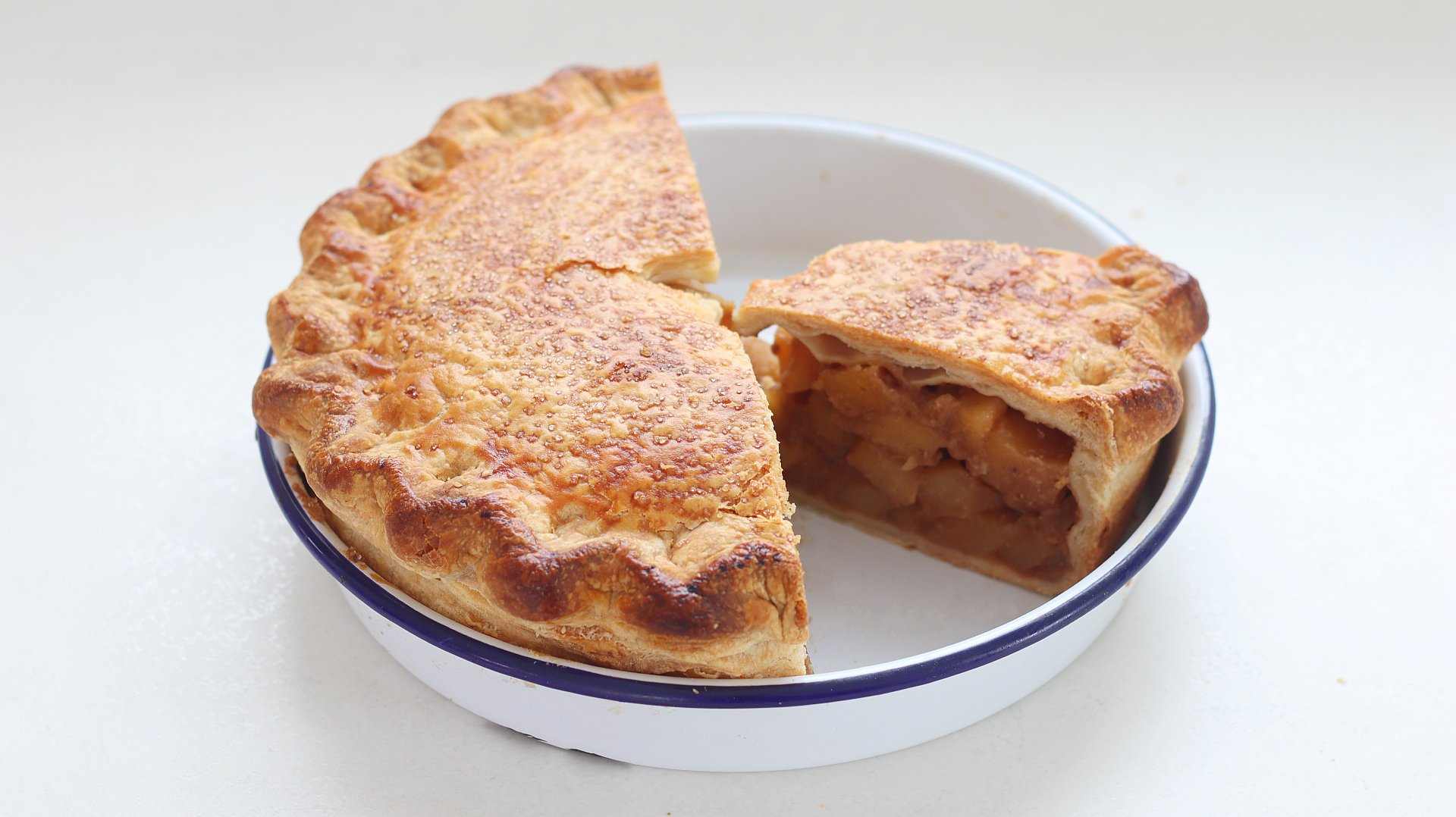
A pastry chef once recommended adding cream cheese to a pie dough for extra tenderness and I have to say, I really love this dough! It is slightly technical as we are ‘laminating’ the pie dough to get it extra flakey, but it’s nothing like laminating a croissant so don’t panic! We use the same apple filling as Tier 1 and use it for a classic double crust apple pie. Serve with custard (and ice cream!).
1
9 inch pie
Ingredients
Makes 1 9-inch Pie
Pie Dough
500g Plain/all-Purpose Flour
6g Fine Sea Salt
25g Caster/White Sugar
325g Unsalted Butter, Cold
80g Full-Fat Cream Cheese, Cold
100–150g Ice-cold water
Apple Filling
75g Unsalted Butter
1200g Pink Lady Apples (About 12 Apples)
110g Dark Muscovado Sugar
20g Caster/White Sugar
27g Cornstarch/Corn flour
¾ Tsp Ground Cinnamon
½ Tsp Ground Ginger
1 Tsp Vanilla Bean Paste
Freshly Grated Nutmeg
150–225g water (adjust based on desired consistency)
Lemon Juice
Flakey Sea Salt
To Finish
1 Egg, Whisked
Demerara Sugar
Special equipment
9-inch pie dish
Rolling pin
Method
Pie Dough
1. Add the flour, sugar & salt into a large bowl.
2. Add in the butter (cut into small cubes), and toss it in the flour to coat the pieces.
3. Using your hands, work the butter into the flour, squeezing each piece between your fingers to flatten them.
4. Add in the cream cheese, and stir it through with your hands again to dissolve it into the flour mixture.
5. Now, mix in the ice-cold water, starting with about half, and swirl your hands to mix the water into the dry ingredients. Keep adding water just until there are no more dry ingredients in the bowl. The amount of water you need will depend on the type of flour you use.
6. Lift the dough onto your work surface and pull it together with your hands into a rough square shape.
7. Flour your work surface and the top of the dough, and using a rolling pin, roll it into a long rectangle. The dough might want to stick, so use a bench scraper to get underneath the dough to loosen it.
8. Fold one-third of the dough up, then fold the other third of the dough over the top of this. Wrap the dough in cling film and refrigerate for 30 minutes.
9. Repeat this laminating process two more times, rolling the dough into a rectangle and folding it on itself. Once you have performed the final fold, cut the dough in half, then wrap and chill the dough for at least 1.5 hours, or leave it overnight.
Apple Filling
1. Peel and core the apples, then cut them into cubes – 2x2cm as a guide.
2. Toss them in a bowl with a squeeze of lemon juice once chopped, to prevent them from browning.
3. Into a large saucepan, add the butter and place it over a medium heat.
4. Stir it until the butter begins to brown slightly and smells nutty.
5. Add in the apples, and stir, cooking over a medium heat for 2 minutes.
6. Add in the sugars, and continue to cook for 5 minutes, to release some of the moisture from the apples.
7. Reduce the heat to medium low, and add in the spices, cook for 30 seconds, then add in the cornflour and cook for a minute.
8. Stir in the water, starting with about half, until you have a sauce that is thick and glossy – the consistency of a runny caramel. If you prefer a pie with a saucier consistency, then you can add more water.
9. Finally, stir through a pinch of flaky sea salt.
10. Pour the mixture onto a baking tray, and cover the surface with clingfilm. Refrigerate for 1 hour.
Assembly
1. Remove one half of the pie dough from the fridge, and on a lightly floured surface, roll it out into a rough circle, around 3-5mm thick.
2. Lift it into a 9” pie dish – you should have a 1” overhang of dough over the edge of the tin.
3. Scoop the cooled apple filling into the dough, pressing it down with a spatula to remove any air pockets.
4. Place the pie in the fridge.
5. Remove the second piece of dough from the fridge, and on a lightly floured surface, roll it into a rough circle.
6. Remove the pie from the fridge and apply a light egg wash around the edge.
7. Lift the second piece of dough on top, and using your fingers, firmly crimp the edges to seal the two pieces of dough together.
8. Using scissors, cut the excess dough away, leaving about a ¼” of dough around the edge.
9. Fold this excess dough underneath itself to create a thick rim.
10. Use your thumb and index finger on one hand to gently pinch the edge of the dough. With the index finger of your other hand, press into the pinched section to push the dough outward, creating a fluted edge. Continue this motion, crimping the entire crust of the pie.
11. Place the pie into the fridge for 30 minutes.
12. Meanwhile, pre-heat the oven to 225C/435F non-fan assisted, and place a baking tray on the lower third rack of the oven.
13. Once the pie is chilled, remove it from the fridge and brush an egg wash over the dough.
14. Sprinkle a light dusting of demerara sugar on top, and then use a knife to cut 3 air vents in the centre of the pie.
15. Place it onto the pre-heated tray, and bake for 25 minutes.
16. Then, move the pie up to the middle shelf of the oven and lower the temperature to 180C/355F. Bake for a further 60-70 minutes.
17. The pie will darken quite quickly, so you will most likely need to cover the top of the pie with a sheet of foil for the final 30-45 minutes to prevent it from burning.
18. Once baked, the pie should be a deep golden colour, and the filling should be bubbling up slightly.
19. Remove the pie from the oven and allow it to cool. Let the pie cool for at least 30 minutes before serving. It will still be warm, with a soft, and runny center. But for cleaner slices, allow it to cool completely or even chill it in the fridge—then reheat individual slices as needed.
Shop the Equipment


Chausson Aux Pommes
TIER 1
Chausson Aux Pommes
Ok these are essentially apple turnovers, but I felt the name didn’t do them justice and it sounds much more fancy in French! In this recipe I take you through how to make rough puff pastry in detail, so make sure you watch the video to master those folds! Then we cut it into a classic turnover shape and fill it with a sweet apple compote. It’s the perfect buttery, fruity, flakey dessert!
4-6
TURNOVERS
Ingredients
Makes 4-6 Turnovers
Rough Puff Pastry
500g Plain/All-Purpose Flour
10g Fine Sea Salt
240g Ice Cold Water
10g White Vinegar
400g Unsalted Butter, Very Cold & Cubed
Apple Compote
500g Apples (Braeburn/Pink Lady/Golden Delicious – about 5-6 large apples)
60g Dark Brown Sugar
25g Unsalted Butter
1 Vanilla Bean/1 Tsp Vanilla Bean Paste
Pinch of Sea Salt Flakes
Bowl of ice water with the juice of 1 lemon
Egg Wash
25g Egg Whites
60g Egg Yolks
15g Double/Heavy Cream
Glaze
60g Water
60g Caster/White Sugar
Or
65g Water
125g Sugar
30g Liquid Glucose
Special equipment
Stand mixer
Rolling pin
Hand blender
Digital calipers (optional)
Oval template (see PDF)
Fluted pastry wheel
Method
Rough Puff Pastry
1. Pour the flour into the bowl of a stand mixer along with the salt.
2. Pour in the cold water and vinegar.
3. Tip the cubed butter into the centre, then with the paddle attachment, mix on a low speed, just until the dry bits of flour have been absorbed. This should only take 15-20 seconds. The lumps of butter will still be there!
4. Scoop the mixture out of the bowl onto a lightly floured work surface. Using a rolling pin, roll the dough into a long rectangle. You need to work quickly here especially if it is a warm day as the butter will start to soften too much.
5. Once you’ve rolled it out, you might need to use a lightly floured bench scraper to loosen it from the work surface.
6. Perform a single turn, by folding one-third of the dough up on itself, and then folding the remaining third of dough over the top as seen in the PDF.
7. Wrap the dough in cling film and chill it. If it is a warm day, I prefer to do 10 minutes in the freezer then 15 minutes in the fridge. But on a ‘normal day’, 20 minutes in the fridge will be enough.
8. Unwrap the dough and with the open seam facing you, turn the dough 90 degrees so it is now adjacent to you. Roll the dough slightly to give it a little bit of width, then rotate it 90 degrees again so the open seam is facing you again. Roll the dough into a long rectangle again, flouring as needed to ensure it doesn’t stick.
9. Use a bench scraper to get underneath the dough if it feels like it is sticking, then perform a double turn, by folding ¼ of the dough up on itself, then the remaining ¾ of the dough to meet. Fold the dough in half, then wrap in cling film to chill again.
10. Repeat steps 9&10, 2 more times (performing two more double turns) and chill the dough.
11. Unwrap the dough again, and roll it out, performing one final single turn (as seen in step 7). In total you will have done 1x single turn, 3x double turn, 1 x single turn. Refrigerate the dough for 2 hours (or overnight).
Apple Compote
1. Peel and core the apples, then dice them into small cubes (‘brunoise’ as they would say in French!). As you are chopping them, add them to the bowl of cold water with the lemon juice to prevent them from oxidising.
2. Once chopped, drain them and add them into a medium saucepan. Cook them over a medium heat until the juices start to come out of the apples – about 3 minutes. Strain them to remove the excess liquid, then add in the light brown sugar, butter and vanilla.
3. Continue to cook them, stirring frequently, until you have a golden caramelised mixture, this should take about 6-10 minutes. Once cooked, stir through the sea salt flakes.
4. Add the mixture into a jug and blend until you have a thick compote texture.
5. Add this mixture into a bowl and set it to one side in the fridge to cool completely.
Assembly
1. To create the classic chausson aux pommes shape, we need a fluted oval shape which is then folded in half. You can buy special cutters for this but they are expensive, so I created a little hack so that we can do it at home!
2. At the bottom of the PDF there is an oval template you can print off (ideally on some thick card). This will give you an oval that is 6.7”x4.8”.
3. Print this off and then to get the fluted edge, we use a fluted pastry wheel and cut around the template while it is on top of the puff pastry. If you do not have a fluted cutter don’t worry you can just cut around it with a knife. But this template will give you the perfect size!
4. Remove the chilled puff pastry from the fridge and place it onto a floured work surface. Note – it can be easier to work with the pastry in two batches so that it doesn’t get too warm, in this case, just cut the chilled dough in half, and reserve one in the fridge while you roll the other. For the following steps I will assume you are working with a half batch and you just need to repeat the steps to make the remaining pastries.
5. With the open seam facing you, turn the dough 90 degrees so it is now adjacent to you. Roll the dough slightly to give it a bit of width – it needs to be around around 7.5” tall so that it is taller than the oval template.
6. Rotate it 90 degrees again so the open seam is facing you again. Roll the dough into a long rectangle, flouring as needed to ensure it doesn’t stick.
7. Don’t worry about the length of the rectangle, we are more concerned about the thickness – it needs to be around 0.2”/5mm thick. If it is too thick, when it bakes, it will puff up too much! If the dough feels too soft at this point, get it straight into the freezer for 10 minutes to firm up a little. It is much easier to work with when it is cold.
8. Assuming you are working with a half batch of the dough, use the oval template to cut out 2-3 ovals (the number you get will depend on how efficiently you were rolling it and how thick it is!)
9. Lift the fluted ovals onto a tray lined with a silicon mat, and place them in the fridge for 15 minutes.
10. At any point during the process, if you find the dough is getting too warm, place it back into the freezer for 5/10 minutes to chill it down then carry on.
11. Prepare the egg wash by whisking together all the ingredients until you have a homogenous mixture.
12. To ensure you get the same amount of filling, I like to decant my chilled compote into little dishes, each weighing 50g. Then I can just scoop it straight into the pastry knowing I’ve got the correct amount.
13. Remove the chilled pastry from the fridge and, working quickly, scoop 50g of compote into the centre. Refer to the drawing below, we want to make sure we keep the compote away from the edges so it doesn’t leak out later so use your fingers to keep it nice and centred.
14. Brush an egg wash around the edge of the pastry surrounding the compote and fold the bottom half of the pastry over. Use your fingers to seal the dough together, being careful not to warm the dough too much with your hands and ‘smoosh’ it.
15. Use a knife to poke 4 holes in the back of the pastry and then flip it over so this side is now touching the baking tray lined with a silicon mat. Brush the top of the pastry with an egg wash then refrigerate it for 20 minutes. At this point, preheat your oven to 175C/345F non-fan assisted.
16. Remove the pastry from the fridge and apply a second egg wash, then using a sharp knife, lightly score a decorative pattern into the pastry, I just do a series of vertical lines!
17. Place the pastries straight into the oven on the middle shelf and bake for around 45-50 minutes. The apple compote is already cooked so all we are looking for is a nice golden puff pastry.
18. About 10 minutes before you can prepare the glaze so that it is still slightly warm. Add the sugar and water into a saucepan, and simply bring it to a boil. Continue to cook it until it has thickened slightly but is still runny. Slightly looser than the consistency of honey.
19. I’ve given you two options for the glaze, the second one is just slightly shinier from the addition of glucose but is prepared with the exact same method! Just boil the ingredients together.
20. Once the pastries are baked, lift them onto a wire rack and brush them lightly with the glaze. They can be eaten warm or served once cooled, but they are best eaten the same day so that the pastry is as fresh as possible.
Shop the Equipment


Apple Crumble
We would love to see your Bake It Better creations!
Show off your skills by sharing your desserts
#BakeItBetter

Herringbone Lattice Apple Pie
We would love to see your Bake It Better creations!
Show off your skills by sharing your desserts
#BakeItBetter