
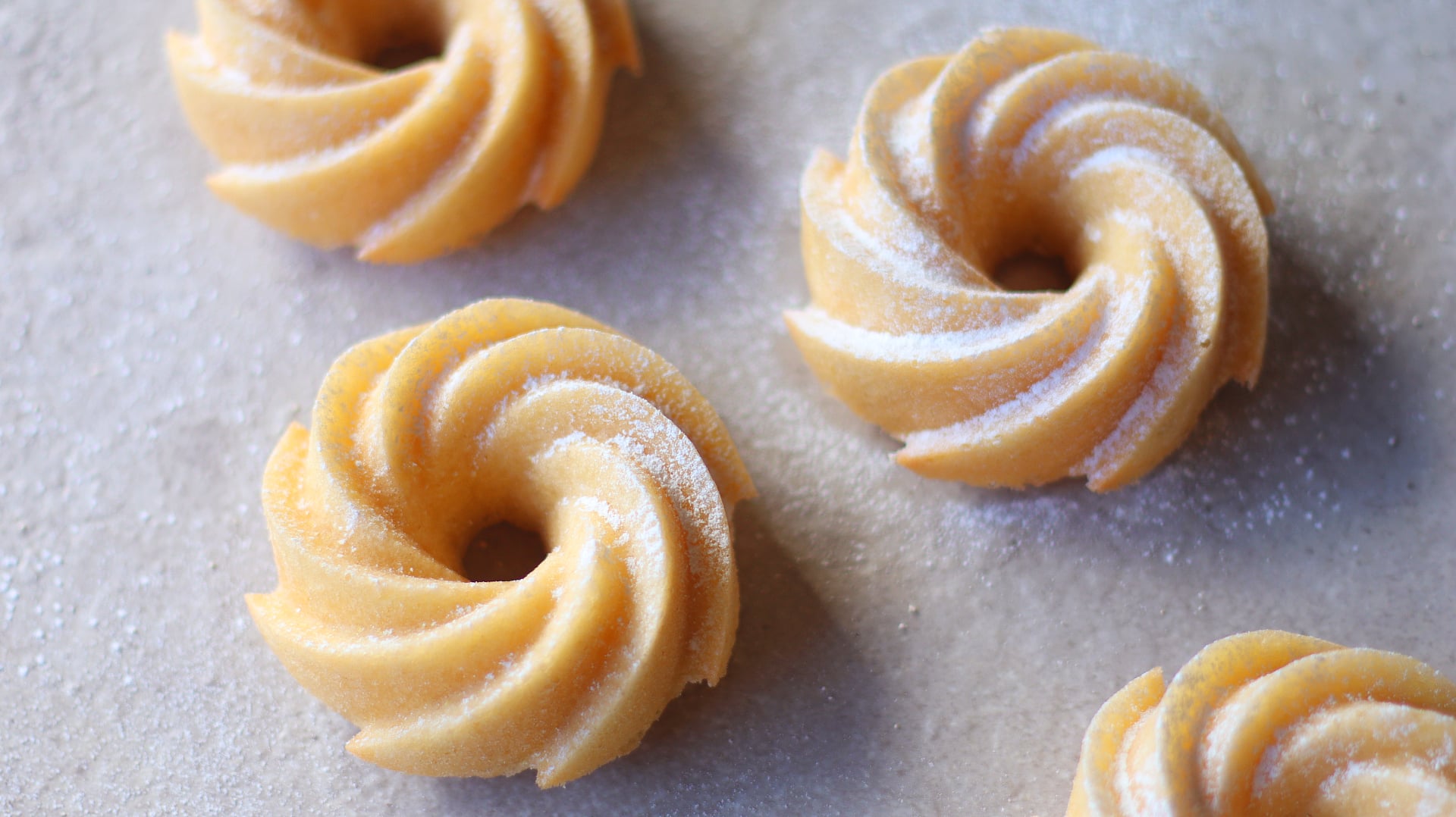
Lemon ‘Babka’ Bundt Cakes
TIER 1
Lemon ‘Babka’ Bundt Cakes
This recipe is my take on a non-yeasted Polish Babka Bundt. It’s a simple lemon cake recipe that’s super soft, covered in a lemon syrup and finished with a lemon sugar. I’ve gone for these beautiful miniature bundts, but if you don’t have a similar tin you can use a muffin tin!

6
INDIVIDUAL BUNDT CAKES
Ingredients
Makes 6 Individual Bundt Cakes
For the lemon sugar
Peel of 4 Large Lemons (60g)
200g Caster/Granulated Sugar
*This will make more than you need but it can be stored in an airtight container – this will ensure the lemon peel doesn’t go bad.
For the lemon cake
Zest 1 Lemon (2g)
125g Caster/Granulated Sugar
100g Plain/All-Purpose Flour
5g Baking Powder
2g Salt
100g Ground Almonds
200g Whole Eggs
50g Vegetable Oil
30g Lemon Juice
Soft Unsalted Butter + Flour To Coat
For the lemon syrup
100g Sugar
50g Lemon Juice
50g Water
Special equipment
Stand Mixer
Blender
4 Cup – 6 Cavity Mini Bundt Tin
Method
Lemon Sugar
1. Preheat the oven to 80C/175F Non- Fan Assisted.
2. Peel the lemons using a vegetable peeler – you should get roughly 60g of lemon peel.
3. Place the lemon peels onto a baking tray lined with a silicon mat.
4. Place the lemon peel in the oven to dry them out, it will take 1-1.5 hours. They should look shrivelled once done.
5. Once completely dry to the touch, remove them from the oven and allow them to cool for 30 minutes.
6. Into a blender, add the sugar and dried lemon peels. Blend on high speed for 15-20 seconds, or until you have a fine, fragrant powder with no large lumps of lemon skin.
7. Add the mixture into an airtight container and set it to one side.
Lemon Cake
1. Preheat the oven to 180C/355F Non-Fan Assisted. Take soft butter (not melted), and use a pastry brush to brush the inside of the bundt tin cavities to ensure an even coating. Over the top of the tins, sieve over a few tablespoons of plain/all-purpose flour in each cavity, and shake it around the tin to coat. Tap out the excess and set the tin to one side.
2. In a medium bowl, add the sugar and the lemon zest. Massage the zest with your fingertips into the sugar to release the citrus oils.
3. Into a medium bowl, sift together the flour, baking powder and salt. Whisk it together to combine, then whisk in the ground almonds. Set this mixture aside.
4. In a large bowl, add the eggs and lemon sugar. Using an electric hand mixer (or a stand mixer), whisk on a medium speed for 3-4 minutes until the mixture is thick, pale and fluffy.
5. Pour in the oil, along with the lemon juice and whisk by hand to incorporate it, ensuring to catch any ingredients that may be at the bottom of the bowl.
6. Tip in the sifted dry ingredients and use a hand whisk again to combine until there are no more dry bits.
7. Scoop the batter into the cavities of the bundt tin, filling them up about ⅘ (75g per cavity if you’re using the same sized Bundt tin as me).
8. Bake the cakes for 18-20 minutes, until a skewer comes out clean. Whilst baking, make the Lemon Syrup.
9. In a medium saucepan over a medium heat, mix together the sugar, water and lemon juice and bring to a gentle simmer. Once simmering, take off the heat and leave to cool whilst the cakes continue to bake.
10. Once the cakes have baked and a skewer comes out clean, let them cool in the tin for 5 minutes, then place a wire rack on top before carefully flipping them over to release the cakes. Pour over the lemon syrup.
11. The cakes can be eaten warm or allowed to cool. Before serving, take the lemon sugar you made earlier and place it into a fine mesh sieve, and gently dust it over the top of the cake. The extra sweetness elevates the flavour of the cake!
Shop the Equipment


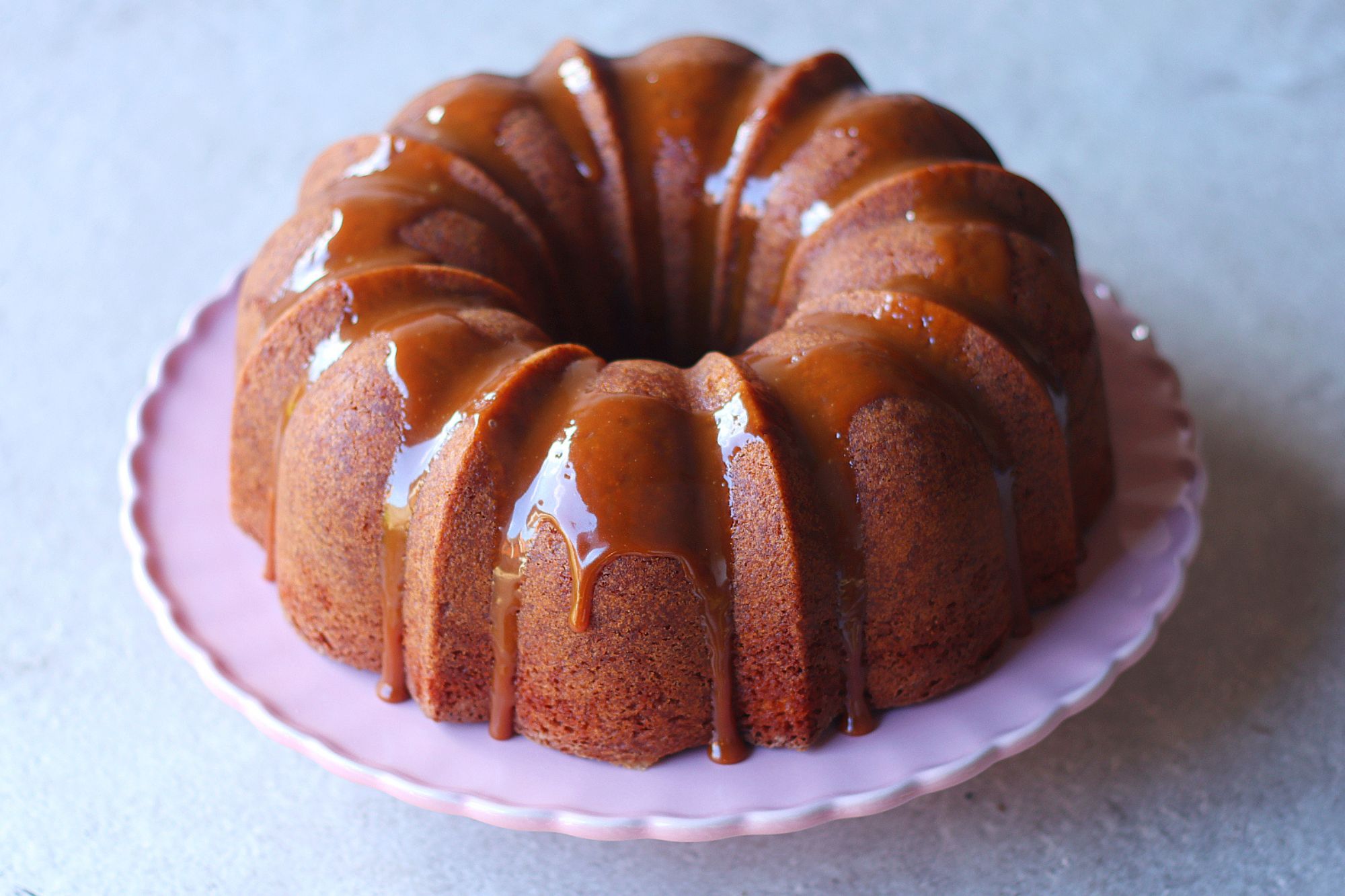
Salted Caramel Bundt Cake
TIER 2
Salted Caramel Bundt Cake
This recipe we advance the ‘flavoured sugar’ technique from Tier 1 and make a powdered salted caramel to add to the cake batter. This was a bit of a fluke whilst recipe testing but wow, the flavour of this cake is unreal! I’ve topped it with a decorative salted caramel sauce that’s quite chewy in texture. If you want something softer, switch it out for the salted caramel recipe in Tier 2 of the Chocolate Tart classes!
112 CUP BUNDT CAKE
Ingredients
Makes 1 12 Cup Bundt Cake
For the caramel sugar
320g Caster/Granulated Sugar
4g Fine Sea Salt
For the caramel cake
245g Caramel Sugar (Recipe Above)
95g Caster/Granulated Sugar
95g Light Brown Sugar
465g Unsalted Butter, Room Temperature
385g Whole Eggs, Room Temperature
1 Tsp Vanilla Bean Paste
465g Self Raising Flour
35g Boiling Water
Soft unsalted butter + flour to coat the bundt tin
For the caramel sauce
125g Caster/Granulated Sugar
65g Water
75g Double Cream
30g Unsalted Butter
Pinch Sea Salt Flakes
Special equipment
Blender
Stand Mixer
12 Cup Bundt Tin
Method
Caramel Sugar
1. Into a medium frying pan, add about ⅕ of the sugar, spreading it evenly across the pan.
2. Place the pan onto a medium heat, and gently shake the pan to agitate the caramel, until it has melted.
3. Add another ⅕ of the sugar on top and agitate the pan again to dissolve the sugar, until it has melted.
4. Continue adding the sugar in increments, ensuring it is fully melted before adding the next addition. At this point, you can begin to use a rubber spatula to stir it through.
5. Once you have added all of the sugar, add in the salt and continue to stir it with a rubber spatula until it reaches a deep amber colour.
6. Immediately remove it from the heat and pour it evenly onto a baking tray lined with a silicon mat.
7. Allow to cool at room temperature for 30 minutes, until it has set completely firm.
8. Once set, break the caramel into shards and place it into a high powered blender and blender for 5-10 seconds, into a fine powder*
* Once you have blended the sugar, it is important to use it immediately for the cake, otherwise it will begin to absorb moisture and go very sticky.
Caramel Cake
1. Preheat the oven to 180C/355F Non-Fan Assisted. Take soft butter (not melted), and use a pastry brush to brush the inside of the bundt tin to ensure an even coating. Sieve over a few tablespoons of plain/all-purpose flour and shake it around the tin to coat. Tap out the excess and set the tin to one side.
2. Take the caramel sugar and weigh 245g.
3. Into the bowl of a stand mixer, add the soft butter and all the sugars. With the paddle attachment, beat it on a medium speed for 3-4 minutes, until the mixture is thicker and paler in consistency, scraping down the bowl as needed.
4. Add the eggs in four parts, beating for a few seconds between each addition (still at a medium speed). Then add the vanilla bean paste. At this point, the batter will look split but don’t panic.
5. Sift in the self-raising flour, and mix on a low speed just until the flour has been absorbed.
6. Finally, tip in the boiling water and mix to combine. This will help to loosen the cake batter slightly.
7. Use a spatula to evenly scoop the cake batter into the lined bundt tin, then using the back of a slightly warm spoon, spread the top of the batter out just to smooth it slightly.
8. Place the cake into the oven and bake for 45-55 minutes or until a skewer inserted comes out clean.
9. Allow it to cool in the tin for 5 minutes before placing a wire rack on top, and then flip the cake out to release it. Allow to cool for 30 minutes before adding the Caramel Sauce
Caramel Sauce
Note: if you want a softer, runny caramel sauce I would recommend using the Tier 2 salted caramel recipe from the October’s chocolate tart recipe.
1. Into a medium saucepan add the water, then the sugar. Place it on a medium heat.
2. Cook the caramel, until it reaches a deep golden brown colour, being careful not to burn it.
3. Pour in the cream and add the butter. Be careful as this will bubble quite violently. Use a hand whisk to mix it through and continue to cook for about 30 seconds on a medium low heat until you have a smooth glossy caramel. Stir in a good pinch of sea salt flakes and whisk them through.
4. The caramel can be served immediately as a warm sauce, or poured over the top of the cake in a decorative drip. The caramel will set as it cools, and turn into a more stringy, chewy texture, like a candy bar! It holds its shape very well, so is perfect to leave at room temperature on the cake for when you are ready to serve.
Shop the Equipment

