
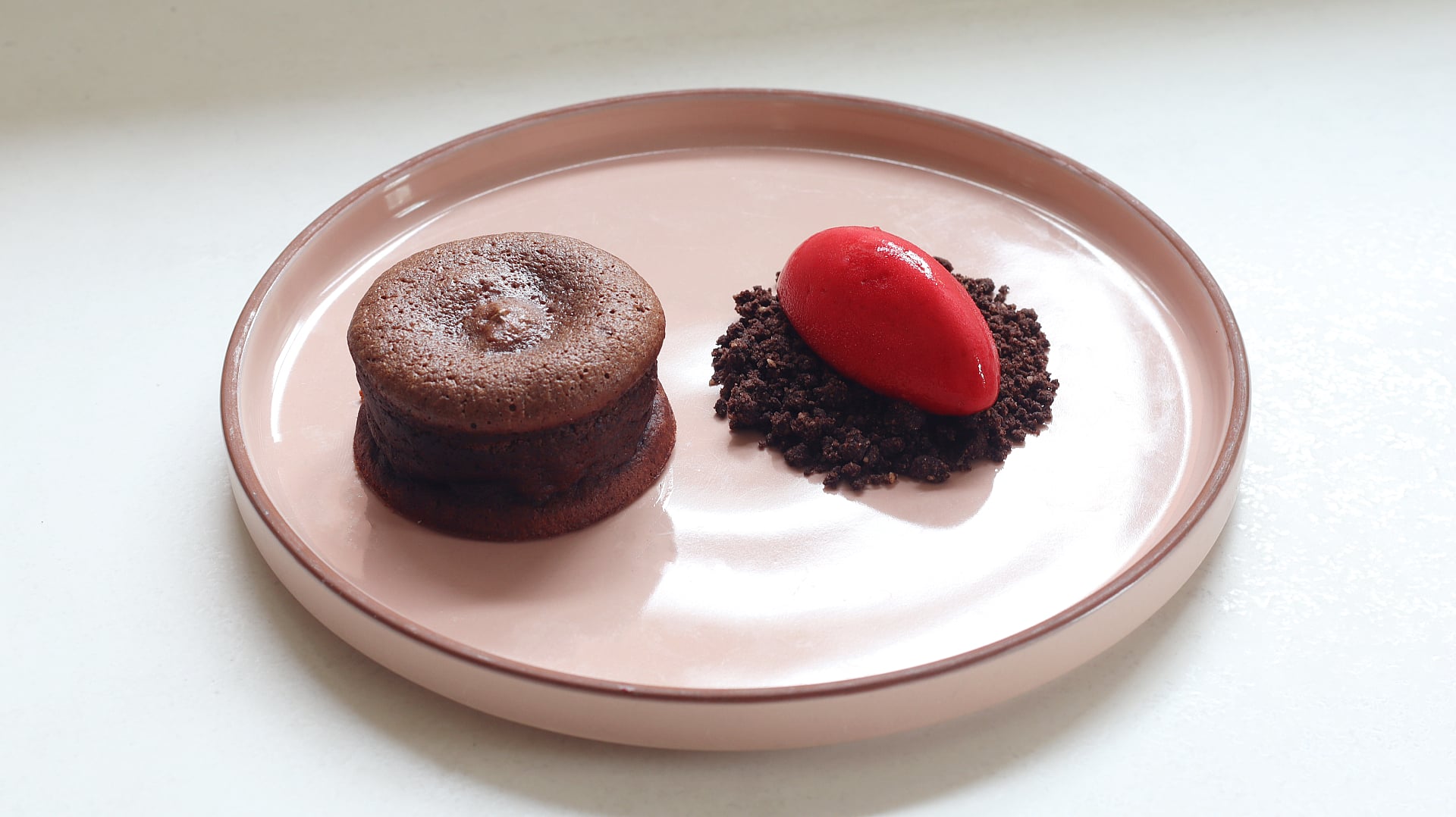
Chocolate Fondant with Strawberry Sorbet
TIER 2
Chocolate Fondant with Strawberry Sorbet
This is a more refined take on the Tier 1 recipe. The fondants are baked in individual ring moulds and plated with chocolate soil and raspberry sorbet. The soil adds crunch and a subtle saltiness, while the sorbet brings brightness and balance to the plate. All the elements can be prepared in advance, then the fondants are baked just before serving.

4
FONDANTS
Ingredients
Makes 4 Fondants
Strawberry Sorbet
90g Water
160g Caster/White Sugar
35g Liquid Glucose or any invert sugar
2g Locust Bean Gum or NH Pectin
450g Strawberry Puree
Citric Acid To Taste (1-2g)
Fine Sea Salt To Taste
Chocolate Crumble
50g Caster/White Sugar
50g Ground Almonds
30g Plain/All-Purpose Flour
20g Cocoa Powder
3g Flakey Salt
35g Unsalted Butter, Melted
Chocolate Fondant
200g Dark Chocolate (70% Cocoa Solids), Chopped
200g Unsalted Butter, Room Temperature
200g Icing/Powdered Sugar
220g Whole Eggs
75g Egg Yolks
55g Plain/All-Purpose Flour
45g Cocoa Powder
Pinch of Flakey Sea Salt
Special equipment
Digital thermometer
Hand blender
Ice cream machine
4 7×3.5cm (2.7×1.3”) metal ring molds
Stand mixer or electric hand whisk
Piping bags (optional)
Method
Strawberry Sorbet
1. Place a medium bowl inside a large bowl that is filled with ice water. Set this to one side.
2. Into a medium saucepan, add the water, sugar, glucose and locust bean gum.
- 90g Water
- 160g Caster/White Sugar
- 35g Liquid Glucose or any invert sugar
- 2g Locust Bean Gum or NH Pectin
3. Whisk the mixture over a medium heat until it reaches 85C/185F on a digital thermometer.
4. Immediately remove it from the heat and pour it into the medium bowl you set aside, over the ice. Stir this occasionally until it reaches around 10C/50F on a digital thermometer.
5. Transfer the cooled mixture to a tall measuring jug, then pour the strawberry puree on top. Blend till smooth with a hand blender.
- 450g Strawberry Puree
6. Add in the citric acid (or lemon juice) and blend. Taste the mixture and add more if needed to suit your taste.
- 1-2g Citric Acid
7. The mixture can be churned immediately in your ice cream machine, or left in the fridge for up to 24 hours.
8. When you are ready to churn it, add a pinch of salt and stir this through. Then pour it into your machine, churning according to the machine instructions. It usually takes around 15-30 minutes until it is a thick, scoopable texture.
9. Once it is done, it will still be slightly soft, so transfer it to a tupperware and place it back in the freezer for 2-3 hours. Then it will be the perfect scooping texture.
Chocolate Soil
1. Preheat the oven to 160C/320F non-fan assisted (145C/295F fan-assisted)
2. Place all the dry ingredients into a bowl and stir together with a spatula.
- 50g Caster/White Sugar
- 50g Ground Almonds
- 30g Plain/All-Purpose Flour
- 20g Cocoa Powder
- 3g Flakey Salt
3. Pour in the melted butter and stir together to form a crumbly chocolate mix.
- 35g Unsalted Butter, Melted
4. Tip the crumble onto a baking sheet and bake for 12 minutes. Remove from the oven and allow it to cool completely. If you would like the soil to be a finer consistency you can blend it briefly in a food processor but it’s optional! Store the mixture and set to one side.
Chocolate Fondant
1. Preheat the oven to 190C/375C non-fan assisted (175C/345F fan-assisted).
2. Lightly grease four 7×3.5cm (2.7×1.3”) metal ring molds with soft butter and then coat with cocoa powder, tapping out the excess. Place these onto a baking tray lined with a silicon mat or baking paper.
3. Place the chocolate into a bowl and place this over a pan of gently simmering water, stirring occasionally until it has melted. Remove it from the heat to cool for 5 minutes.
- 200g Dark Chocolate (70% Cocoa Solids), Chopped
4. Add the butter and sugar to the bowl of a stand mixer fitted with a paddle attachment and beat on a medium speed for 2-3 minutes, until it is very thick and pale.
- 200g Unsalted Butter, Room Temperature
- 200g Icing/Powdered Sugar
5. Lower the speed, and drizzle in the eggs slowly, scraping down the side of the bowl as needed.
- 220g Whole Eggs
- 75g Egg Yolks
6. Pour in the cooled chocolate and mix to combine, scraping down the bowl as needed.
7. Finally, sift in the flour and cocoa powder, along with a good pinch of the salt. Stir this through with a spatula until you have a smooth, thick batter.
- 55g Plain/All-Purpose Flour
- 45g Cocoa Powder
- Pinch of Flakey Sea Salt
8. Add the mixture to a piping bag and pipe it into the greased ring molds, filling them about ¾ of the way up.
9. Place the tray into the centre of the oven and bake for 14 minutes. They should feel slightly firm/bouncy when you touch the edge and then the centre should look slightly molten.
Assembly
1. While they are baking, prepare the plates. Take the chocolate soil and pour 1-2 tbsp on the side.
2. Remove the sorbet from the freezer and let it warm up for a few minutes before using a warm spoon to scoop some on top of the soil. Do this, just before the fondant comes out of the oven.
3. Once the fondants are baked, place a palette knife underneath each one and carefully lift it onto the serving plate.
4. Carefully remove the ring mold and peel away the baking paper. Serve immediately.
Shop the Equipment






Berry Charlotte Cake
TIER 2
Berry Charlotte Cake
In Tier 2 we take the precision of the ladyfingers to another level, using them to decorate the outside of this berry charlotte cake. When piping them, we want to get them as neat and as even as possible so making the Tier 1 tiramisu is a great place to build your confidence. The charlotte cake has a light berry mousse, with two layers of the lady fingers covered in raspberry jam, and it’s finished with a smooth mascarpone cream. This is frozen overnight and takes a little while to defrost, so keep those timings in mind!
8-10
SERVINGS
Ingredients
Makes 8-10 Servings
Savoiardi Biscuits
115g Egg Yolks
25g Whole Eggs
40g Caster/White Sugar (A)
100g Plain/All-Purpose Flour (A)
260g Egg Whites
100g Caster/White Sugar (B)
1.5g Fine Salt
35g Plain/All-Purpose Flour (B)
Caster/White Sugar To Coat
Berry Bavarois Mousse
6g Gelatin Powder (220-250 Bloom) + 36g Cold Water (or 2 Sheets of Gelatin, soaked)
75g Egg Yolks
30g Caster/White Sugar
50g Whole Milk
300g Double/Heavy Cream (A)
250g Fruit Puree (Raspberry or Strawberry)
400g Double/Heavy Cream (B)
Mascarpone Cream
3g Powdered Gelatin + 18g Cold Water (or 1 Gelatin Sheet, Soaked)
250g Double/Heavy Cream (A)
100g Mascarpone
15g Icing/Powdered Sugar
50g Double/Heavy Cream (B), Cold
To Assemble
Crushed Pistachios
Raspberry/Strawberry Jam
Fresh Strawberries/Raspberries, Sliced
Special equipment
10mm round tip nozzle
Piping bag
Stand mixer
Digital thermometer
Hand blender
7” ring mold
1M star tip nozzle
Method
Savoiardi Biscuits
1. Pre-heat the oven to 160C/320F non-fan assisted.
2. Take 2 large sheets of baking paper and draw two sets of train track lines on the baking paper, each 90mm/3.5” tall. Flip these upside down (so the ink doesn’t touch the pastry) and place them on a baking sheet.
3. Take another baking sheet and draw two 7” circles on baking paper. Flip this upside down.
4. Take a small round tip nozzle (10mm) and put it into a piping bag. The piping nozzle needs to be smaller than you think, as the batter will spread slightly as it is piped.
5. Into a medium bowl, add the egg yolks, whole eggs, and sugar (A). Whisk this to combine, then add the flour (B) and whisk to form a thick paste. Set this to one side.
6. Into the bowl of a stand mixer, add the egg whites (room temperature) along with the salt.
7. With the whisk attachment, whisk on a medium-low speed until it becomes frothy, with small bubbles on top (this will take a few minutes).
8. Slowly add in the sugar (B), about a tablespoon at a time. Once you have added all the sugar, whisk until you have a stiff peak.
9. Take about ⅕ of the meringue mixture and whisk it through the egg yolk mixture. This will be quite stiff, so it needs to be whisked firmly to smooth it out.
10. Add the remaining meringue in 2-3 parts, gently folding it through to ensure you don’t beat out too much air.
11. Once smooth, sift over the remaining flour (B) and fold through until there are no more lumps.
12. Add the mixture into your piping bag and let it rest for a few minutes; this will just make it slightly easier to pipe.
13. Using the guides on your baking tray, pipe two large 7” circles and then individual lines for the lady fingers. You will need 25-30 lady fingers, depending on the size of the ring mold you are using for the mousse. The more you can make, the better! But remember, they need to be baked immediately or the meringue will begin to collapse.
14. Once piped, sprinkle a thin coating of caster/white sugar over the top.
15. Place them directly into the oven and bake until a deep golden brown colour.
Note – as we are baking multiple trays of ladyfingers and sponge discs for the charlotte cake, the placement in the oven affects browning. The top tray will turn golden first because it’s directly exposed to the heat from the top of the oven, while the lower trays are shielded, preventing them from browning properly. We don’t care about the 7” disc brownings, but we need both sets of lady fingers to be golden, so rotate the trays halfway through baking, bringing the lower trays to the top and vice versa. Just do it very very quickly, so we don’t deflate the lady fingers.
16. Bake everything for around 30 minutes, being sure not to underbake the lady fingers especially. They need to be firm to the touch. What I like to do is pop the 7” circles back in the oven just to get them slightly more golden.
17. Remove them from the oven and then allow them to cool at room temperature. Leave the 7” discs out at room temperature but freeze the remaining lady fingers in a sealed tupperware as we won’t need these until the next day.
18. If you want to make these ahead of time, you can place them in an airtight container and freeze them for up to 2 months.
Berry Bavarois Mousse
1. Add the powdered gelatin into a small bowl and pour the cold water over the top. Let it bloom for 5-10 minutes. If using a gelatin sheet, soak this in ice-cold water.
2. Into a medium bowl, add the egg yolks and sugar and whisk briefly to combine.
3. Meanwhile, add the cream and milk to a medium saucepan and heat just until it is steaming.
4. Slowly pour the hot cream over the egg yolk mixture and whisk to combine.
5. Pour it back into the pan and whisk constantly, cooking until it reaches 82C/180F on a digital thermometer, then immediately remove it from the heat. You need to do this quickly or it will begin to scramble.
6. Pour it straight through a sieve into a tall measuring jug.
7. Scoop in the bloomed gelatin powder (or squeeze the water out of the gelatin sheet), and then use a hand blender to blend until smooth.
8. Pour in the fruit puree and blend to combine.
9. Pour this mixture into a tray and cover the surface with cling film. We need this to cool to around 30C/86F on a digital thermometer, so refrigerating it can be the quickest way to chill it.
10. Once at temperature, add the remaining cream to the bowl of a stand mixer and whisk on a medium speed until you have a medium stiff peak.
11. Pour the chilled fruit mixture into a bowl, and then whisk in the whipped cream in 3 parts until you have a smooth mousse.
Assembly Part 1
1. Take the cooled 7” savaordi biscuit discs and, using your 7” ring mold, trim them down to size.
2. Line the inside of the 7” cake ring mold with acetate and place this onto a tray lined with a baking mat.
3. Take a few tablespoons of jam and spread this evenly across each disc, then place one into the base of the ring mold.
4. Take the berry bavarois mousse and fill the ring mold up halfway.
5. Add the second savoiardi disc.
6. Pour the remaining mousse in, filling it to the top of the rind mold. It should settle evenly, but if it needs it, flatten it with a palette knife.
7. Place this into the freezer, ideally overnight, but a minimum of 6 hours.
Mascarpone Cream
1. Add the powdered gelatin into a small bowl and pour the cold water over the top. Let it bloom for 5-10 minutes. If using a gelatin sheet, soak this in ice cold water.
2. Into a medium saucepan, add the cream and heat until it is steaming.
3. Remove it from the heat, and add the bloomed gelatin into a tall measuring jug and pour over the hot cream.
4. Blend to combine, then add the sugar and mascarpone and blend again.
5. Finally, add the remaining cold cream and blend one more time.
6. Cover the surface with clingfilm and refrigerate for 6 hours or overnight.
Note – there is no vanilla in this, but you can absolutely add it, if you want that flavour! Add it to the cream when you are heating it.
Assembly Part 2
1. Remove the frozen berry bavarois from the freezer, and lift it onto your serving dish. Peel off the acetate.
2. Leave it at room temperature for about 30 minutes – 1 hour to soften, this will make it easier to stick the lady fingers on. Alternatively, you can use a heat gun/blow torch to warm the sides and press the lady fingers on.
3. Once the edges have softened slightly, remove the lady fingers from the freezer, and then trim them down slightly so they are all of identical height. You can also use a microplane to lightly shave the edges to get them nice and straight.
4. Press them into the side of the cake – just note that the longer you leave them on the cake, the softer they will become. So if you want them to be a bit more crunchy, then it is best to place them on the cake just as you are serving. But note the cake needs quite some time to defrost!
5. Remove the mascarpone cream from the fridge and add it to a stand mixer fitted with a whisk attachment.
6. Whisk on a medium speed until it holds a medium peak, being careful not to over whip it.
7. Add the mixture into a piping bag fitted with a 1M star tip nozzle.
8. Pipe a spiral border around the edge of the cake.
9. Finish the cake by decorating it with some crushed pistachios and freshly sliced fruit.
10. The cake needs around 3-4 hours in total once removed from the freezer to defrost so just take those timings into consideration before serving.
Shop the Equipment


Raspberry Sachertorte
TIER 2
Raspberry Sacher Torte
This is a new and improved version of my original Sachertorte. It has 2 layers of chocolate financier (which is delicious baked on its own too!), with a layer of raspberry compote in the centre. We then sandwich that in a chocolate mousse which uses a pâte à bombe base. The whole thing is frozen and finished with a shiny chocolate ganache glaze. I’d recommend a good quality hand blender for this glaze, to avoid adding too many air bubbles.
7"
CAKE
Ingredients
Makes 1 7-inch Cake
Chocolate Financier
210g Dark Chocolate (70% Cocoa Solids)
75g Unsalted Butter
75g Icing Sugar
60g Ground Almonds
60g Plain Flour
6g Baking Powder
1g Fine Sea Salt
150g Egg Whites (Room Temperature)
195g Double/Heavy Cream
Raspberry Compote
180g Raspberry Puree
40g Caster/White Sugar
3g Pectin Nh
15g Lemon Juice
Chocolate Mousse
90g Egg Yolks
45g Whole Eggs
70g Caster/White Sugar
200g Dark Chocolate (70% Cocoa Solids)
(a) 150g Cream (35-48% Fat)
(b) 275g Cream (35-48% Fat)
Chocolate Glaze
200g Dark Chocolate (55% Cocoa Solids), Chopped
240g Cream (35-40% Fat) – Ideally we want a cream that is lower in fat here as it will make the glaze more fluid. I used 39% fat.
40g Soft, Unsalted Butter
20g Raspberry Liqueur (Optional)
Special equipment
9×13” baking tray
6.3”x1.7” (16×4.5cm) ring mold
Stand mixer
Digital thermometer
Hand blender
7″ ring mold
Method
Chocolate Financier
1. Take a 9×13” baking tray, and lightly grease the bottom, lining it with a sheet of parchment paper. Pre-heat the oven to 175C/345F Non-fan assisted.
2. Into a small bowl, add the chocolate and butter and place this over a pan of gently simmering water. Stir until it has completely melted and then set it to one side to cool slightly.
3. Into a medium bowl, add the icing sugar, ground almonds, salt, flour, and baking powder. Whisk these together until they are combined.
4. Pour in the egg whites and whisk again until smooth.
5. Pour in the cream and whisk until smooth.
6. Finally, slowly pour in the chocolate mixture while whisking, until you have a thick chocolate batter.
7. Pour the batter into the lined tray and use an offset spatula to spread it out evenly.
8. Bake for 20 minutes in the oven and then remove and allow to cool at room temperature for 30 minutes, before refrigerating for 2-3 hours – chilling it will make it easier to cut without falling apart!
Raspberry Compote
1. If you don’t have raspberry puree, you can simply blend 180g of fresh raspberries and use that.
2. Pour the raspberry puree into a medium saucepan and place it on a medium low heat.
3. Meanwhile, in a small bowl, stir together the sugar and pectin.
4. Once the puree is steaming, whisk in the pectin sugar mixture and keep cooking until it reaches a boil.
5. Remove it from the heat, and whisk in the lemon juice.
6. Pour the mixture into a bowl and cover the surface directly with clingfilm. Refrigerate for 1-2 hours.
Assembly Part 1
1. Once the financier has chilled, use a 6.3”x1.7” (16×4.5cm) ring mold to cut two discs. If you don’t have enough space to cut two full discs, you can cut a second disc, and then cut some scraps and press the cake together slightly. Don’t worry too much if you don’t have a ring mold this exact size, you just want something smaller than the ‘main’ 7” ring mold that we are using later. This is the insert layer that gets sandwiched in between the chocolate mousse.
Note – we will need the spare financier scraps later to decorate the cake so set them to one side. When you have a moment, very briefly blend them to a crumb, then get them onto a tray and into the freezer to use later.
2. Lift one of the discs into the bottom of the 6.3” ring mold, which is on a tray lined with a silicon baking mat.
3, Remove the raspberry puree from the fridge and stir it to loosen it.
4. Pour this into the ring mold and spread it to the edges so that you have an even layer.
5. Place the second chocolate sponge on top and gently sandwich it together.
6. Place the ring into the freezer for 2-3 hours or until frozen.
Chocolate Mousse
1. The key to this mousse is ensuring that the temperatures are correct otherwise, it could split or go grainy.
2. Into a medium bowl, add the chocolate and place this over a pan of gently simmering water. Stir this until melted, then turn off the heat, but keep it on the water so it stays warm & fluid.
3. Then, add the whole eggs, egg yolks and sugar into the bowl of a stand mixer.
4. Place the bowl over a pan of gently simmering water and whisk by hand until it reaches around 60C/140F on a digital thermometer.
5. Immediately remove the bowl from the heat, place it onto a stand mixer and whisk on a medium speed.
6. Meanwhile, add the cream (a) into a small saucepan and place it over a medium heat, stirring until it is steaming.
7. Remove the cream from the heat and pour it over your melted chocolate, then use a hand blender to emulsify them together.
8. At this point we need to check the temperatures of both ingredients. The chocolate/cream needs to be between 40-50C (104-122F) and the egg yolk mixture needs to be between 20-25C (68-77F) when we combine them. This will ensure they combine properly.
9. If you find one is colder than the other, just gently stir it over a pan of very gently simmering water.
10. Once both components are at temperature, gently fold the egg yolk mixture (which will have thickened) into the chocolate in three parts until smooth. Set this bowl to one side.
11. Into the bowl of a stand mixer fitted with the whisk attachment, add the remaining cream (b). Whisk this until it forms medium soft peaks, do not overwhip it.
12. Take the soft cream and fold it into the chocolate base in three parts until you have a smooth mousse.
13. Take a 7” ring mold and tightly wrap the bottom with clingfilm (you can line it with acetate if you want – this will just make it slightly easier to demold). Place it onto a tray lined with a baking mat.
14. Scoop a small portion of the chocolate mousse into the ring mold, then remove the raspberry/chocolate insert from the freezer. Pop it out of the ring mold and press it into the chocolate mousse.
15. Top up the rest of the ring mold with the chocolate mousse, using a palette knife to completely smooth the top. You may have a little extra chocolate mousse – get this into some ramekins and chill it to have a nice dessert later!
16. Place the entire dessert into the freezer for a minimum of 6 hours, until frozen solid.
Chocolate Glaze
1. Once the glaze is ready we are going to pour it immediately over the cake so be prepared with the frozen cake nearby and a rack ready to pour it on. It can help to demold the mousse from the ring mold, then place it back in the freezer so when you are ready to glaze you don’t need to faff around getting it out of the mold.
2. Into a tall jug, add the chopped chocolate.
3. Add the cream into a small saucepan, and gently stir it until it is steaming.
4. Immediately remove it from the heat and pour it over the chopped chocolate.
5. Let it sit for a minute, then use a hand blender to blend it until smooth. Really try to avoid adding any air bubbles here.
6. Add in the soft butter and raspberry liqueur (optional) and blend again until smooth.
7. Remove the frozen mousse from the freezer and place it onto a glass, with a tray and wire rack underneath.
8. Pour the glaze evenly over the entire cake.
9. The glaze will set quickly, so once it has stopped dripping, use a knife to just trim away the drips.
10. Remove the blended-up crumbs from the freezer and press these into the bottom of the cake.
11. Then carefully lift it onto your serving plate. You might damage it slightly lifting it up/moving it, so just patch up any bits with more blended crumb!
12. Let it defrost for 2 hours at room temperature, then serve.
Shop the Equipment


Raspberry Jam Frangipane Tart
TIER 2
Raspberry Jam Frangipane Tart
In this recipe we take our homemade raspberry jam from tier 1 and spread it on a Páte Brisée pastry case. Then we fill it with an almond frangipane and delicately decorate it with a pattern of flaked almonds. I usually fill my desserts with almond cream instead of frangipane, but the addition of pastry cream really improves the texture and adds even more flavour to the dessert.
1
9-INCH TART
Ingredients
Makes 1 9-inch Tart
Pâte Brisée
200g Plain/All-Purpose Flour
100g Unsalted Butter, Cold & Cubed
50g Cold Water
3g Sea Salt
Pastry Cream
250g Whole Milk
½ Fresh Vanilla Bean Pod
35g Caster/White sugar
60g Egg Yolks
20g Cornstarch/Cornflour
2g Fine Sea Salt
20g Cold Unsalted Butter
Frangipane
165g Unsalted Butter, Room Temperature
165g Caster/White Sugar
Zest ½ Lemon
130g Whole Egg, Lightly Whisked Together
165g Ground Almonds/Almond Flour
2g Sea Salt
85g Pastry Cream, Cooled
To Fill & Finish
Raspberry Jam (Tier 1)
Flaked Almonds
Fresh Raspberries
Icing/Powdered Sugar
Special equipment
Stand mixer
Silicon mats
9-inch fluted tart ring
Baking beans
Piping bag
Method
Pâte Brisée
1. Into the bowl of a stand mixer, add the butter, flour and salt. Mix on a low speed until the butter has completely broken down into fine crumbs and there are no large chunks of butter.
2. Slowly drizzle in the cold water and mix for a few seconds until it pulls together into a dough.
3. Gently knead the dough into a disc on your work surface and wrap it in clingfilm, then refrigerate for 30 minutes.
4. After 30 minutes, place it in between two silicon mats (or two sheets of parchment paper), and roll the dough into a rough disc that is around 3-5mm thick.
5. Refrigerate the pastry again for 1 hour and preheat the oven to 180C/355F Non-fan Assisted. This is a good point to prepare your pastry cream.
6. Peel the silicon mats/parchment paper off the pastry and ensure the dough is cold but flexible. If it is too cold it will break so just leave it for a few minutes to soften slightly if needed.
7. Lift the pastry into a 22.5cm fluted tart ring and use your hands to gently press it into the edges. Work quickly, being careful not to tear the pastry.
8. Use a knife to trim the excess pastry off and place the tart shell back into the fridge to chill for 15 minutes.
9. Scrunch up a piece of baking paper and press this into the chilled tart shell. Fill the tart shell with baking beans or rice and then place it on a tray and straight into the oven to bake.
10. Bake the tart for 30 minutes, then remove the baking beans, and continue to bake for a further 10-15 minutes, or until the pastry is an even golden brown colour.
11. Remove it from the oven and allow it to cool for 30 minutes.
Pastry Cream
1. In a medium saucepan on the stovetop over medium heat, add the milk and the scraped vanilla pod just until it is steaming.
2. In a separate medium bowl, whisk together the sugar, egg yolks, cornstarch, and salt until smooth and thickened.
3. Slowly pour the hot milk mixture over the sugar and eggs mixture, whisking constantly.
4. Pour the mixture back into the saucepan. Whisk constantly over medium heat until it begins to bubble, then cook for 1 minute.
5. Remove the saucepan from the heat and pass the mixture through a sieve placed over a large bowl.
6. Whisk in the butter until the mixture is smooth. Cover the bowl with cling film and refrigerate it for an hour.
Frangipane
1. Into a stand mixer, add the soft butter, salt, lemon zest and sugar. Beat for 2-3 minutes on a medium-low speed until slightly thicker and paler in texture.
2. Slowly drizzle in the eggs and beat for a further minute.
3. Finally, add in the ground almonds/almond flour and scoop in the required amount of cooled pastry cream. Beat until smooth.
4. Add the mixture into a piping bag.
Assembly & Baking
1. Lower the oven temperature to 175C/345F Non-Fan Assisted.
2. Take the raspberry jam and spread a few tablespoons across the bottom of the cooled pastry. Make sure it is nice and even.
3. Next, pipe the frangipane evenly into the tart shell. Use a palette knife if needed to smooth it out.
4. Slice your fresh raspberries in half and press them gently into the frangipane.
5. Next, take your time, and evenly place the flaked almonds around the entire tart in a nice circular pattern. This is optional, you can simply sprinkle them on!
6. Place it into the oven and bake for 25-30 minutes or until it is an even golden colour all over.
7. Remove it from the oven, and at this point this filling will still be slightly soft, so let it cool for an hour at room temperature before serving.
Shop the Equipment


Raspberry & Strawberry Jam
TIER 1
Raspberry & Strawberry Jam
In these recipes we learn the basics of making jams. I walk you through the recipe for raspberry and strawberry jam. The techniques are very similar but I’ll take you through each step, and discuss crucially, the jam setting point, which is a really important temperature to hit to make sure your jam sets! I’ve also included a bonus recipe in the PDF – my dad’s homemade marmalade (thanks Dad!). This was something I grew up eating, so I hope you guys love it as much as me!
4
JAM JARS
Ingredients
Makes 4 Jam Jars
Raspberry Jam
500g Fresh Raspberries
50g Honey
300g Caster/White Sugar
3g Pectin NH + 50g Caster/White Sugar
5g Lemon Juice
Strawberry Jam
750g Fresh Strawberries
450g Caster/White Sugar
225g Water
4.5g Pectin NH + 70g Caster/White Sugar
8g Lemon Juice
BONUS RECIPE
Seville Orange Marmalade (makes 8 jars)
1kg Seville Oranges
Juices of 2 Lemons
2500g Water
2000g Caster/White Sugar
Special equipment
4 x 100g jam jars, sterilised
Digital thermometer
Pectin
Method
Before starting your jam-making, you want to make sure you have cleaned, dried and sterilised your jam jars. Simply wash them in soapy water, dry them, then place them into the oven for 10 minutes at 140C.
Raspberry Jam
1. Into a small bowl, add the pectin and sugar (50g) mixture. Stir the mixture together and set this to one side.
2. Add the fresh raspberries, honey, and remaining sugar into a medium saucepan. Place the pan onto a medium heat and stir it together.
3. Keep cooking the mixture until it reaches 80C on a digital thermometer, and stir in the sugar/pectin mixture.
4. Continue to cook the mixture until it reaches 104C – this can take a little while, between 5-10 minutes so keep a close eye on the thermometer, stirring it pretty continuously.
5. 104C is an important temperature as this is the setting temperature for jams. The closer it gets to this temperature, the thicker and darker the jam will become, and the bubbles will become heavier.
6. As you are cooking it, use a spoon to skim off any foam/impurities that rise to the top.
7. Remove it from the heat, stir in the lemon juice and then distribute it between your jam jars. You should get 2 jars.
8. Leave them to cool to room temperature before refrigerating.
Strawberry Jam
1. Into a small bowl, add the pectin and sugar (70g) mixture. Stir the mixture together and set this to one side.
2. Hull the fresh strawberries and slice them in half. If the strawberries are smaller, then you can leave them whole.
3. Add the sugar and water into a saucepan, and cook it until it reaches 120C.
4. Once at temperature, immediately tip in the strawberries, stir them through the sugar mixture, then add the pectin sugar mixture.
5. Continue to cook the mixture until it reaches 104C – this can take a little while, between 5-10 minutes so keep a close eye on the thermometer, stirring it pretty continuously. 104C is an important temperature as this is the setting temperature for jams. The closer it gets to this temperature, the thicker and darker the jam will become, and the bubbles will become heavier.
5. As you are cooking it, use a spoon to skim off any foam/impurities that rise to the top.
6. Remove it from the heat, stir in the lemon juice and then distribute it between your jam jars. You should get 2 jars (or maybe slightly more)
7. Allow them to cool to room temperature before refrigerating/storing.
Seville Orange Marmalade (My Dad’s Recipe)
1. Wash the Seville oranges if they are dirty.
2. Cut the oranges in half and juice them. Pour the juice into a medium saucepan.
3. Scoop out the flesh from the inside of the oranges and place these into a muslin cloth.
4. Take the remaining peels of the oranges, and cut them into thin strips (or thicker strips if you prefer slightly chunkier strips in your marmelade). Add these to the pan.
5. Add the juice of the lemons into the pan, and place the juiced lemons into the muslin cloth too. Tie thie up so the orange flesh and lemons are secured.
6. Place the muslin into the saucepan, along with the water.
7. Bring the mixture to a boil, and then lower it to a simmer, and continue to cook the mixture until the orange peels are very soft. Anywhere from 1-2 hours!
8. Remove the muslin and squeeze out the juices from it, into the pan.
9. Add in the sugar and boil the mixture, cooking it until it reaches the jam-setting point of 104C.
10. Once it has reached the setting point, remove it from the heat for 15 minutes, and during this time a lot of froth/impurities will rise. Skim these off. The resting time will also help to distribute the orange peels.
11. Scoop the marmalade into your sterilised jam jars (it will make 7-8 jars!). Allow them to cool to room temperature and then place the lids on and refrigerate/store.
Shop the Equipment


Latticed Pistachio Mille-Feuille
TIER 2
Latticed Pistachio Mille-Feuille
You guys know I love a Mille Feuille, and this filling combination has to be my favourite yet. It’s the same rough puff pastry recipe as Tier 1 (I don’t cover this again in the video for Tier 2), but we walk through how to bake it into the perfect Mille Feuille shape. Then we make a raspberry cremeux and a pistachio cremeux to fill it with, alongside a tangy raspberry coulis. The lattice top is optional, but creates a real show stopping design!
1
LARGE MILLE FEUILLE
Ingredients
Makes 1 Large Mille-Feuille
Rough Puff Pastry
250g Plain/All-Purpose Flour
5g Fine Sea Salt
120g Ice Cold Water
5g White Vinegar
200g Unsalted Butter, Very Cold & Cubed
Basic Cremeux
400g Double Cream
115g Egg Yolks
60g Caster Sugar
5g Powdered Gelatin (200-250 Bloom) + 30g Cold Water
Pistachio Cremeux
240g Basic Cremeux
40g Pistachio Paste
Raspberry Cremeux
240g Basic Cremeux
100g Raspberry Puree
Raspberry Coulis
2g Powdered Gelatin (200-250 Bloom)
12g Cold Water
105g Raspberry Puree
105g Frozen Raspberries
5g Pectin NH
20g Caster Sugar
Icing Sugar To Decorate
Special equipment
Stand mixer
Rolling pin
Digital thermometer
Hand blender
Digital calipers (optional)
Lattice pie cutter
Silicon mats
Baking trays
Piping bags
Method
Rough Puff Pastry
1. Pour the flour into the bowl of a stand mixer along with the salt.
2. Pour in the cold water and vinegar.
3. Tip the cubed butter into the centre, then with the paddle attachment, mix on a low speed, just until the dry bits of flour have been absorbed. This should only take 15-20 seconds. The lumps of butter will still be there!
4. Scoop the mixture out of the bowl onto a lightly floured work surface. Using a rolling pin, roll the dough into a long rectangle. You need to work quickly here especially if it is a warm day as the butter will start to soften too much.
5. Once you’ve rolled it out, you might need to use a lightly floured bench scraper to loosen it from the work surface.
6. Perform a single turn, by folding one-third of the dough up on itself, and then folding the remaining third of dough over the top as seen in the PDF.
7. Wrap the dough in cling film and chill it. If it is a warm day, I prefer to do 10 minutes in the freezer then 15 minutes in the fridge. But on a ‘normal day’, 20 minutes in the fridge will be enough.
8. Unwrap the dough and with the open seam facing you, turn the dough 90 degrees so it is now adjacent to you. Roll the dough slightly to give it a little bit of width, then rotate it 90 degrees again so the open seam is facing you again. Roll the dough into a long rectangle again, flouring as needed to ensure it doesn’t stick.
9. Use a bench scraper to get underneath the dough if it feels like it is sticking, then perform a double turn, by folding ¼ of the dough up on itself, then the remaining ¾ of the dough to meet. Fold the dough in half, then wrap in cling film to chill again.
10. Repeat steps 9&10, 2 more times (performing two more double turns) and chill the dough.
11. Unwrap the dough again, and roll it out, performing one final single turn (as seen in step 7). In total you will have done 1x single turn, 3x double turn, 1 x single turn. Refrigerate the dough for 2 hours (or overnight).
Basic Cremeux/Pistachio Cremeux/Raspberry Cremeux
1. Add the pistachio paste and raspberry puree into two separate bowls and set these to one side.
*Note – Pistachio Paste is quite expensive so you can make it yourself. Just toast shelled pistachios in the oven for about 15 minutes at 170C/340F and then process them in а food processor. You will need to do this with about 300g of Pistachios or it won’t be enough for the blades of your food processor to pick up. It will take some time to blend them and you need a high powered food processor!
2. Add the powdered gelatin into a small dish and pour over the cold water. Allow this to bloom for 10 minutes. Once bloomed, scoop this into a large bowl with a sieve placed over the top.
3. Into a medium bowl, add the egg yolks and sugar. Whisk briefly to combine.
4. Add a splash of the cream just to prevent any lumps and whisk to combine.
5. Pour the entire mixture into a medium saucepan along with the cream. Place the pan on a medium heat and whisk constantly, The mixture needs to reach 80-82C. As you continue to cook it, you will see it thicken in the pan, just be really careful not to scramble the eggs.
6. Once at temperature, immediately remove it from the heat and pour it through the sieve over the gelatin. Some of the egg might have caught on the bottom of the pan but don’t panic!
7. Use a hand blender to blend the mixture to ensure the gelatin has completely incorporated.
8. The mixture should weigh around 480-500g so we’re going to split this equally between the two bowls.
9. Pour around 240g of the mixture over the pistachio paste and blend it with a hand blender to completely emulsify it. Cover the surface with cling film and refrigerate overnight (minimum of 6 hours)
10. For the raspberry, let the basic cremeux cool to around 40C/104F before pouring it over the puree. Blend with a hand blender to completely emulsify it. Cover the surface with cling film and refrigerate overnight (minimum of 6 hours)
Raspberry Coulis
1. Add the powdered gelatin into a small dish and pour over the cold water. Allow this to bloom for 10 minutes.
2. Meanwhile, whisk together the sugar and pectin and set this to one side.
3. Add the frozen raspberries (they can be fresh too) and raspberry puree to a small saucepan.
4. Cook them down until they reach around 40C/104F on a digital thermometer, then add in the sugar/pectin mixture. Continue to cook the mixture until it reaches a boil.
5. Remove the pan from the heat, scoop in the bloomed gelatin and stir it to dissolve it into the raspberry mixture.
6. Pour this into a bowl and cover the surface with clingfilm. Refrigerate for a minimum of 1-2 hours.
Assembly
1. Remove the chilled puff pastry from the fridge and place it onto a floured work surface.
2. With the open seam facing you, turn the dough 90 degrees so it is now adjacent to you. Roll the dough slightly to give it a little bit of width, then rotate it 90 degrees again so the open seam is facing you again. Roll the dough into a rectangle, flouring as needed to ensure it doesn’t stick.
3. We are going to bake this on a baking tray, so we just need to ensure the rectangle we roll isn’t bigger than the tray. We are more concerned about the thickness. It needs to be around 7.5” tall and 0.2”/5mm thick.
4. Once you are at that thickness, you can use a pastry wheel or a knife, to trim the rectangle of pastry down so it fits perfectly on your tray.
5. Lift the dough onto a silicon mat and refrigerate it for 20 minutes.
6. Once chilled, cutting vertically, cut off ⅓ of the rectangle, leaving the remaining ⅔ intact.
7. Work quickly here so the dough stays cold (if not, chill it again. This part will be a disaster if the dough is too warm!), use a lattice pastry wheel cutter or a lattice cutter and cut the ⅓ of dough to create the lattice design.
8. Get both the latticed strip of dough, and the other strip of dough into the fridge for another 20 minutes while you pre-heat the oven to 175C/345F non-fan assisted.
9. Once it has chilled. Remove it from the fridge and place a second silicon mat on top, along with another tray and some extra weight! We need to weigh the top tray down as much as possible to stop the pastry from puffing up. I like to use more baking trays!
10. Place the tray of pastry into the oven on the middle shelf and bake it for 60 minutes.
11. After 60 minutes remove all the trays on top, and the pastry should be a light golden colour (if not place the trays back on and bake it for a little longer)
12. Place it back into the oven, uncovered, and bake until it is golden brown.
13. Remove it from the oven and increase the oven temperature to 220C/430F.
14. Dust the puff pastry liberally with icing/powdered sugar and then place it back in the oven, closer to the top shelf this time.
15. Keep a very close eye on it and bake it until the sugar has caramelised and the pastry is a deep, shiny golden colour. Be really careful not to burn it. It can take anywhere from 2-5 minutes.
16. You will find the lattice probably caramelises quicker than the other piece of pastry so you can remove this early.
17. Get both onto a wire cooling rack to cool for 15 minutes.
18. Using a serrated knife trim down the latticed piece of pastry into a neat rectangle. Then cut the other piece of pastry into two, and then trim each of those pieces down so they match the exact size of the lattice pastry.
Final Assembly
1. Add the chilled raspberry coulis into a tall jug, and with a hand blender, blend it to a smooth mixture. Add this into a piping bag and set it to one side.
2. Whisk both the raspberry and pistachio cremeux using a stand mixer until they are thick and hold a stiff peak. The pistachio cremeux will whisk up thicker than the raspberry cremeux, so don’t worry if the raspberry is slightly softer.
3. Add these into separate piping bags fitted with large round tip piping nozzles.
4. Pipe three lines of the pistachio cremeux onto the base of the plain, non latticed pieces of puff pastry. There should be one line on each outer edge and one in the centre. It’s important the pistachio is on the outside to provide support, as the raspberry cremeux would be too soft to support the weight of the layers.
5. Pipe the raspberry cremeux into the gaps and then pipe 2 lines of raspberry coulis on top.
6. Dust icing sugar diagonally across the top of the latticed pastry, using a flat object to cover one side of the pastry.
7. Carefully stack and assemble the mille-feuille, finishing the latticed piece on top. It is now ready to serve. If you need to serve it later, ensure you keep it refrigerated so the cremeux doesn’t soften too much at room temperature.
Shop the Equipment


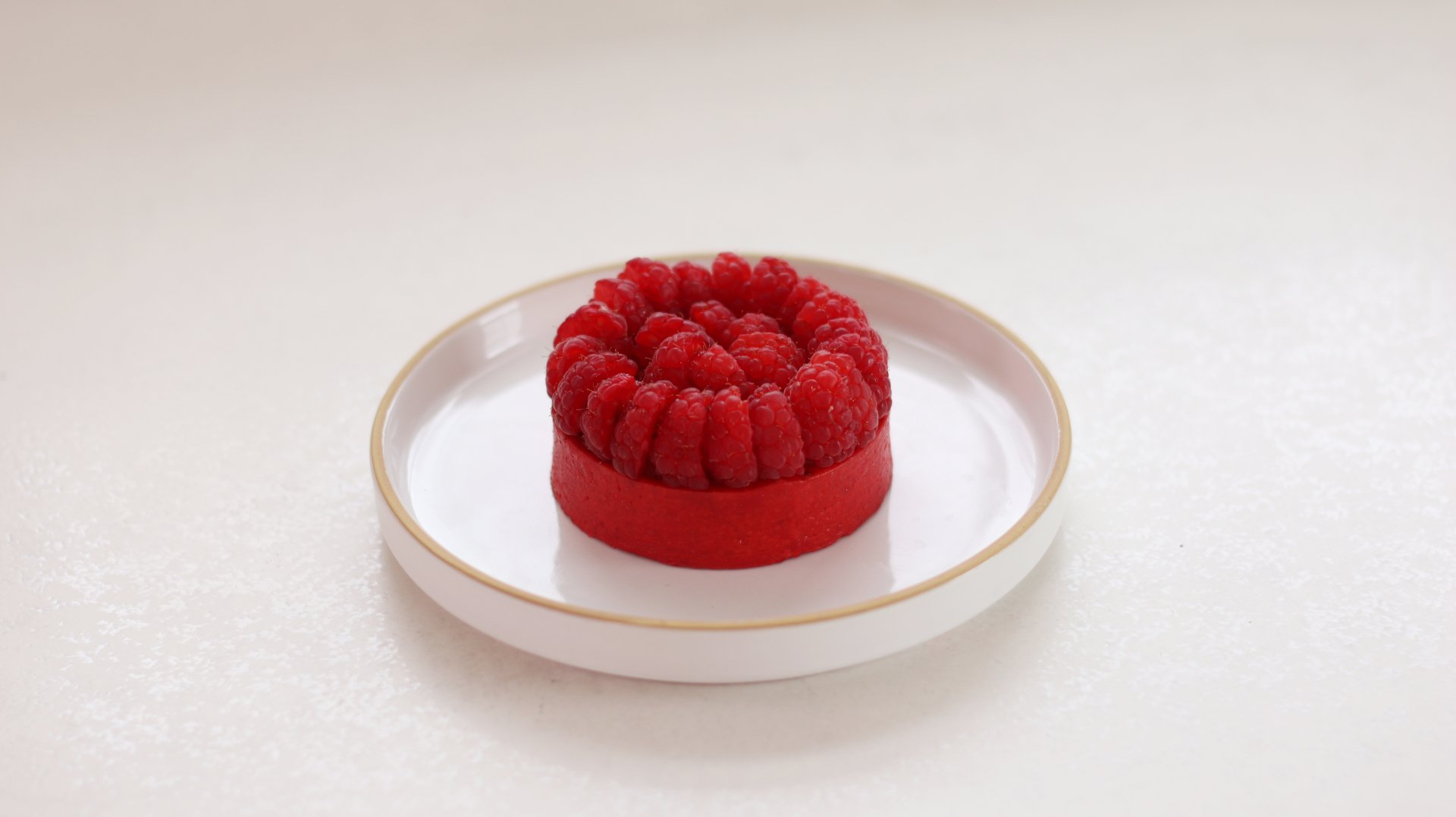
Raspberry Soufflé Tartlets
TIER 2
Raspberry Soufflé Tartlets
In Tier 2 we make a Bake It Better first – raspberry pastry! I tested this a few times and am really happy with the result. We fill this with a raspberry soufflé and garnish with fresh raspberries. It’s actually the pastry element of this recipe that makes this the Tier 2 recipe – the beauty of adding soufflé to a tart is there’s no pressure on the rise! So once you’ve mastered the pastry, it’s plain sailing!
4
INDIVIDUAL TARTS
Ingredients
Makes 4 Individual Tartlets
Raspberry Pastry
75g Unsalted Butter, Cold & Cubed (small cubes)
50g Icing Sugar
4g Powdered Raspberry Powder
38g Egg Yolks
150g Plain/AP Flour
Red Food Colouring Powder/Gel
Egg Wash
20g Egg Yolk
5g Double/Heavy Cream
Red Food Colouring Powder/Gel
Raspberry Soufflé
– Raspberry Base
120g Raspberry Puree
10g Cornstarch
Pinch of Sugar
– Meringue Base
75g Raspberry Base
80g Egg Whites
50g Caster Sugar
Fresh Raspberries To Fill + Garnish
Special equipment
Stand mixer
Silicone mats
4x 7.5cm x 2cm perforated tart rings
Multi-wheel pastry cutter OR a ruler
Digital thermometer
Piping bags
Method
Raspberry Pastry
1. Into the bowl of a stand mixer, add the cold cubed butter and then sift over the raspberry powder, icing sugar and red food powder. With the paddle attachment, beat on a medium low speed for 2 minutes or until the butter is smooth. As the butter is cold you will need to scrape down the bowl a few times to ensure it is completely incorporated.
2. Add in the egg yolks and beat again for around 30 seconds, scraping down the bowl again to ensure it’s all incorporated.
3. Finally, sift in the flour, scrape the bottom of the bowl just to loosen the butter stuck on the bottom, and then mix again on a low speed until it pulls together to form a dough, about 20-30 seconds.
4. Scoop the dough out and place it onto a large silicone mat and place a second silicone mat on top. Roll the dough out with a rolling pin until it is around 3-5mm thick, don’t worry too much about the shape.
5. Place the entire sheet of pastry into the freezer for 30 minutes.
6. While the dough is chilling, take the perforated tart ring and very lightly grease the inside with soft butter. This helps to prevent the dough from sticking to the ring.
7. Remove the chilled dough from the freezer and, working quickly, peel the top silicone mat off of the dough. Press the 4 tart rings firmly into the dough, lift them up, and transfer them to a perforated tray lined with a perforated baking mat. The dough should be cold enough that it attaches to the ring as you lift it up. Place the tray in the fridge while you cut the walls.
8. With the remaining dough, use a ruler and a sharp knife to cut 4 strips of dough each measuring 9.6 x 0.9 inches (24.4 x 2.3cm). These measurements seem quite precise, but this will ensure the dough fits perfectly into the tart rings with no excess overlapping. If they feel too warm to lift up, place them back in the freezer for 5 minutes just so they can cool back down slightly.
9. Remove the baking tray with the tart bases from the fridge and remove one strip of dough for the walls.
10. Working quickly, take the strip of dough and place it inside the tart ring. Use your fingers to gently press together this strip of dough, against the base of the tart. The idea is to slightly push down the wall of dough so that it meets the dough on the base of the tart shell and there are no gaps. If at any point you feel the dough is too warm or is tearing, place everything back in the freezer for 10 minutes then carry on.
11. Repeat this with the remaining tarts, again, chilling the dough if needed. At this point, squeeze together the remaining scraps of dough, and repeat the process, rolling the dough and chilling it, so that you can create the final 2 tart shells.
12. Once you have lined all the tart shells, avoid trying to move them in case the dough tears. Chill the entire tray in the freezer for 15 minutes and pre-heat your oven to 175C/350F.
13. Remove the shells from the freezer and holding a knife perpendicular to the tart shell, trim off the excess pastry hanging over the tart ring so that the pastry is flush.
14. Place the tart shells in the oven, and bake for 15 minutes. While they bake, add the egg wash ingredients to a small ramekin and blend it to combine – I prefer to use a hand blender as it fully emulsifies the colouring into the egg mixture.
15. Remove the tarts from the oven and allow them to cool for 5 minutes. At this point, the pastry should have retracted slightly from the ring mould, and you should be able to lift it off easily.
16. Lift the shells up and using a pastry brush, apply an even egg wash all over the tart. Lower the oven temperature to 140C/285F and place them back on the tray and into the oven for a further 5 minutes. Remove from the oven to cool.
Raspberry Soufflé
– Raspberry Base
1. Into a medium bowl, whisk together the sugar and cornstarch.
2. Add the puree into a medium saucepan and heat it until it reaches around 40C. Once hot, sift in the cornstarch mixture and whisk together. Continue to cook until the mixture thickens and starts to bubble. Once bubbling, cook for a further minute.
3. Immediately pass the mixture through a sieve into a bowl and cover the surface with cling film. Chill for 30 minutes in the fridge.
– Meringue Base
1. Fill a pan with a shallow amount of water and place it over a medium heat. Meanwhile, add the egg whites and sugar into a medium bowl and place this over the water once it is simmering.
2. Whisk constantly until it reaches 60-65C (140-150F) on a digital thermometer.
3. Immediately remove it from the heat and place it on a stand mixer fitted with a whisk attachment.
4. Whisk on a medium speed for 6-7 minutes until you have a stiff meringue.
5. While it is whisking, remove the raspberry base from the fridge, whisk it, then weigh 75g and add this into a medium bowl.
6. When the meringue is done, fold it in thirds into the raspberry base until you have a homogenous mixture.
Assembly
1. Add the raspberry soufflé mixture into a piping bag and snip the end off.
2. Take the cooled tart shells, and place a few torn up raspberries into the base.
3. Pipe the soufflé mixture into the tart shells, filling them right to the top, and then use a palette knife to level them so they are completely flush with the top of the tart.
4. Place the tarts back onto your baking tray, and place the perforated tart rings around the pastry again. This will just help to provide a little structure and prevent the pastry from cracking as the soufflé expands.
5. Place the tarts into the oven and bake them for 7 minutes. They should rise just slightly.
6. Once they are baked, these can be served warm or alternatively served chilled (place the tarts into the fridge for 1 hour)
7. To garnish, add some freshly sliced raspberries.
Shop the Equipment


Chocolate and Raspberry Soufflé
TIER 1
Chocolate and Raspberry Soufflé
I’ve cheated a bit in Tier 1 and used the chocolate soufflé recipe from my book, because you honestly can’t beat it! But I tried adding a frozen raspberry insert in the middle, which oozes out once baked, and it really takes the dessert to the next level from both a flavour and a wow factor perspective. Make sure you use good quality chocolate with 50-60% cocoa solids to ensure the right consistency.
4-5
SOUFFLÉS
Ingredients
Makes 4-5 Souffles
Raspberry Insert
50g Raspberry Jam
50g Fresh Raspberries
Splash of Water
Chocolate Soufflé
– Beurre Manie
50g Unsalted Butter, Softened
50g Plain Flour
Pinch of sea salt
– Chocolate Base
270g Whole Milk
50g Granulated/Caster Sugar
200g Chopped Dark Chocolate, 50-60% Cocoa Solids
110g Egg Yolks
French Meringue
180g Egg Whites
70g Granulated/Caster Sugar
Special equipment
3.8cm x 1.9cm silicone half-sphere mould (15 hole) OR a small silicone ice cube tray
Stand mixer
Piping bags
Ramekins
Method
Raspberry Insert
1. Into a medium saucepan, add the fresh raspberries, raspberry jam and just a little splash of water (3 tsp roughly).
2. Place it over a medium low heat, and stir it together until the raspberries have broken down, and it is bubbling and has thickened just slightly.
3. Into a silicone half sphere mould, or a silicone ice cube tray, pour the raspberry mixture in, spread it out so it is even, and then freeze for 3 hours or until it is solid.
Chocolate Soufflé
– Beurre Manie
1. Into a small bowl, add the butter, flour and salt and use a spatula to form it into a paste. Sometimes it is actually easier just to use your hands and mix it together as the quantities are so small.
2. Set this bowl to one side.
– Chocolate Base
1. Into a medium saucepan, add the milk and sugar. Place it over a medium heat and stir occasionally until the sugar has dissolved and the mixture is steaming.
2. Remove it from the heat and add in the beurre manie from above. Whisk this through until it has dissolved, then place the pan back on the heat and whisk constantly until the mixture has thickened and holds a slightly more elastic consistency.
3. Remove it from the heat and whisk in the chocolate until the chocolate has completely dissolved. Don’t worry if it looks slightly greasy or split here. Scoop this mixture into a medium bowl.
4. Add the egg yolks on top and immediately whisk this (to make sure the eggs don’t cook from the heat), until you have a smooth, glossy mixture.
5. Cover the surface with cling film and let it rest for 30 minutes.
French Meringue & Assembly
1. Preheat the oven to 160C/320F Fan Assisted.
2. Lightly grease the ramekins with soft butter, using an upwards stroking motion.
3. Tip in a few tablespoons of sugar and swirl this around, tipping out the excess. Place these on a tray and set to one side.
4. Meanwhile, add the egg whites into the bowl of a stand mixer fitted with a whisk attachment and whisk on a medium low speed until the mixture is frothy and thick bubbles have formed.
5. With the speed on medium, slowly add in the sugar a tablespoon at a time, waiting about 15 seconds in between each addition.
6. Once you’ve added all the sugar, keep whisking until you have a stiff meringue.
7. Fold the meringue in thirds, into the chocolate base, until you have a homogenous mixture with no streaks of meringue.
8. Remove your frozen raspberry inserts from the freezer.
9. Add the soufflé mixture into a piping bag, and pipe the mixture into the ramekins, filling them about 3⁄4 of the way. Then press your raspberry into the middle and cover it up, filling the ramekin to the top with the remaining soufflé mixture.
10. Use a palette knife to smooth the top and create a flush edge, then quickly run your thumb around the outside of the soufflé to create a rim.
11. Place them into the oven immediately and bake for 18 minutes.
12. Remove them from the oven and serve immediately. They should be well risen!
Shop the Equipment


Advanced Raspberry Sorbet
TIER 2
Advanced Raspberry Sorbet
In Tier 2 we get our maths head on! We walk through the formula I learnt to make any fruit sorbet, and we put it into practice in this stunning raspberry sorbet. It’s the perfect balance of flavours (thanks to the formula!), and the addition of the stabiliser makes it super smooth. I’ve included a detailed Google Sheets document for you to use to create any fruit sorbet in future, so be sure to check it out.
1
TUB (APPROX. 300G)
Ingredients
Makes 1 Tub (approx. 300g)
202g Caster Sugar
36g Dextrose
3g Stabiliser
299g Water
10g Fresh Lemon Juice
450g Fresh Raspberries
Special equipment
Digital thermometer
Hand blender
Ice-cream machine
Method
For the ‘science’ behind this recipe and the option to create your own flavoured sorbet, follow the guidelines in this document.
1. Pour the cold water into a saucepan and heat over a medium heat to 40C. In a bowl, stir together the sugar, dextrose and stabiliser and then pour into the water once it’s reached temperature. Whisk together until the mixture reaches 85C, then take off the heat and leave to cool to approximately 40C.
2. Once cooled, add the mixture to a bowl and pour in the lemon juice and raspberries. Blend briefly with a hand blender to combine (don’t blend for too long as you will start to blend the raspberry seeds, which will dull the colour of your sorbet). Pass the mixture through a sieve into a bowl, then cover the surface with cling film and put it in the fridge for 12 hours/overnight.
3. The next day, pour the mixture into your ice cream machine and churn for 20-30 minutes until it’s a thick, sorbet-like consistency.
4. Transfer the sorbet into a container and freeze for 1-2 hours before serving.
Shop the Equipment


Raspberry Maritozzi Marchigiani
TIER 2
Raspberry Maritozzi Marchigiani
For this recipe, we use the same dough as Tier 1 but we turn it into a more advanced shape. We make a raspberry reduction and a raspberry gel which really takes it to the next level. I’ve not added crème pâtissière to this one, but you easily can to add that extra bit of decadence. I’ve topped it with raspberry powder and edible flowers to give it that extra wow factor.
6
LONG BUNS
Ingredients
Makes 6 Long Buns
For the raspberry gel + raspberry reduction
400g Frozen Raspberries
40g Caster/Granulated Sugar
Agar Agar Powder
For the dough
315g White Bread Flour
25g Caster/Granulated Sugar
6g Instant Dry Yeast
5.5g Sea Salt
55g Whole Eggs
160g Whole Milk
Zest ½ Lemon
2g Vanilla Bean Paste (1 Tsp)
55g Unsalted Butter, Cold + Cubed
For the egg wash
50g Whole Egg
5g Whole Milk
For the vanilla cream
300g Double/Heavy Cream
5g Icing/Powdered Sugar
To Decorate
Raspberry Powder
Edible Flowers (Micro Amaranth, Wood Sorrel)
Special equipment
Stand mixer with paddle and whisk attachments
Hand blender
Piping bag
Palette knife
Method
For the Raspberry Gel and Reduction
1. Into a medium heat-proof bowl, add the frozen raspberries and pour the sugar over the top. Toss them gently to combine. Tightly wrap the surface of the bowl with cling film so that it is completely sealed.
2. Place a medium saucepan on the hob, filling it ⅓ with water. Bring this to a gentle simmer.
3. Immediately lower the heat to its lowest setting and place the bowl of raspberries on top. Let this sit on the pan for 2 hours.
4. After 2 hours, place a sieve lined with kitchen paper over a large bowl and pour the cooked raspberries into the sieve.
5. Place the bowl into the fridge for 2 hours (or ideally overnight), allowing the raspberry syrup to drip into the bowl underneath.
6. Scoop the raspberry reduction out of the sieve and scoop this into a bowl. Cover it and refrigerate until ready to use.
7. Take the raspberry liquid from the bowl, and pour it into a jug sitting on a digital scale. For every 100g of raspberry syrup, we are going to add 1g of agar agar powder. (So for example, if the liquid weighs 120g, add 1.2g of agar agar powder)
8. Add the raspberry syrup and the agar agar powder into a saucepan and bring it to a boil, whisking to combine. Once at a boil, cook for 1 minute.
9. Remove it from the heat and pour it onto a shallow baking tray and set it in the fridge to cool until firm to the touch (this should take about 30 minutes).
10. Once firm, break the gel into pieces and blend until smooth. Set this gel aside, covered in the fridge, until ready to use.
For the Dough
1. Into the bowl of a stand mixer, add milk, eggs and yeast. On top of that, pour the flour, sugar & finally the salt. Add in the lemon zest & vanilla.
2. Knead the dough for 10 minutes on a medium low speed, scraping down the sides half way through to make sure everything is incorporated.
3. After 10 minutes, add in the cubed cold butter a little at a time, and increase the speed to medium. Once all the butter has incorporated, knead for a further 3 minutes by which point the dough should be nice and smooth.
4. Lift the dough out of the bowl and onto your work surface. Gently shape it into a smooth round ball and lift it into a lightly oiled bowl. Cover the bowl with cling film and proof the dough for 1 hour, or until it has doubled in size.
5. Once proofed, remove the dough from the bowl and cut it into 100g pieces. You should get 6 pieces of dough in total.
6. Take each piece of dough and roughly shape it into a tight ball. Then, using your hand, flatten the dough into a rough oval shape, flip it over, so the smooth side is now facing down, and the short edge of the dough is facing towards you.
7. If the dough has started to contract, just press it out again with your fingers.
8. Use your fingers to gently blend the bottom edge of the dough into the work surface. Then, starting at the top, tightly roll the dough on itself, into a log shape. You might need a tiny bit of flour on your hands as you do this, but avoid using too much or it will prevent the dough from sticking together.
9. Once you’ve got the log shape, gently roll it back and forth on the surface, and then use your fingers to apply some pressure at the ends of the dough, pressing down and rocking the dough back and forth, to form small ‘tails’ on the end of the dough (almost like a baguette)
10. Carefully lift the dough, seams side down, onto a baking tray lined with parchment paper, and repeat with the remaining dough.
11. Cover the dough loosely with a tea towel and allow it to proof again for another 1-1.5 hours until the dough has increased in size about 1.5x.
12. Just before the dough is ready, preheat the oven to 180C/355F (non-fan assisted).
13. Prepare the egg wash by whisking together the egg and milk.
14. Use a pastry brush to paint an even coating over the dough and then place the dough into the oven and bake for around 25 minutes, or until golden brown.
15. Remove from the oven and lift them onto a wire cooling rack, to cool completely.
For the cream
1. In a stand mixer, whisk together the double cream and icing sugar until you have a medium peak.
Assembly
1. Cut your bun down the centre (like a hot dog!) and add a small amount of the raspberry pulp across the bottom of the bun. I wouldn’t recommend overloading your bun with this! If you want to take this to the next level, you can also add some crème pâtissière from Tier 1 too!
2. Fill the rest of the bun with the whipped cream. Then, using a warm palette knife, scrape across the edge of the bun to smooth the cream and create a nice clean finish. You’ll be left with a little cream around the edges, so I tend to use my (clean!) finger to remove this.
3. Next, add your raspberry gel to a piping bag and cut a small hole at the end. Pipe the gel onto your bun as you wish. I went full-on hot dog and piped mine like ketchup in a zigzag pattern over the cream.
4. Finally, dust your optional raspberry powder over the top of the bun, and add the optional edible flowers. Repeat for all buns.
Shop the Equipment


Pistachio & Raspberry Cookies
We would love to see your Bake It Better creations!
Show off your skills by sharing your desserts
#BakeItBetter
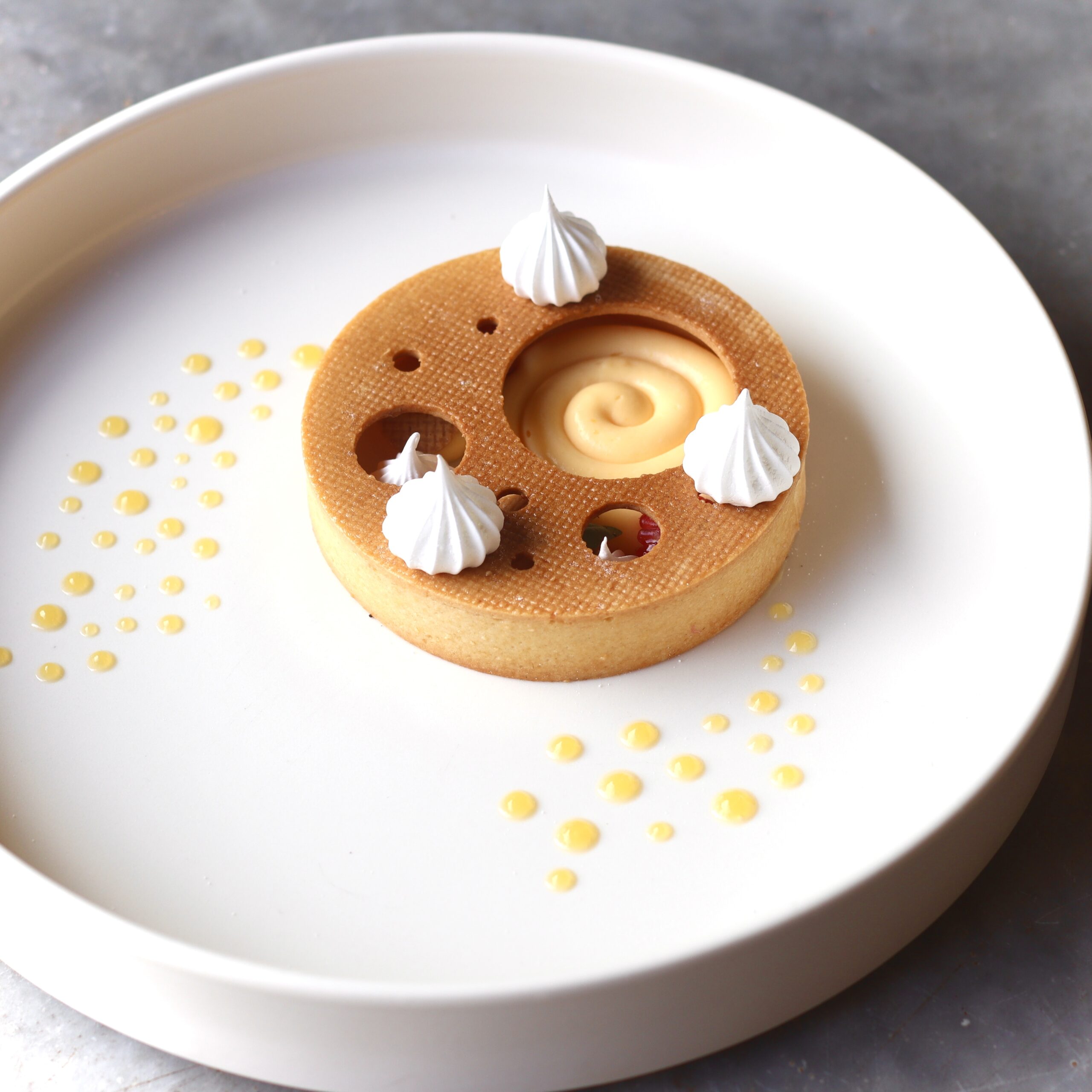
Lemon Meringue Pie
We would love to see your Bake It Better creations!
Show off your skills by sharing your desserts
#BakeItBetter
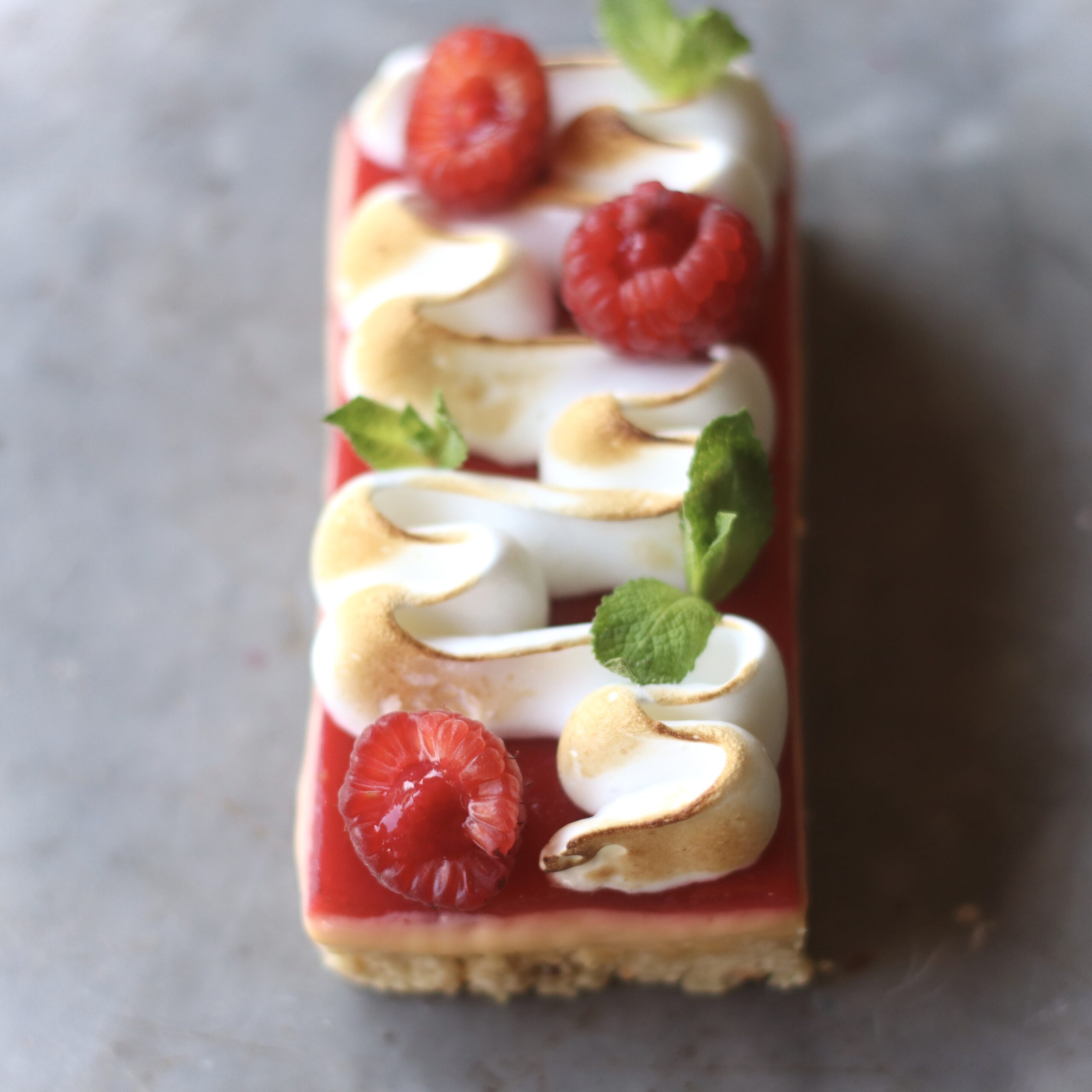
Passion Fruit Slice
We would love to see your Bake It Better creations!
Show off your skills by sharing your desserts
#BakeItBetter

Summer Fruits Cheesecake
We would love to see your Bake It Better creations!
Show off your skills by sharing your desserts
#BakeItBetter

Vanilla Panna Cotta
We would love to see your Bake It Better creations!
Show off your skills by sharing your desserts
#BakeItBetter