
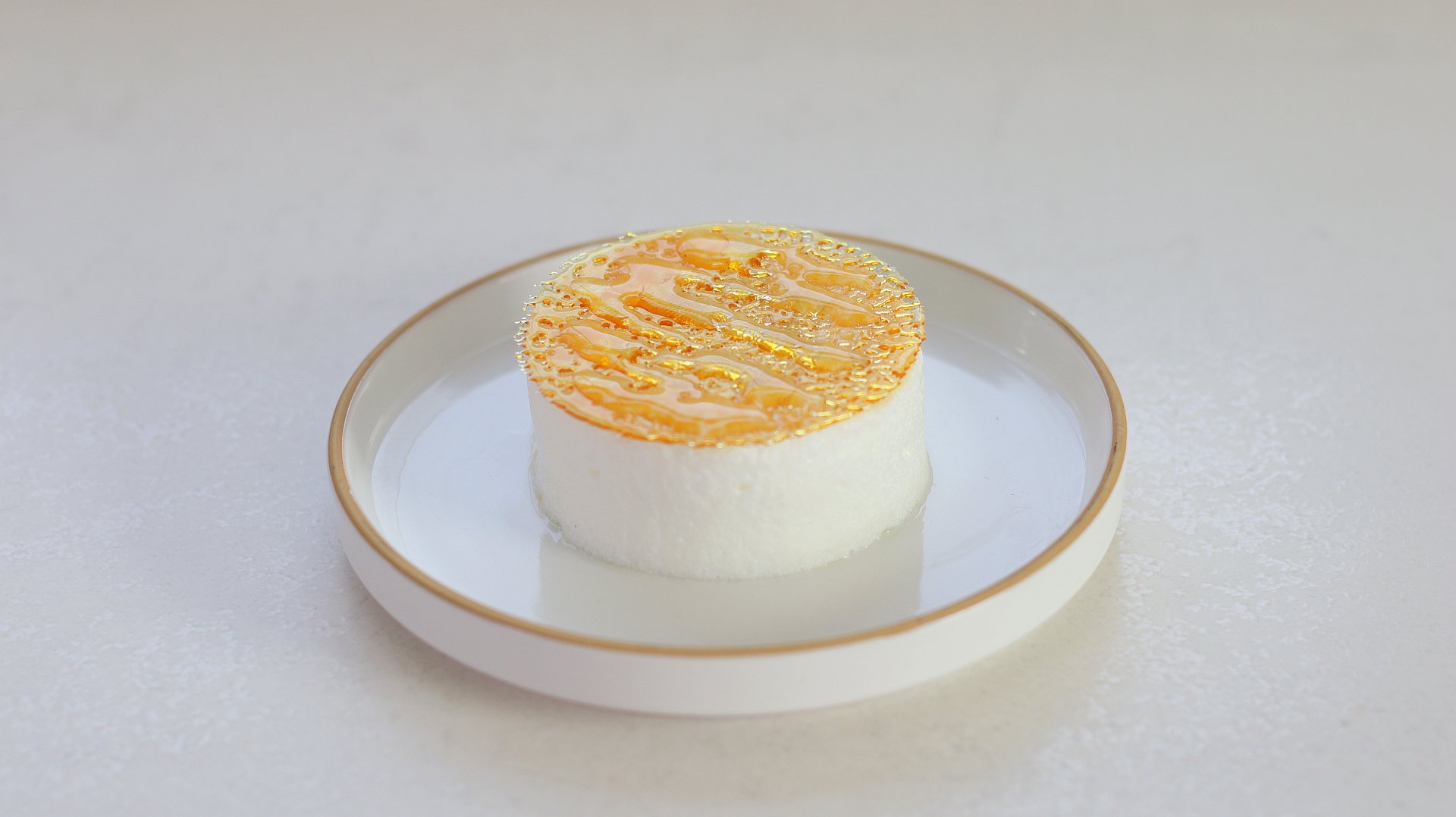
île Flottante
TIER 1
île Flottante
For Tier 1 I decided to try a twist on the classic Île Flottante, inspired by working in the kitchen with Tom Aiken. Typically made by poaching a meringue and serving it in a warm bowl crème anglaise, this version is much more refined, with a Swiss meringue that is cut into a perfect disc. We fill the centre with crème anglaise and then top it with a thin caramel disc and clear caramel sauce.

4
INDIVIDUAL DESSERTS
Ingredients
Makes 4 île Flottantes
Crème Anglaise
125g Double Cream
250g Whole Milk
75g Caster/White Sugar
75g Egg Yolks
1 Fresh Vanilla Pod
Pinch of Flaky Sea Salt
Caramel Sauce
200g Caster/White Sugar
60g Water
100g Water
Caramel Discs
70g Caster/White Sugar
70g Liquid Glucose
Swiss Meringue
300g Egg Whites
205g Caster/White Sugar
5g White Vinegar
Roasted & Chopped Almonds or Hazelnuts To Serve
Special equipment
Digital thermometer
13″ x 9″ x 2” baking dish
Stand mixer
Blender
9cm/3.5” cookie cutter
Piping bag
Method
Crème Anglaise
1. Into a medium saucepan, add the milk, cream and beans scraped from a fresh vanilla pod (keep the leftover vanilla pod as we will use this in the caramel sauce). Place this onto a medium low heat, stirring occasionally.
2. Meanwhile, add the egg yolks and sugar to a medium bowl and whisk for 30 seconds to combine.
3. Once the cream is hot, slowly pour it over the egg yolk mixture, whisking to combine.
4. Pour the entire mixture back into the saucepan and whisk until it reaches between 82-85C (180-185F) on a digital thermometer.
5. Immediately remove it from the heat and pass it through a sieve into a clean bowl. Whisk through a pinch of salt.
6. Place a sheet of clingfilm on the surface and refrigerate the mixture for at least an hour. Alternatively, place it over a bowl of ice water and that will thicken it quickly.
Caramel Sauce
1. Into a small saucepan, add 100g of water, along with the leftover vanilla pod from above. Place this over a low heat so that it becomes steamy.
2. Meanwhile, add the remaining 60g of water and sugar into a medium saucepan. Place it on a medium heat, and cook it to 180C/355F on a digital thermometer. This will be a light golden colour.
3. Whisk in the hot vanilla water and cook for a further 30 seconds. Pour it through a sieve, into a clean bowl. Cover the bowl with clingfilm and refrigerate it for at least an hour. Alternatively, place it over a bowl of ice water and that will thicken it quickly.
Caramel Discs
1. Into a medium saucepan, add the glucose and sugar.
2. Place it over a medium heat and allow the mixture to bubble up and start to caramelise.
3. Once it begins to go a light golden colour you can stir it.
4. Stir it occasionally until it turns a deep golden colour, then immediately remove it from the heat and pour it onto a silicon mat.
5. Allow it to set at room temperature for 30 minutes.
Swiss Meringue
1. Take a 13x9x2” baking dish (something deep), and very lightly grease the bottom with butter and place a sheet of parchment along the base. Pre-heat the oven to 160C/320F non-fan assisted.
2. Into the bowl of a stand mixer, add the egg whites, sugar and vinegar.
3. Place this over a pan of gently simmering water and whisk constantly until it reaches around 60-65C (140-149F) on a digital thermometer.
4. Immediately remove it from the heat and place it onto the stand mixer fitted with a whisk attachment. Whisk for 5 minutes on a medium high speed, until it is thick and glossy and holds a medium stiff peak. Be very careful not to over whisk this as it is a slightly lower amount of sugar, so we don’t want to make the meringue go grainy by mixing it for too long.
5. Tip the meringue into the lined baking tray and use a palette knife to smooth it so it is flat.
6. Place it into the oven and bake for 12-15 minutes, until it is a light golden brown colour on top. Remove it from the oven but leave the oven on.
Assembly
1. While the meringue is cooling, blend the caramel to a fine powder. Take a sieve, and sieve the powder in an even layer onto a baking tray lined with a silicon mat. You may not need all of the caramel powder.
2. Use a 9cm/3.5” cookie cutter to create indents in the powder, gently shimmying it around to create a circular outline.
3. Place the tray into the oven and bake for 2-4 minutes, or until the caramel powder has just melted and it is a glass like consistency. Remove the tray from the oven and allow it to cool.
4. Pour the chilled creme anglaise into a small saucepan and just gently stir it over a low heat until it is steaming, then transfer it into a serving jug.
5. Scoop the thickened caramel sauce into a piping bag and set this to one side.
6. The meringue should have cooled for around 10-15 minutes now.
7. Use the 9cm/3.5” cookie cutter which is slightly warm, to cut 4 discs.
8. The easiest way to remove them is to pull away the excess meringue around the disc, then carefully slide a palette knife underneath the disc, and lift it onto your serving plate.
9. Use a teaspoon to dig a hole out of the centre of each meringue disc, but do not cut all the way through to the bottom.
10. Pour the warm creme anglaise into the hole, then with a palette knife, slide it underneath a caramel disc and place this on top.
11. Cut a small hole in the end of the piping bag, and drizzle this across the caramel disc.
12. Finally finish with a sprinkle of roasted nuts for texture and serve immediately.

Salted Caramel Cookies
TIER 2
Salted Caramel Cookies
In Tier 2 we step things up by adding a brown sugar streusel and salted caramel to the basic cookie dough recipe. The roasted hazelnuts in the dough add an amazing flavour, and the texture combination of this with the streusel and salted caramel is next level! The salted caramel centre can be swapped out for other fillings too – ganache, lemon cremeux, hazelnut praline etc!
8
COOKIES
Ingredients
Makes 8 Cookies
Hazelnut Sablé
350g Plain/All-Purpose Flour
190g Unsalted Butter, Cold & Cubed
120g Icing/Powdered Sugar
45g Ground Hazelnuts (or Almonds)
1g Fine Sea Salt
65g Whole Eggs
Streusel
60g Cold Unsalted Butter, Cubed
60g Light Brown Sugar
75g Ground Almonds/Hazelnuts
60g Plain/All Purpose Flour
Pinch of Sea Salt
Zest ¼ Lemon
Salted Caramel
175g Double/Heavy Cream
45g Whole Milk
135g Liquid Glucose Syrup, Divided
80g Caster/White Sugar
2g Flakey Sea Salt
60g Unsalted Butter
Special equipment
78mm Tart Ting
50mm Cookie Cutter
Stand mixer
Rolling pin
Silcon mats (optional)
Piping bags (optional)
Method
Salted Caramel
1. In a medium saucepan on the stovetop over medium heat, combine the milk, heavy cream, and 45 grams of corn/glucose syrup. Bring to a gentle simmer, whisking the mixture to ensure the syrup has fully dissolved. Remove the saucepan from the heat but ensure the mixture stays warm.
2. In a medium saucepan on the stovetop over medium heat, combine the superfine/caster sugar and the remaining 45 grams of glucose sugar. Cook until the mixture turns a deep caramel colour, whisking slowly to help disperse the sugar.
3. Once golden, immediately pour in the hot cream mixture, being very careful as it will bubble up violently. Whisk the mixture and cook for 1 minute.
4. Remove the saucepan from the heat and pour the mixture through a sieve and into a large bowl. Let the mixture cool for 2 minutes. Add the sea salt flakes and butter. Blend or whisk until smooth.
5. Pour the mixture into a container and leave at room temperature.
Streusel
1. Into the bowl of a stand mixer, fitted with the paddle attachment, add all of the ingredients.
2. Mix on a low speed until the butter has broken down and the mixture is sandy in texture. This will take a few
3. Transfer this to a baking tray and place it into the freezer while you make the sablé.
Hazelnut Sablé
1. Into the bowl of a stand mixer, fitted with the paddle attachment, add all of the ingredients except the egg.
2. Pour in the whole egg and mix on low speed for 30 seconds, then stop the mixer and use your hands to squeeze the dough together to form a dough.
3. Place the dough in between two silicon mats or pieces of parchment paper, and using a rolling pin, roll it to around 7mm/0.25” thick.
4. Place this in the freezer for 20 minutes.
5. Once chilled, work quickly and use the 78mm tart ring to cut out discs, then cut the middle of the dough out with a 50mm cookie cutter to leave you with donut shape. Place these onto a tray lined with parchment paper, ensuring you keep the tart rings around the outside of the dough. Place these back into the freezer for 15 minutes, meanwhile preheat your oven to 160C/320F Non-fan assisted.
6. Place the dough into the oven and bake for 12 minutes – it should turn a very light golden colour.
7. Once baked, let them cool for a few minutes before pressing the sables out of the tart ring and letting them cool completely.
8. Use the same tart ring and place it back onto the baking tray. Add a few tablespoons of the chilled streusel and press it down with the back of a spoon so you have an even layer.
9. Take the chilled hazelnut sablé and press this on top of the streusel, it should fit snugly into the tart ring. You need to make sure the sablé is touching the streusel. (If you find it won’t touch – when it is baking, it will soften, so after a few minutes you can press it down while it is in the oven).
10. Place the cookies into the oven and bake for around 20 minutes, or until they are a golden colour.
11. Remove them from the oven and allow to cool for a few minutes before pressing them out of the tart rings.
12. Ensure the caramel is a soft, almost runny honey-like texture, and pipe this into the centre of the biscuits. The caramel will be soft and runny if served immediately but will thicken the longer they sit at room temperature.
Shop the Equipment


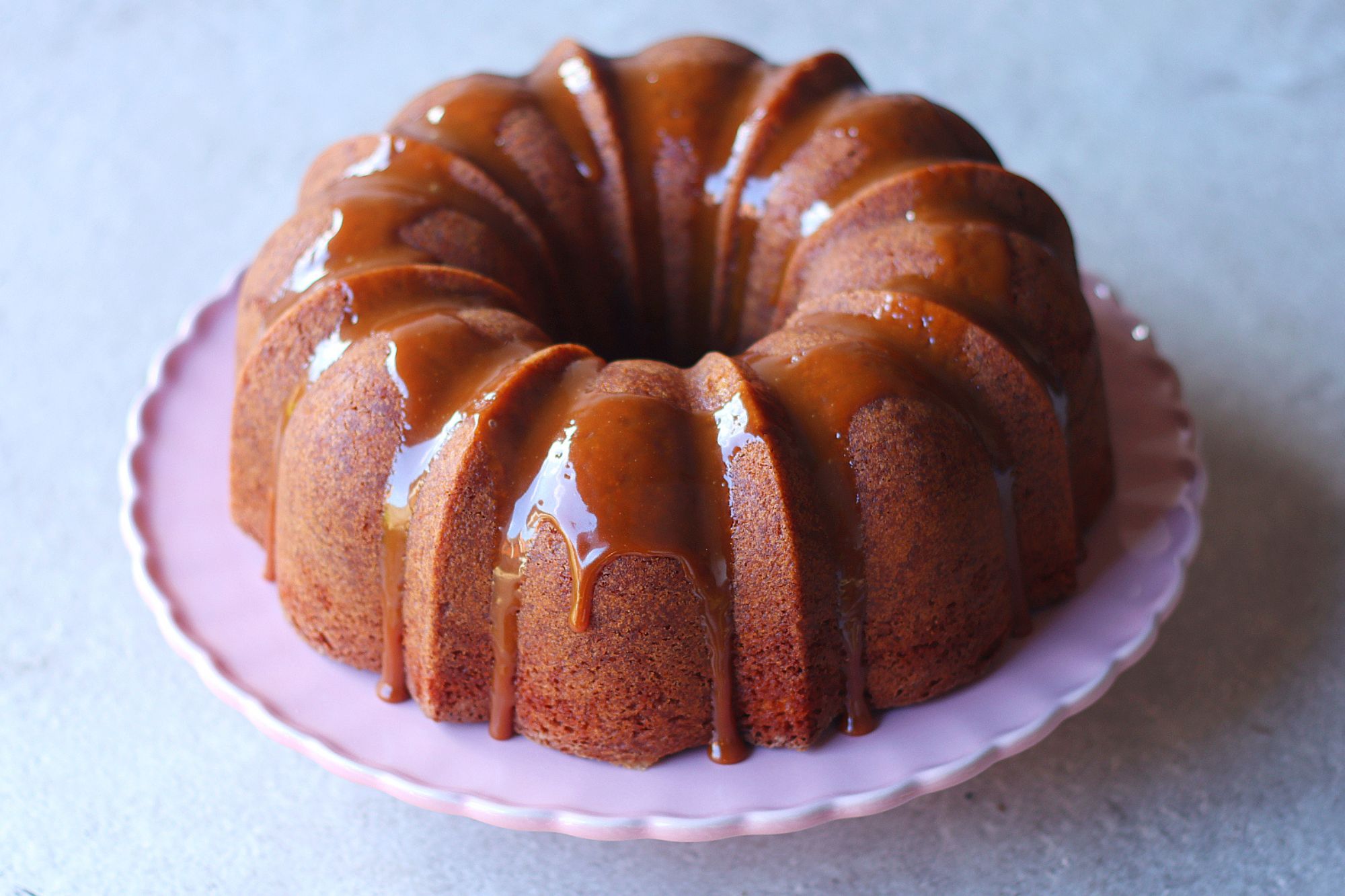
Salted Caramel Bundt Cake
TIER 2
Salted Caramel Bundt Cake
This recipe we advance the ‘flavoured sugar’ technique from Tier 1 and make a powdered salted caramel to add to the cake batter. This was a bit of a fluke whilst recipe testing but wow, the flavour of this cake is unreal! I’ve topped it with a decorative salted caramel sauce that’s quite chewy in texture. If you want something softer, switch it out for the salted caramel recipe in Tier 2 of the Chocolate Tart classes!
112 CUP BUNDT CAKE
Ingredients
Makes 1 12 Cup Bundt Cake
For the caramel sugar
320g Caster/Granulated Sugar
4g Fine Sea Salt
For the caramel cake
245g Caramel Sugar (Recipe Above)
95g Caster/Granulated Sugar
95g Light Brown Sugar
465g Unsalted Butter, Room Temperature
385g Whole Eggs, Room Temperature
1 Tsp Vanilla Bean Paste
465g Self Raising Flour
35g Boiling Water
Soft unsalted butter + flour to coat the bundt tin
For the caramel sauce
125g Caster/Granulated Sugar
65g Water
75g Double Cream
30g Unsalted Butter
Pinch Sea Salt Flakes
Special equipment
Blender
Stand Mixer
12 Cup Bundt Tin
Method
Caramel Sugar
1. Into a medium frying pan, add about ⅕ of the sugar, spreading it evenly across the pan.
2. Place the pan onto a medium heat, and gently shake the pan to agitate the caramel, until it has melted.
3. Add another ⅕ of the sugar on top and agitate the pan again to dissolve the sugar, until it has melted.
4. Continue adding the sugar in increments, ensuring it is fully melted before adding the next addition. At this point, you can begin to use a rubber spatula to stir it through.
5. Once you have added all of the sugar, add in the salt and continue to stir it with a rubber spatula until it reaches a deep amber colour.
6. Immediately remove it from the heat and pour it evenly onto a baking tray lined with a silicon mat.
7. Allow to cool at room temperature for 30 minutes, until it has set completely firm.
8. Once set, break the caramel into shards and place it into a high powered blender and blender for 5-10 seconds, into a fine powder*
* Once you have blended the sugar, it is important to use it immediately for the cake, otherwise it will begin to absorb moisture and go very sticky.
Caramel Cake
1. Preheat the oven to 180C/355F Non-Fan Assisted. Take soft butter (not melted), and use a pastry brush to brush the inside of the bundt tin to ensure an even coating. Sieve over a few tablespoons of plain/all-purpose flour and shake it around the tin to coat. Tap out the excess and set the tin to one side.
2. Take the caramel sugar and weigh 245g.
3. Into the bowl of a stand mixer, add the soft butter and all the sugars. With the paddle attachment, beat it on a medium speed for 3-4 minutes, until the mixture is thicker and paler in consistency, scraping down the bowl as needed.
4. Add the eggs in four parts, beating for a few seconds between each addition (still at a medium speed). Then add the vanilla bean paste. At this point, the batter will look split but don’t panic.
5. Sift in the self-raising flour, and mix on a low speed just until the flour has been absorbed.
6. Finally, tip in the boiling water and mix to combine. This will help to loosen the cake batter slightly.
7. Use a spatula to evenly scoop the cake batter into the lined bundt tin, then using the back of a slightly warm spoon, spread the top of the batter out just to smooth it slightly.
8. Place the cake into the oven and bake for 45-55 minutes or until a skewer inserted comes out clean.
9. Allow it to cool in the tin for 5 minutes before placing a wire rack on top, and then flip the cake out to release it. Allow to cool for 30 minutes before adding the Caramel Sauce
Caramel Sauce
Note: if you want a softer, runny caramel sauce I would recommend using the Tier 2 salted caramel recipe from the October’s chocolate tart recipe.
1. Into a medium saucepan add the water, then the sugar. Place it on a medium heat.
2. Cook the caramel, until it reaches a deep golden brown colour, being careful not to burn it.
3. Pour in the cream and add the butter. Be careful as this will bubble quite violently. Use a hand whisk to mix it through and continue to cook for about 30 seconds on a medium low heat until you have a smooth glossy caramel. Stir in a good pinch of sea salt flakes and whisk them through.
4. The caramel can be served immediately as a warm sauce, or poured over the top of the cake in a decorative drip. The caramel will set as it cools, and turn into a more stringy, chewy texture, like a candy bar! It holds its shape very well, so is perfect to leave at room temperature on the cake for when you are ready to serve.
Shop the Equipment


Chocolate and Caramel Tartlets
TIER 2
Chocolate and Caramel Tartlets
For this recipe, we use the same pastry and filling from Tier 1, but we advance it by using individual perforated tart rings, and by creating a Chocolate Namelaka and a Salted Caramel. I’ve used a #127 piping nozzle to create a funky design around the edge, but you can do whatever you fancy!
6
TARTLETS
Ingredients
Makes 6 Tartlets
For the chocolate pastry
70g powdered/icing sugar
100g unsalted butter, cold and cubed
20g cocoa powder
50g egg yolks
180g all purpose/plain flour, plus a pinch of sea salt
For the cocoa egg wash
40g egg yolks, plus 5g cocoa powder
10g heavy/double cream
For the Namelaka
3g powdered gelatin
18g cold water
160g dark chocolate, 70% cocoa solids
120g whole milk
12g glucose
240g heavy/double cream, cold
For the salted caramel
88g heavy/double cream
23g whole milk
68g glucose syrup, divided
40g superfine/caster sugar
1g flaky sea salt
30g unsalted butter
For the filling
100g eggs
50g granulated/caster sugar
pinch of sea salt
110g heavy/double cream
200g whole milk
80g dark chocolate, 70% cocoa solids
Special equipment
Stand mixer with paddle and whisk attachments
6x 3 x 0.78 inch (7.6×1.98cm) perforated tart rings
2x piping bags, plus a #127 tip piping nozzle
Hand blender
Method
Chocolate pastry and egg wash
- Into the bowl of a stand mixer fitted with the paddle attachment, sift in the sugar. Add the butter and the cocoa powder.
- Beat for 2 to 3 minutes, or until the mixture forms a smooth paste, pausing to scrape down the sides as needed.
- Add in the egg yolks, scrape down the sides and beat for 30 seconds, or until incorporated.
- Scrape down the bowl once again to ensure no butter is stuck to the sides. Add the flour and salt and mix on low speed for about 20 to 30 seconds, or until the mixture pulls together into a dough.
- Squeeze the mixture in your hand to form a rough ball. Place the ball of dough onto a silicone mat. Place a second silicone mat on top and roll the mixture into a rough rectangle, getting it around 0.15 to 0.2 inch (4mm to 5mm) thick. If you don’t have silicone mats you can roll the dough between parchment paper, but it will be more difficult as it has less grip. Place it in the freezer for 20 minutes.
- While the dough is chilling, take the perforated tart ring and very lightly grease the inside with soft butter. This helps to prevent the dough from sticking to the ring.
- Remove the chilled dough from the freezer and, working quickly, peel the top silicone mat off of the dough. Press the 4 tart rings firmly into the dough, lift them up, and transfer them to a perforated tray lined with a perforated baking mat. The dough should be cold enough that it attaches to the ring as you lift it up. Place the tray in the fridge while you cut the walls.
- With the remaining dough, use a ruler and a sharp knife to cut 4 strips of dough each measuring 9.6 x 0.9 inches (24.4 x 2.3cm). These measurements seem quite precise, but this will ensure the dough fits perfectly into the tart rings with no excess overlapping. If they feel too warm to lift up, place them back in the freezer for 5 minutes just so they can cool back down slightly.
- Remove the baking tray with the tart bases from the fridge and remove one strip of dough for the walls.
- Working quickly, take the strip of dough and place it inside the tart ring. Use your fingers to gently press together this strip of dough, against the base of the tart. The idea is to slightly push down the wall of dough so that it meets the dough on the base of the tart shell and there are no gaps. If at any point you feel the dough is too warm or is tearing, place everything back in the freezer for 10 minutes then carry on.
- Repeat this with the remaining tarts, again, chilling the dough if needed. At this point, squeeze together the remaining scraps of dough, and repeat the process, rolling the dough and chilling it, so that you can create the final 2 tart shells.
- Once you have lined all the tart shells, avoid trying to move them in case the dough tears. Chill the entire tray for 15 minutes and pre-heat your oven to 350°F/175°C.
- Remove the shells from the freezer and holding a knife perpendicular to the tart shell, trim off the excess pastry hanging over the tart ring so that the pastry is flush.
- Place the tart shells in the oven, and bake for 15 minutes. While they bake, thoroughly whisk together the ingredients for the egg wash.
- Remove the tarts from the oven and allow them to cool for 5 minutes. At this point, the pastry should have retracted slightly from the ring mold, and you should be able to lift it off easily.
- Lift the shells up and using a pastry brush, apply an even egg wash all over the tart. Place them back on the tray and into the oven for a further 5-8 minutes. The pastry is blind baked now ready to add your filling.
Namelaka
- In a small bowl, combine the powdered gelatin and cold water. Mix well and allow to bloom for 5 minutes.
- To a medium bowl, add the chocolate and place the bowl over a pan of gently simmering water without allowing the bowl to touch the water. Stir until the chocolate has completely melted. Remove the bowl from the heat and set aside.
- To a small saucepan over medium heat, combine the milk and glucose. Stir the mixture until steaming. Remove the saucepan from the heat and stir in the bloomed gelatin until it completely dissolves.
- Slowly pour this mixture over the melted chocolate, stirring in small circles in the center of the chocolate as you pour. Initially, the mixture will look quite split and oily, but as you add the remaining milk, everything will pull together.
- Add the cold cream and use a hand blender or a hand whisk to mix until combined. Cover the surface with plastic wrap/cling film and refrigerate for a minimum of 5 hours or ideally overnight.
Salted Caramel
- In a medium saucepan on the stovetop over medium heat, combine the milk, heavy cream, and 23 grams of corn/glucose syrup. Bring to a gentle simmer, whisking the mixture to ensure the syrup has fully dissolved. Remove the saucepan from the heat but ensure the mixture stays warm.
- In a medium saucepan on the stovetop over medium heat, combine the superfine/caster sugar and the remaining 45 grams of glucose sugar. Cook until the mixture turns a deep caramel color, whisking slowly to help disperse the sugar.
- Once golden, immediately pour in the hot cream mixture, being very careful as it will bubble up violently. Whisk the mixture and cook for 1 minute.
- Remove the saucepan from the heat and pour the mixture through a sieve and into a large bowl. Let the mixture cool for 2 minutes. Add the sea salt flakes and butter. Blend or whisk until smooth.
- Pour the mixture into a container and chill for at least 3 hours
Filling
- Lower the oven temperature to 285°F/140°C.
- To a medium bowl, add the chocolate and place the bowl over a pan of gently simmering water. Stir until the chocolate has completely melted. Remove the bowl from the heat and set aside.
- In a medium bowl, whisk together the eggs, sugar, and salt for 1 minute.
- In a small saucepan over a medium heat, combine the milk and cream. Heat until the mixture is steaming.
- Slowly pour the milk mixture over the eggs, whisking to combine as you pour.
- Slowly pour this mixture over the melted chocolate, using a spatula to stir the mixture in small circles in the center as you pour. Once everything has been combined, use a spoon to scoop off any foamy bubbles on the top.
Assembly
- Place the tray with the tarts on, in the middle of the oven and carefully pour in the chocolate filling—just to the top of the tart shell. Bake for about 25 or 30 minutes or until they have a very small wobble in the center.
- Remove the tarts from the oven and allow them to cool to room temperature before refrigerating for 3 hours.
- Remove the namelaka from the fridge and add it to the bowl of a stand mixer fitted with the whisk attachment. Whisk on medium speed until you get a medium–stiff peak.
- Add the mixture to a piping bag fitted with a small St. Honore nozzle. Holding the piping bag just slightly below vertical, pipe the namelaka around the outside edge of the tart in a zigzag motion, leaving a small gap in the center. If you have a cake turntable, this can make it a little easier to spin the tart as you pipe.
- Add the salted caramel to a piping bag and snip a small hole off the end. Pipe this into the center of the tart.
- Allow the tarts to sit at room temperature for 30 minutes before serving.
Shop the Equipment


Snickers
TIER 3
Snickers Bar
8
BARS
Ingredients
Makes 8 bars
Tempered Chocolate
400g Milk Chocolate + 60g Milk Chocolate
AND
200g Milk Chocolate + 30g Milk Chocolate
Salted Caramel
175g Double Cream
45g Whole Milk
45g Glucose (1)
80g Caster Sugar
90g Glucose (2)
1.5g Sea Salt Flakes
60g Unsalted Butter
Pailleté Feuilletine
50g Unsalted Butter, Room Temperature
50g Icing Sugar
50g Egg Whites
50g Plain Flour Hazelnut Praline
300g Whole Roasted Hazelnuts
200g Caster Sugar
60g Water
2g Fleur De Sel (Or Flaked Sea Salt)
*This will make more than you need
Feuilletine Praliné Crunch
200g Hazelnut Praline
45g Dark Chocolate
30g Paillete Feuilletine
18g Cocoa Butter (Optional)
Roasted Peanuts To Fill
Special equipment
1 x Snack Bar Polycarbonate Chocolate Mold
Piping Bags
Chocolate Scraper
Digital Thermometer
Stand Mixer
Food Processor
Acetate Sheet / Coloured Cocoa Butter Transfer Sheet
Method
Salted Caramel
1. Into a saucepan, add the whole milk, double/heavy cream and glucose.
-
- 175g Double Cream
- 45g Whole Milk
- 45g Glucose (1)
2. Bring the mixture to a gentle simmer, whisking to ensure the glucose has dissolved fully. Once it is hot, set it to one side, but ensure it stays warm while you create the caramel.
3. Into a medium saucepan, add the glucose and the caster sugar.
-
- 80g Caster Sugar
- 90g Glucose (2)
4. Place it over a medium heat and bring it to a deep caramel. Try to avoid stirring the mixture, and shake the pan to help disperse the sugar. If the sugar isn’t breaking down, very quickly stir it in with a spatula.
5. Keep a careful eye on it, it will go from a deep golden colour to burnt quickly!
6. Once you have a nice deep golden colour, immediately pour in the hot cream mixture, being very careful as it will bubble up violently.
7. Whisk the mixture and cook over a medium heat for 1 minute.
8. Remove it from the heat and pour it through a sieve into a separate bowl.
9. Let it cool for 2 minutes, then add in the salt & butter and blend (or whisk) until smooth.
-
- 60g Unsalted Butter
- 1.5g Sea Salt Flakes
10. Pour the mixture into a container and store at room temperature. It should thicken slightly overnight and become a more pipeable consistency that isn’t quite as loose.
Hazelnut Praline
1. Into a medium saucepan, add the sugar & water. Place it on a medium heat, and cook the mixture until it reaches 110C/230F on a digital thermometer.
-
- 200g Caster Sugar
- 60g Water
2. Once at 110C/230F, pour in the hazelnuts. Stir constantly with a spatula. The mixture will initially look quite clumpy, then the sugar will crystallize, but eventually as you keep stirring, the sugars will caramelise and you should have a deep golden caramel surrounding the nuts.
-
- 300g Whole Roasted Hazelnuts
3. Immediately remove the pan from the heat, and tip the caramelised nuts onto a baking tray lined with a silicon mat. Sprinkle some sea salt flakes on top and let it set completely at room temperature for 30 minutes.
-
- Pinch Sea Salt Flakes
4. After 30 minutes, the praline should be completely cool and solid to the touch. Break it into pieces and add it into a high powered food processor. Blend for 4 minutes, scraping it down every so often, until you have a smooth, nutty paste. Store in an airtight container.
Pailleté Feuilletine
1. Into a stand mixer, add the soft butter and sugar. Beat on a medium speed until it forms a smooth paste.
-
- 50g Unsalted Butter, Soft
- 50g Icing Sugar
2. Once smooth, pour in the egg whites and beat again. It may look slightly split and the egg whites may not incorporate fully but that’s ok!
-
- 50g Egg Whites
3. Finally, tip in the flour and beat until it forms a smooth paste.
-
- 50g Plain Flour
4. Take a scoop of the mixture and spread it as thin as possible on a silicon mat. It is really important to get it nice and thin as it will puff up as it bakes. It should look almost translucent once spread out.
5. Place it into a preheated oven at 175C/350F and bake until a nice golden colour. It should take around 3-5 minutes.
6. Remove the tray from the oven, and once it has cooled, break the mixture into tiny pieces.
Tempering – Milk Chocolate
1. Take a medium saucepan and place a small amount of water in the bottom. Place it over a low heat until it is a very very gentle simmer. You do not want this to be too hot otherwise the chocolate will heat up too quickly.
2. Pour your first part of chocolate into a bowl and place it on the pan.
-
- 400g Milk Chocolate
3. Stir the mixture constantly with a rubber spatula until it reaches a temperature of of 45C/113F on a digital thermometer. The bowl will retain some heat so it is best to take it off the pan at about 43C/109F and then keep stirring until it reaches 45C/113F.
4. Once at temperature, with the bowl off the heat, immediately add in the remaining chocolate.
-
- 60g Milk Chocolate
5. Again, stir the mixture constantly with a rubber spatula, scraping the sides as you go, until it cools down to 27C/80F.
6. Place the bowl of chocolate back on the heat, and being very careful not to overheat it here, heat it to between 28-30C (82-86F). Your chocolate is now in temper.
7. Ensure you completely dry the bottom of your bowl, before pouring the chocolate into a piping bag (if any water mixes in with the chocolate it will seize).
8. Take the chocolate bar mold and pipe the tempered chocolate into the snack bar mold, filling each cavity to the top.
9. Take a chocolate scraper and vigorously tap each side of the mold to settle the chocolate and help to release any air bubbles.
10. After 30 seconds of tapping – tip the mold upside down (it is best to place a silicon mat underneath!) and tap the mold, to get rid of the excess chocolate.
– A quick note – if it is very cold, your chocolate may set faster in the mold in which case 30s may be too long to wait before tipping it out. It is not the end of the world but you will just end up with a slightly thicker chocolate shell.
11. Keep tapping the mold until the drips have stopped.
12. Once they have stopped, use your scraper to scrape the top of the mold so that you wipe away any excess chocolate and create a nice flush top.
13. Place the mold on its side, and leave it to set at room temperature for 30 minutes – 1 hour. Again, it may depend on your room temperature, if it is very cold it will set much faster, if it is hot, it will take a little longer!
Assembly
1. To prepare your feuilletine praliné crunch, melt the chocolate (and cocoa butter if you have it) and stir this into your hazelnut praline.
-
- 200g Hazelnut Praline
- 45g Dark Chocolate
- 18g Cocoa Butter
2. Next, add in the pailleté feuilletine and stir it all together until combined.
-
- 30g Pailleté Feuilletine
3. The chocolate should’ve set in the mold now – add your salted caramel to a piping bag, and pipe a layer of this into the bottom of each cavity of the mold.
4. Take a few roasted peanuts, and press these into the salted caramel.
5. Next, add the hazelnut praline crunch to a piping bag, and pipe a layer into the mold on top of the caramel, leaving just enough room at the top so that you can cap the mold.
6. Allow this to set at room temperature (you will see it appears dull and will be not be wet to the touch).
Note – most chocolatiers would probably say you need to let the praline crunch fully crystalise for 12 hours before capping the mold but..it is up to you 🙂
7. Once set, you need to temper your second batch of milk chocolate (200g + 30g) – this is a much smaller amount of chocolate so be careful when tempering as it will heat + cool much faster.
8. Once the chocolate is in temper, add it into a piping bag.
– Note: If you have a hair dryer or a heat gun, you can very gently heat the top of your chocolate mold – this will melt the chocolate ever so slightly and make it easier for the fresh tempered chocolate to adhere.
9. Pipe the chocolate to cover each cavity of the chocolate bar.
10. Place a sheet of acetate on top (or a coloured cocoa butter transfer sheet) and then with your chocolate scraper, apply firm pressure and scrape across the top of the mold, press out any excess chocolate and air bubbles from the mold, to create a tight seal of the acetate sheet to the mold.
– If you don’t have an acetate sheet you can also scrape the mold with the exact same technique – just without the acetate sheet on there.
11. You can allow the chocolate bars to sit at room temperature for 12 hours (or an hour then pop it in the fridge for 5 minutes)
12. Once the chocolate has set, crack the mold firmly against your counter top. If the chocolate doesn’t release, try twisting the mold and then repeating the crack.

Gourmet Brownie
TIER 2
Gourmet Brownie
8
BROWNIES
Ingredients
Makes 8 brownies
Chocolate Chip Brownie
250g Dark Chocolate (70% Cocoa)
120g Unsalted Butter
215g Whole Eggs (4 Large)
300g Caster Sugar
50g Light Brown Sugar
60g Plain, All Purpose Flour
25g Cocoa Powder
1 Tsp Salt
1 Tsp Vanilla Bean Paste
Handful Chocolate Chips
Chocolate Ganache
Depending on how thick you want the layer of ganache to be you can adjust the amount of ganache accordingly below. I used a thick layer but it is very decadent!
Thick
600g Double Cream
300g Dark Chocolate
Medium
400g Double Cream
200g Dark Chocolate
Thin
200g Double Cream
100g Dark Chocolate
Muscovado Chantilly
2.5g Powdered Gelatin + 15g Cold Water
400g Double/Heavy Cream
40g Dark Muscovado Sugar
Soft Caramel
This will make more than you need but you can cut them into little rectangles, wrap them in baking paper so you have little caramel chews!
100g Water
200g Caster Sugar
120g Glucose
20g Honey
160g Double/Heavy Cream
100g Butter, Room Temperature
Heavy Pinch of Salt
Special equipment
9” Square Brownie Tin
Stand Mixer
Digital Thermometer
Hand Blender
8” Round Metal Ring Mold (or any silicon/metal mold)
Piping Bags
4B Nozzle
Round Tip Nozzle
Method
Chocolate Chip Brownie
1. Preheat the oven to 180C/350F Non-Fan Assisted . Lightly grease a 9×9” square tin, and then line all the sides & base with parchment paper.
2. Into a medium bowl, add the chocolate and butter. Place the bowl over a pan of gently simmering water.
-
- 250g Dark Chocolate
- 120g Unsalted Butter
3. Into a medium bowl, whisk together the flour, salt and cocoa powder.
-
- 60g Plain, All-Purpose Flour
- 25g Cocoa Powder
- 1 Tsp Salt
4. Into a separate bowl, whisk together the sugar, vanilla, eggs & sugar. Whisk until combined, no need to beat too much air into the mixture. It should take around 30 seconds.
-
- 300g Caster Sugar
- 50g Light Brown Sugar
- 215g Whole Eggs
- 1 Tsp Vanilla Bean Paste
5. Take the cooled melted chocolate and very slowly pour this over the eggs, whisking constantly. If the mixture is too hot, it can scramble the eggs and cause the mixture to split so make sure it has cooled enough.
6. Next, sift over the dry ingredients and fold the batter together with a spatula. Mix it until the dry ingredients have incorporated.
7. Pour the batter into your lined tin, and then spread it to the edges. Sprinkle some chocolate chips on top, along with some flakey salt.
8. Place the tin into the oven and bake for 30-35 minutes. Every oven is different so keep an eye on them after about 25 minutes.
9. They should have a very small wobble in the centre when they are done.
10. Let them cool completely at room temperature – at least 2-3 hours.
Chocolate Ganache
Depending on the thickness you want, you can adjust the recipe accordingly.
1. Add your double/heavy cream into a medium saucepan and bring it to a gentle simmer.
-
- 600g Double/Heavy Cream (For a thick layer of ganache)
2. Meanwhile, add your chocolate (finely chopped if you are not using chocolate chunks) into a tall container.
-
- 300g Dark Chocolate (For a thick layer of ganache)
3. Once the cream is hot, pour it over the chocolate and let it steep for 2 minutes. Then use a hand blender to blend until smooth and all the chocolate is completely melted into the cream.
4. At this point the ganache is too liquid, so you need to put it in the fridge for 1-1.5 hours, stirring every 15 minutes or so (this will prevent it from setting too firm on top). We want it to be a slightly thicker pourable consistency as at the moment it is too runny so every time you stir it, check the consistency.
5. Once the ganache is at the right consistency take your cooled brownies, still in the tin, and pour the ganache over the top. The brownies shouldn’t have shrunk so the ganache shouldn’t really leak down the edges.
6. The ganache will still be relatively liquid, so carefully transport it into the fridge to chill overnight.
Muscovado Chantilly
1. Into a small saucepan, add the powdered gelatin and the cold water. Stir the mixture together and let it bloom for 5 minutes. After this time it should look drier in consistency and all the water will have been absorbed.
-
- 2.5g Powdered Gelatin
- 15g Cold Water
2. Into a medium saucepan, add the cream and muscovado sugar. Whisk the mixture over medium heat, until it is steaming and the sugar has dissolved completely.
-
- 400g Double/Heavy Cream
- 40g Dark Muscovado Sugar
3. Once hot, remove it from the heat, and scoop in the bloomed gelatin you made earlier.
4. Whisk it until the gelatin has completely dissolved.
5. Pour the chantilly into a bowl, cover the surface with cling film and refrigerate it overnight.
Soft Caramel
1. Into a medium saucepan, add the water, glucose, honey and sugar. Place it over a medium heat.
-
- 100g Water
- 200g Caster Sugar
- 120g Glucose
- 20g Honey
2. Meanwhile add the cream to a small saucepan and pace it over a low heat so that it is warm.
-
- 160g Double/Heavy Cream
3. Cook the sugar water mixture until it reaches a nice deep golden colour, you can stir it gently occasionally to ensure it is all fully incorporated. Don’t be scared to take it to a nice deep colour, as when you add the cream it will automatically become much lighter in colour. So if you don’t cook the caramel enough, you will end up with quite pale caramels.
4. Once you have a deep caramel, immediately remove it from the heat and pour in the warm cream. Be careful as it will bubble up quite violently.
5. Place the mixture back on the heat, and cook it until it reaches 120C/248F on a digital thermometer. This won’t take long.
6. Remove it from the heat and pour it into a tall container. Add in the soft, unsalted butter, a big pinch of salt, and blend the mixture until it is nice and smooth.
-
- 100g Unsalted Butter, Room Temperature
- Big Pinch of Salt
7. Allow it to cool slightly, about 5 minutes, then take any mold – it could be a metal ring mold lined with a sheet of cling film, or a silicon mold – but make sure you grease it lightly with some neutral oil. I used a 8” ring mold and lined the bottom with a sheet of cling film. The bigger your mold the thinner your caramels will be.
8. Place your mold onto a tray and pour the caramel in.
9. Let it set at room temperature for 3 hours, or overnight.
Assembly
1. Remove the chilled brownie from the fridge.
2. Add the chantilly to the bowl of a stand mixer (or a large bowl if you are using a hand whisk) and whisk on a medium speed until you have a medium peak to the mixture. Be careful not to over whisk it, as if you whisk for too long it could start to split so keep a close eye on it.
3. Split the chantilly between two piping bags, one fitted with a round tip nozzle and the other with a star tip nozzle. I used a 4B nozzle and a 12mm Round Tip Nozzle.
4. Pipe alternating dollops of cream all over the brownie in any pattern.
5. Then, using a hot knife, cut the brownies into 8 squares, or any shape you like! If the brownie is still quite cold from the fridge it can be slightly tough to cut, so you can always leave it out for a little while then cut it. Alternatively, cut it first THEN decorate with the cream! That saves you from messing up the cream when you cut it.
6. Once you have cut through the brownies, you can quickly use a warm palette knife, to clean up the edge of the cream and make sure that no chocolate has “bled” onto it.
7. Remove the soft caramel from your mold, and cut this into small cubes on a chopping board. Decorate the top of the brownie with the caramel and serve.

Chocolate Hazelnut Tart
TIER 2
Chocolate Hazelnut Tart
4
INDIVIDUAL TARTS
Ingredients
Makes 4 individual tarts
Chocolate Pâte Sucrée
100g Unsalted Butter, Cold & Cubed
70g Icing/Powdered Sugar
50g Egg Yolks
175g Plain/All-Purpose Flour
25g Cocoa Powder
Pinch of Salt
Chocolate Frangipane
70g Unsalted Butter
60g Icing/Powdered Sugar
15g Cocoa Powder
75g Ground Almonds
70g Whole Egg
30g Chopped Hazelnuts
Soft Caramel
175g Double Cream
45g Whole Milk
45g Glucose (1)
80g Caster Sugar
90g Glucose (2)
1.5g Sea Salt Flakes
60g Unsalted Butter
Vanilla Namelaka
2.5g Powdered Gelatin + 15g Cold Water
100g Whole Milk
10g Glucose
185g White Chocolate, Melted
½ Tsp Vanilla Bean Paste
200g Double/Heavy Cream, Cold
Dark Chocolate Namelaka
2.5g Powdered Gelatin + 15g Cold Water
100g Whole Milk
10g Glucose
135g Dark Chocolate, Melted
200g Double/Heavy Cream, Cold
Special equipment
Hand Blender
Stand Mixer
4 x 5” Perforated Tart Rings
Metal Ruler
Perforated Baking Mat
Perforated Baking Tray
Piping Bags
Star Tip Piping Nozzle (4B)
Round Tip Piping Nozzle
Method
Vanilla Namelaka
1. Into a small bowl, add the gelatin powder and cold water. Stir together. Allow the mixture to bloom for 5 minutes.
-
- 2.5g Powdered Gelatin + 15g Cold Water
2. Into a small saucepan, add the whole milk and glucose. Place it over a medium heat and bring it to a gentle simmer. Once it is hot, scoop out the bloomed gelatin and add it into the hot milk. Stir it through until it is dissolved.
-
- 100g Whole Milk
- 10g Glucose
3. Take the melted white chocolate, and pour the hot milk mixture over, in three parts. Whisk the mixture thoroughly each time as you add the milk. Initially it may thicken or look oily, don’t panic – add the remaining milk and it will become smooth.
-
- 185g White Chocolate, Melted
4. Once it is all incorporated, pour in the cold double/heavy cream and blend or whisk the mixture to combine it.
-
- 200g Double/Heavy Cream, Cold
5. Pour the cream into a bowl and cover the surface directly with cling film. Refrigerate overnight.
Chocolate Namelaka
1. Into a small bowl, add the gelatin powder and cold water. Stir together. Allow the mixture to bloom for 5 minutes.
-
- 2.5g Powdered Gelatin + 15g Cold Water
2. Into a small saucepan, add the whole milk and glucose. Place it over a medium heat and bring it to a gentle simmer. Once it is hot, scoop out the bloomed gelatin and add it into the hot milk. Stir it through until it is dissolved.
-
- 100g Whole Milk
- 10g Glucose
3. Take the melted dark chocolate, and pour the hot milk mixture over, in three parts. Whisk the mixture thoroughly each time as you add the milk. Initially it may thicken or look oily, don’t panic – add the remaining milk and it will become smooth.
-
- 135g Dark Chocolate
4. Once it is all incorporated, pour in the cold double/heavy cream and blend or whisk the mixture to combine it.
-
- 200g Double/Heavy Cream, Cold
5. Pour the cream into a bowl and cover the surface directly with cling film. Refrigerate overnight.
Soft Caramel
1. Into a saucepan, add the whole milk, double/heavy cream and glucose.
-
- 175g Double Cream
- 45g Whole Milk
- 45g Glucose (1)
2. Bring the mixture to a gentle simmer, whisking to ensure the glucose has dissolved fully. Once it is hot, set it to one side, but ensure it stays warm while you create the caramel.
3. Into a medium saucepan, add the glucose and the caster sugar.
-
- 80g Caster Sugar
- 90g Glucose (2)
4. Place it over a medium heat and bring it to a deep caramel. Try to avoid stirring the mixture, and shake the pan to help disperse the sugar. If the sugar isn’t breaking down, very quickly stir it in with a spatula.
5. Keep a careful eye on it, it will go from a deep golden colour to burnt quickly!
6. Once you have a nice deep golden colour, immediately pour in the hot cream mixture, being very careful as it will bubble up violently.
7. Whisk the mixture and cook over a medium heat for 1 minute.
8. Remove it from the heat and pour it through a sieve into a separate bowl.
9. Let it cool for 2 minutes, then add in the salt & butter and blend (or whisk) until smooth.
-
- 60g Unsalted Butter
- 1.2g Sea Salt Flakes
10. Pour the mixture into a container and store at room temperature.
Chocolate Pâte Sucrée
*Note – the recipe makes enough for 4 tarts, however, you might not quite get that out of 2 dough balls. In this case, simply take the leftover scraps of dough and re-roll it for any remaining tart shells.
1. Into a large bowl (or the bowl of a stand mixer), add the cubed, cold butter and sift over the cocoa powder and icing/powdered sugar.
-
- 100g Unsalted Butter, Cold & Cubed
- 70g Icing/Powdered Sugar
- 25g Cocoa Powder
2. With a paddle attachment or with the beaters on a hand mixer, beat the butter and sugar for 2-3 minutes until it is evenly combined. Scrape down the mixture with a spatula twice during this time.
3. While still beating the mixture, pour in the eggs and beat to combine. After about 30 seconds, scrape down the bowl ensuring all the butter is scraped off the bottom of the bowl and then mix for another 30 seconds.
-
- 50g Egg Yolks
4. Add in the flour, and mix on a very low speed, until the dry ingredients are just combined. Be careful not to overbeat the mixture, simply mix until no more flour is visible and the mixture is clumping together. It should take about 15 seconds.
-
- 175g Plain Flour/All-Purpose
5. Split the mixture into two equal parts. Squeeze the mixture in your hand to form a rough ball. Place the first ball of dough onto a silicon mat. Place a second silicon mat on top and roll the mixture into a rough circle, getting it as thin as possible. If you don’t have silicon mats you can roll the dough between parchment paper but it will be very difficult as it will slip and slide all over the place!
6. Once you have a rough circle of dough, place it into the freezer for 30 minutes. This dough will be for the base of the tart shells.
7. With the remaining dough, shape it into a rough log shape. Place the log of dough onto a silicon mat. Working with the silicon mat lengthways, fold it in half so you have a long vertical mat.
8. Roll the log of dough into a long vertical strip of dough. The reason we do this, is that we are going to use this portion of the dough to create the walls for our tart shells. By rolling it into a long vertical shape, we maximise the dough and reduce any wastage. Place the sheet of dough in the freezer for 30 minutes.
9. While the dough is chilling, take the perforated tart ring and very very lightly grease the inside with some soft butter.
10. Remove the chilled dough from the freezer that you are going to use for the base of the tart shell.
11. Working quickly, peel the dough off of the silicon matt and place it onto your baking tray lined with a baking mat (ideally a perforated baking mat). Press the tart shells into the dough and peel away any excess dough. Arrange the 4 tart shells on the baking tray and place it back in the freezer.
12. Remove the dough from the freezer that we are going to use for the walls of our tart shell. Working quickly, peel the top of the silicon mat off, and using a ruler and a sharp knife, cut long strips of dough, ensuring the width is slightly more than the height of your tart shells.
13. Cut 4 strips of dough in total and then quickly place these back into the freezer for 10 minutes. You need to work quickly so the dough doesn’t melt.
14. Once chilled, remove the baking tray from the freezer that has the tart bases on and remove one strip of dough for the walls.
15. Work quickly and take the strip of dough and place it inside the tart ring. Use a knife to cut it to size so that there isn’t too much excess dough overlapping. Alternatively, you can measure a piece of paper on the inside of the tart ring so that it measures perfectly, then cut your strips of dough to this exact length so they fit perfectly when you place them in.
16. Use your fingers to press together the base and the walls. The idea is to slightly push down the base of the wall, so that it meets the dough on the base of the tart shell. Do this all the way around the tart shell so that there are no gaps in between the wall and the base.
17. You have to do this while the dough is cold, otherwise as you press the dough it will tear. If it feels too warm, place it back in the freezer for 10 minutes.
18. Remove the remaining strips of dough for the walls from the freezer and repeat this with the remaining tarts.
19. Once you have attached the walls and the dough, do not try and move the tart shells or lift them up as the dough will have softened and it will tear. Always keep them on the tray. Place the entire tray of tart shells in the freezer while you make the frangipane.
Chocolate Frangipane
1. Preheat the oven to 175C/350F.
2. Into the bowl of a stand mixer, add the room temperature unsalted butter along with the sugar & cocoa powder. Beat for 1-2 minutes, scraping down the bowl halfway through, until the mixture is smooth.
-
- 70g Unsalted Butter
- 60g Icing/Powdered Sugar
- 15g Cocoa Powder
3. Next, pour in the eggs in three parts (ensure they are room temperature) and beat again. Initially the mixture will look quite split, but scrape down the sides halfway through and keep beating for 1 minute. Don’t worry if there are a few lumps of butter left.
-
- 70g Whole Egg
4. Finally, add the ground almonds. Beat until the mixture forms a smooth paste, about 30 seconds.
-
- 75g Ground Almonds
5. Add the mixture into a piping bag fitted with a round tip nozzle.
6. Remove the tart shells from the freezer and using a sharp knife, cut off any excess dough that is hanging over the edge. As the dough is cold, you should be able to lift these up in your hand and cut them easily.
7. Place them back onto your baking tray and pipe the frangipane in. Only fill the tart shells up about halfway or the frangipane will spill over as it bakes.
8. Press a few chopped roasted hazelnuts into the frangipane and place the tarts into the oven. Bake for 25 minutes, then remove from the oven and allow to cool completely.
Assembly
1. Remove the vanilla namelaka from the fridge, and add it into a stand mixer (or a large bowl if you are using an electric whisk)
2. Whisk the mixture on a medium speed until it holds a medium stiff peak.
3. Add the mixture into a piping bag fitted with a round tip nozzle.
4. Take the cooled tarts and pipe, odd dollops of the vanilla cream over the tart, leaving space to pipe the chocolate namelaka cream.
5. Remove the chocolate namelaka cream from the fridge and whisk that to a medium stiff peak too.
6. Add it into a piping bag fitted with a star tip nozzle.
7. Fill in the gaps of the tart, piping dollops of the chocolate cream.
8. Once the tart has been filed up, very carefully heat the back of a small melon baller or a metal measuring spoon in hot water or with a blow torch.
9. Very carefully press it into the top of one of the vanilla cream dollops. Press down to melt the top of the dollop, then slowly rotate it 180 degrees and lift it out.
10. Repeat this for 2-3 of the vanilla dollops.
11. Add the salted caramel to a piping bag and pipe a very small amount into the vanilla dollops that you created a small crater in.
12. Repeat this with all of the tarts and then serve.

Salted Caramel Bon Bons
We would love to see your Bake It Better creations!
Show off your skills by sharing your desserts
#BakeItBetter

Macarons
We would love to see your Bake It Better creations!
Show off your skills by sharing your desserts
#BakeItBetter