
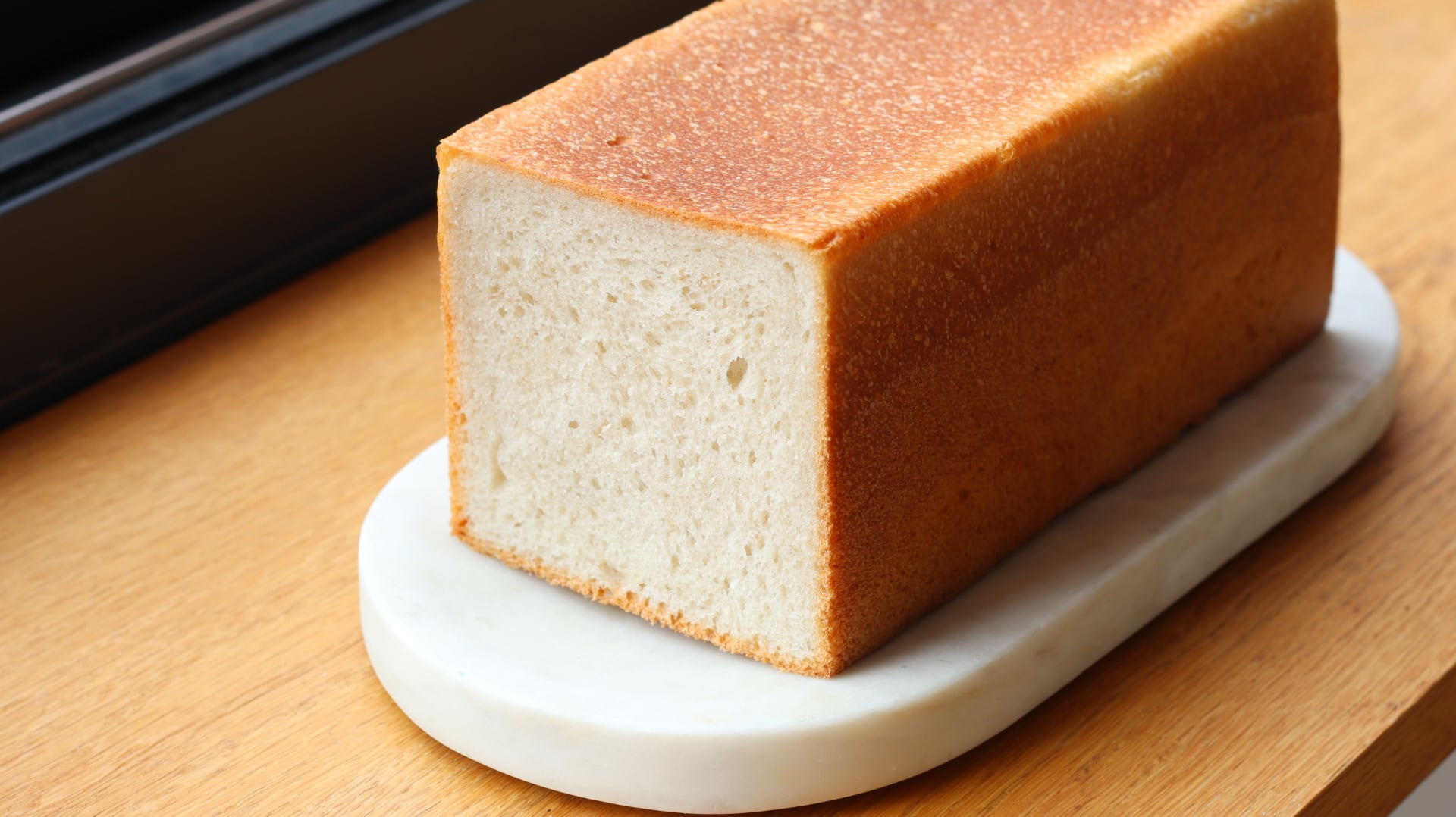
Pullman Loaf
TIER 1
Pullman Loaf
A pullman style loaf is pretty typical with Japanese Milk bread, but works really well for this hybrid sourdough sandwich loaf. This is my go to weekly bread, as it’s easy to prepare and baking with a lid on top means you don’t need to worry quite as much about achieving a perfectly shaped dough. The dough is soft and the rye flour in the sourdough starter adds a subtle flavour, with little flecks of bran throughout the crumb.

1
LOAF
Ingredients
Makes 1 Loaf
Levain
12g Sourdough Starter*
100g Strong White Bread Flour
19g Dark Rye Flour
119g Water (24℃)
*See the guide at the bottom of the recipe for preparing a sourdough starter
Dough
280g Cold Water
0.5g Instant Dry Yeast
155g Mature Sourdough Starter
50g Olive Oil
20g White Sugar
10g Fine Sea Salt
500g Strong White Bread Flour
Special equipment
Stand mixer
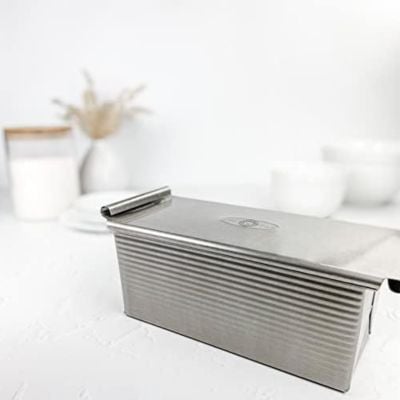
9×4 inch Pullman loaf tin
Digital thermometer
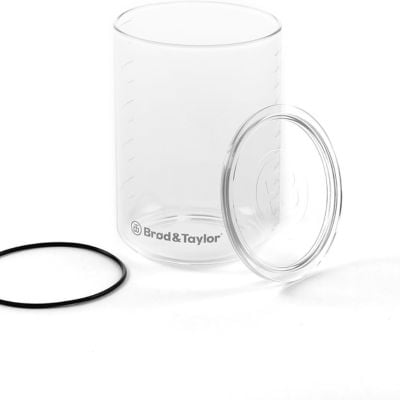
Sourdough starter jar
Method
Levain
A levain is essentially an offshoot of your sourdough starter, made specifically for a particular recipe. You take a small amount of your mature starter and feed it separately, usually in a different ratio, then use the levain once it has fermented and is ready.
However, you don’t always need to make a separate levain. For these recipes, I’ve called it a ‘Levain’ but you can simply feed your existing sourdough starter using the quantities given above. Once it has fermented, use the required amount in the dough and keep whatever is left over as your starter to feed again for your next bake. This keeps things simpler while still giving you the same result.
The ratio for the levain is 1:10:10 which for my starter, peaks in around 8 hours. This means I can feed it in the evening, then it is ready to use the next morning. Depending on your conditions and starter, this might be too slow. If you find that ratio is too slow, a ratio of 1:2:2 will peak much faster (50g Sourdough Starter, 90g Strong White Bread Flour, 10g Dark Rye Flour, 100g Water (24C)
1. In the evening, prepare your levain by mixing all the ingredients in a bowl with a rubber spatula. Scoop them into a clean jar and place the lid on top.
-
- 12g Sourdough Starter
- 100g Strong White Bread Flour
- 19g Dark Rye Flour
- 119g Water (24℃)
2. Leave it at room temperature until the starter has tripled in volume – about 8-10 hours. Depending on your starter, it may only double in volume, that is absolutely fine!
Dough
1. Into the bowl of a stand mixer, add the cold water, sourdough starter, olive oil and instant dry yeast.
-
- 280g Cold Water
- 0.5g Instant Dry Yeast
- 155g Mature Sourdough Starter
- 50g Olive Oil
2. Add the flour on top followed by the salt.
-
- 500g Strong White Bread Flour
- 10g Fine Sea Salt
3. Attach the dough hook and knead the dough on a medium speed for 6-8 minutes, until the dough is smooth and elastic.
4. Lift it out of the bowl, onto a very lightly floured work surface and using a bench scraper, shape it into a smooth boule shape.
5. Lift it into a lightly oiled bowl and cover the bowl tightly with cling film. Allow the dough to proof at room temperature until double in volume – about 2.5-3 hours.
6. Lightly flour the top of the dough and your work surface. Carefully scoop the dough out of the bowl, smooth side down, onto the work surface.
7. Use your hands to flatten the dough into a rough ‘A’ shape, so the base is slightly smaller than the width of your bread tin.
8. Fold the top edge down and press firmly to seal. Continue rolling the dough tightly towards you, creating a compact log and sealing the dough with each roll.
9. Once fully rolled, gently roll the log back and forth to even out the shape, keeping it roughly the same length as the tin.
10. Place the dough seam-side down into a non-stick 9 × 4 × 4-inch Pullman tin (if it’s not non-stick, make sure it is lightly greased with oil). Slide the lid of the pullman tin on and allow it to proof at room temperature. It should take a further 2-3 hours. It may take longer in a cooler room temperature.
11. The dough is ready when it has risen to about 2 cm below the rim of the tin. Don’t proof so far that the dough reaches the rim, as you need to be able to slide the lid into place without it touching the dough. If the dough has risen too much, it will be overproofed and may push out of the tin during baking.
12. About 30 minutes before it is ready, preheat the oven to 205C/400F (non-fan assisted. 190C/375F fan assisted)
13. With the lid on the tin, place it into the centre of the oven and bake for 45-50 minutes. As you are baking ‘blind’ you really want to avoid taking it out too early and disrupting the bake so I always try not to check before 45 minutes.
14. The dough is ready when you slide back the lid, it is a deep golden colour, and the centre of the dough registers 90C/195F on an instant read thermometer.
15. Immediately remove it from the tin and lift it onto a wire rack to cool completely before slicing. I like to wrap the loaf in a clean tea towel as it cools, which softens the crumb slightly.
Sourdough Starter
There are many ways to create a sourdough starter by using different flours, hydration levels, and feeding ratios. The method below follows a 1:2:2 ratio (starter:water:flour), which is a reliable and simple approach, but it can easily be adjusted to suit your schedule, environment, or preferences.
Notes:
Daily feeding is essential in the beginning.
During the first 5-6 days, consistency matters. Try not to skip a day, as this early period is crucial for developing an active and reliable culture.
Don’t worry about perfect timing.
While it helps to feed your starter at around the same time each day in the beginning, sourdough is more resilient than people think. If you’re a few hours late – or even miss a day – it won’t kill the starter. With a couple of consistent feeds, it will usually bounce back.
Temperature plays a major role.
Keeping your starter at a stable temperature will help it ferment on a regular, predictable cycle. Use the same water temperature for each feed when possible, and if you’re serious about consistency, a home dough proofer can be a great investment. It allows you to maintain a steady environment, which leads to more predictable fermentation.
Choose the right container.
A straight-sided glass jar (like a canning jar) with a loose-fitting lid is ideal. It should be large enough to allow the starter to double or even triple in size during peak activity. It’s helpful to place a thin rubber band around the jar to mark the level of your sourdough starter so you can easily tell when it has doubled in size.
Day 1
45g Strong White Bread Flour
5g Dark Rye Flour
50g Water (24C)
1. Into a small bowl, add the ingredients and stir them together with a rubber spatula to form a paste.
2. Scrape the mixture into a clean glass jar, scraping down the sides of the jar if needed so that the starter is level in the jar.
3. Place the lid loosely on top of the and leave it for 24 hours at an ambient room temperature.
Day 2
25g Sourdough Starter
45g Strong White Bread Flour
5g Dark Rye Flour
50g Water (24C)
1. After 24 hours, you may see a tiny bit of activity, small bubbles, but don’t worry if nothing has happened.
2. Scoop out 25g of Day 1’s mixture (the sourdough starter) into a small bowl, discarding the remaining.
3. Add the fresh flour and water on top, and stir them together to combine.
4. Pour the mixture into a clean glass jar and scrape down the sides to ensure it is level. Place the lid loosely on top and leave it for 24 hours at an ambient room temperature.
Days 3-6
25g Sourdough Starter
45g Strong White Bread Flour
5g Dark Rye Flour
50g Water (24C)
1. We now follow the exact same process as day 2, for the rest of the week. As the days progress you will see the starter becoming more active and bubbly.
Day 6
By the 6th day, you should see significantly more activity in your starter, with bubbles visible on the surface and throughout the starter, as well as a more consistent rise and fall pattern. While the exact timing of the peak will depend on your conditions and the flour you’re using, it’s important to establish this consistency before using the starter to bake with.
While by day 7 the starter can typically be used to bake with, feeding it for an extended period of time, such as 14 days or longer, before using it, can help to lead to a stronger starter. In the early stages of development, the pH is higher, but over time, as acids accumulate, the starter promotes the growth of more acid-tolerant bacteria. This shift helps to create a more stable fermentation ecosystem, with a more reliable balance between lactic acid bacteria and wild yeasts.
Depending on your starter, it may either double or triple in volume every time you feed it. This will be your ‘peak’ so take note of every time you feed it, where it rises before falling. If your starter just doubles in volume that is fine too!
Maintaining Your Sourdough Starter
Option 1 – Daily Feeding
If you plan on baking with the starter regularly, then it is best to keep it at room temperature and feed it on a consistent 24-hour cycle. This will ensure it is active and ready to use when you need to bake. However, feeding it daily can be time-consuming and use a significant amount of flour over time.
Option 2 – Refrigeration
If you bake less frequently, you can store your starter in the fridge to slow down fermentation. To do this, feed your starter and then place it in the fridge. It can typically be left for up to a week without additional feedings. After a week, remove it from the fridge and feed the starter following the same ratios as above. Depending on your starter, it may need one or more feedings at room temperature to fully reactivate
Option 3 – Dehydration
For long-term storage, you can dehydrate your starter. Take your starter at its peak and spread it thinly onto a sheet of parchment paper placed on a baking tray. Let it air dry in the oven with the heat off—this can take anywhere from 1 to 3 days, depending on your environment. Once the starter is completely dry and brittle, break it into flakes and store it in an airtight bag or container and freeze. To reactivate the dry starter, add about 15g of the dried starter flakes into a jar along with your normal feed quantities and feed it as you normally would for 2-3 days, or until it shows signs of activity and strength.
Shop the Equipment


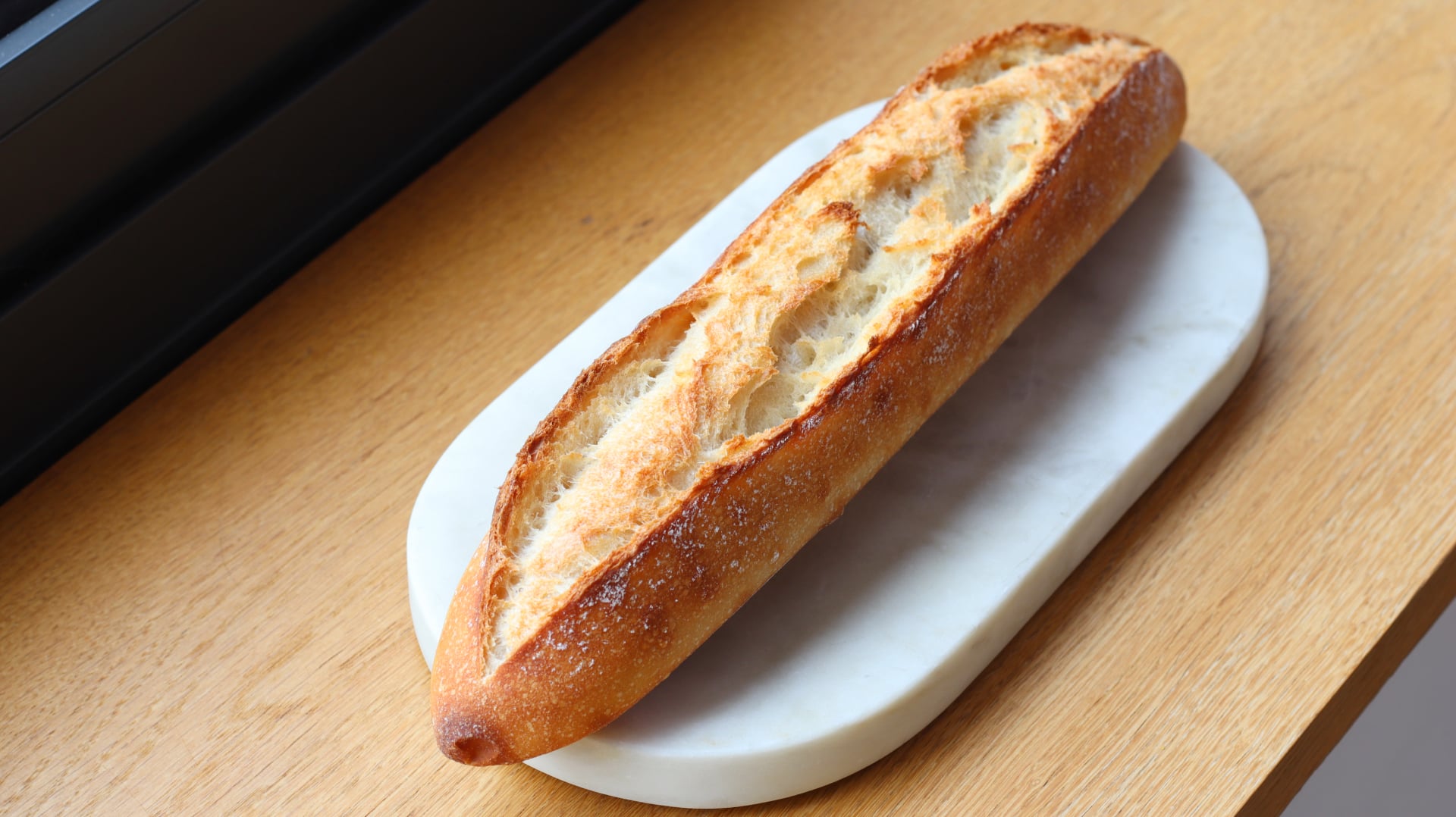
Demi-Baguette
TIER 2
Demi-Baguette
I’m a little nervous to call this a ‘baguette’, as I’m sure the purists might have something to say! But this is possibly the easiest baguette-style bread I’ve ever made. The dough is incredibly simple to prepare, with no stand mixer required. The main thing to focus on is the shaping, which takes a little practice, but using a perforated baguette mould acts as a bit of a cheat, helping you achieve a nice, neat shape. You’ll be amazed by the results for such little effort.
2
DEMI-BAGUETTES
Ingredients
Makes 2 Demi-baguettes
Levain
12g Sourdough Starter*
100g Strong White Bread Flour
19g Dark Rye Flour
119g Water (24℃)
*See the guide at the bottom of the recipe for preparing a sourdough starter
Dough
350g Water, Cold
15g Mature Sourdough Starter
0.5g Instant Dry Yeast
500g Strong White Bread Flour
12g Fine Sea Salt
Special equipment
Perforated baguette tray
Sourdough starter jar
Method
Timings
This dough is designed to be proofed overnight, either at room temperature or in the refrigerator. To ensure your dough is ready to bake the following morning, prepare your sourdough starter so that it reaches its peak in the early evening, ready to use when making the dough.
Levain
A levain is essentially an offshoot of your sourdough starter, made specifically for a particular recipe. You take a small amount of your mature starter and feed it separately, usually in a different ratio, then use the levain once it has fermented and is ready.
However, you don’t always need to make a separate levain. For these recipes, I’ve called it a ‘Levain’ but you can simply feed your existing sourdough starter using the quantities given above. Once it has fermented, use the required amount in the dough and keep whatever is left over as your starter to feed again for your next bake. This keeps things simpler while still giving you the same result.
The ratio for the levain is 1:10:10 which for my starter, peaks in around 8 hours. This means I can feed it in the morning, then it is ready to use in the early evening. Depending on your conditions and starter, this might be too slow. If you find that ratio is too slow, a ratio of 1:2:2 will peak much faster (50g Sourdough Starter, 90g Strong White Bread Flour, 10g Dark Rye Flour, 100g Water (24C)
1. In the morning, prepare your levain by mixing all the ingredients in a bowl with a rubber spatula. Scoop them into a clean jar and place the lid on top.
-
- 12g Sourdough Starter
- 100g Strong White Bread Flour
- 19g Dark Rye Flour
- 119g Water (24C)
2. Leave it at room temperature until the starter has tripled in volume – about 8 hours. Depending on your starter, it may only double in volume, that is absolutely fine!
Dough
1. Into a large bowl, add the cold water, sourdough starter and instant dry yeast. Swirl it together with your hand to dissolve the starter.
-
- 350g Water, Cold
- 15g Mature Sourdough Starter
- 0.5g Instant Dry Yeast
2. Add the flour on top followed by the salt.
-
- 500g Strong White Bread Flour
- 12g Fine Sea Salt
3. Mix it together with a spatula just until the flour has absorbed all the liquid and there are no more dry ingredients left in the bowl. Lightly wet your hand and briefly fold the dough in on itself, starting from the edges and folding into the centre. Flip it over so the smooth side is facing up and cover the bowl with a tea towel.
4. Allow the dough to rest for 30 minutes.
5. After 30 minutes. begin the first stretch and fold by lightly wetting one hand. Slide it under the dough in the bowl, then lift and gently stretch the dough upward. Fold it back down toward the center. Rotate the bowl 90° and repeat the motion. Do this four times in total. At first, the dough may feel a bit tough and shaggy, but it will become noticeably more elastic as you go. Once you’ve completed all the folds, lift the dough gently from the bowl, allowing the dough to hang. Tuck the hanging tail underneath the dough, then repeat 2–3 times until the surface is smooth and taut. Cover the bowl with a tea towel and leave it at room temperature for 30 minutes.
6. Repeat this three more times, performing a total of 4 sets of stretch and folds, for a total of 2 hours.
7. After the final stretch and fold, flip the dough over so the smooth side is facing up and then gently spritz the top of the dough with water (or gently rub a light layer on top with your hand). Cover the bowl with cling film and leave at room temperature for 8-10 hours. Alternatively you can refrigerate the dough overnight, but it will just need longer to proof the following day. Personally, I prefer to chill the dough overnight, as it makes the shaping slightly easier but by proofing at room temperature, the dough will be quicker to make the next day.
8. Remove the chilled dough from the fridge and lightly flour the top. Use a plastic bench scraper to lift it onto a very lightly floured work surface, keeping the smooth side facing up. Divide the dough in half; each piece should be roughly 425g if you want to weigh them.
9. Brush away any excess flour and turn one piece of dough over so the smooth side is facing down. Fold the edges of the dough into the centre, working your way around, to create a rough dumpling-like shape.
10. Turn the dough over so the smooth side is facing up. Using your hands or a bench scraper, gently pull the dough towards you to create tension and form a tight, smooth ball. Repeat with the second piece.
11. Place both dough balls on a lightly floured surface, cover with a tea towel and leave to rest at room temperature for 30 minutes.
12. To shape the baguettes, turn one dough ball onto a very lightly floured surface, smooth side down. Gently flatten it with your hands, pressing out some of the gas, until you have a rough oval.
13. Take the top third of the dough and fold it down towards the centre. As you fold, gently tuck the two corners in towards the centre, creating a slightly tapered edge. Seal the fold firmly with your fingertips or the heel of your hand. This helps create the tapered end of the baguette.
14. Rotate the dough 180°, checking that it isn’t sticking to the work surface. Fold the top third down towards the centre again, once more gently tucking the corners in as you fold. Seal firmly.
15. Fold the dough one final time, bringing the top edge all the way down to the bottom edge. Seal the seam firmly with the heel of your hand to create a neat, compact log.
16. Turn the dough over so the seam is underneath. Starting in the centre, gently roll the dough back and forth, gradually moving your hands towards the ends. As you reach the ends, apply slightly more pressure to taper them into a pointed tail. Repeat a few times until the baguette is evenly shaped.
17. Carefully lift the baguette, keeping the seam underneath, and place it into a perforated baguette tray. Repeat with the second piece of dough.
18. If the dough has been chilled, it will need 2.5-3 hours to proof at room temperature. The dough is proofed when it looks fuller in volume, and when you poke it, it should slowly spring back. If it springs back too quickly, it hasn’t proofed enough yet. If you proofed the dough at room temperature overnight, then the dough should only need around an hour.
19. About 30 minutes before it is done proofing, preheat the oven to 240C/465F non-fan assisted (225C/435F fan-assisted) with a small tray at the bottom of the oven.
20. Place the proofed baguettes into the centre of the oven and splash about ½ cup warm water on the tray that is on the bottom of the oven.
21. Bake the baguettes for around 20-22 minutes until they are an even golden brown colour, then drop the oven temperature to 160C/330F non-fan assisted (150C/300F fan-assisted) and bake for a further 3-5 minutes, until you are happy with the colour.
22. Remove them from the oven and lift them straight onto a wire rack to cool completely.
Sourdough Starter
There are many ways to create a sourdough starter by using different flours, hydration levels, and feeding ratios. The method below follows a 1:2:2 ratio (starter:water:flour), which is a reliable and simple approach, but it can easily be adjusted to suit your schedule, environment, or preferences.
Notes:
Daily feeding is essential in the beginning.
During the first 5-6 days, consistency matters. Try not to skip a day, as this early period is crucial for developing an active and reliable culture.
Don’t worry about perfect timing.
While it helps to feed your starter at around the same time each day in the beginning, sourdough is more resilient than people think. If you’re a few hours late – or even miss a day – it won’t kill the starter. With a couple of consistent feeds, it will usually bounce back.
Temperature plays a major role.
Keeping your starter at a stable temperature will help it ferment on a regular, predictable cycle. Use the same water temperature for each feed when possible, and if you’re serious about consistency, a home dough proofer can be a great investment. It allows you to maintain a steady environment, which leads to more predictable fermentation.
Choose the right container.
A straight-sided glass jar (like a canning jar) with a loose-fitting lid is ideal. It should be large enough to allow the starter to double or even triple in size during peak activity. It’s helpful to place a thin rubber band around the jar to mark the level of your sourdough starter so you can easily tell when it has doubled in size.
Day 1
45g Strong White Bread Flour
5g Dark Rye Flour
50g Water (24C)
1. Into a small bowl, add the ingredients and stir them together with a rubber spatula to form a paste.
2. Scrape the mixture into a clean glass jar, scraping down the sides of the jar if needed so that the starter is level in the jar.
3. Place the lid loosely on top of the and leave it for 24 hours at an ambient room temperature.
Day 2
25g Sourdough Starter
45g Strong White Bread Flour
5g Dark Rye Flour
50g Water (24C)
1. After 24 hours, you may see a tiny bit of activity, small bubbles, but don’t worry if nothing has happened.
2. Scoop out 25g of Day 1’s mixture (the sourdough starter) into a small bowl, discarding the remaining.
3. Add the fresh flour and water on top, and stir them together to combine.
4. Pour the mixture into a clean glass jar and scrape down the sides to ensure it is level. Place the lid loosely on top and leave it for 24 hours at an ambient room temperature.
Days 3-6
25g Sourdough Starter
45g Strong White Bread Flour
5g Dark Rye Flour
50g Water (24C)
1. We now follow the exact same process as day 2, for the rest of the week. As the days progress you will see the starter becoming more active and bubbly.
Day 6
By the 6th day, you should see significantly more activity in your starter, with bubbles visible on the surface and throughout the starter, as well as a more consistent rise and fall pattern. While the exact timing of the peak will depend on your conditions and the flour you’re using, it’s important to establish this consistency before using the starter to bake with.
While by day 7 the starter can typically be used to bake with, feeding it for an extended period of time, such as 14 days or longer, before using it, can help to lead to a stronger starter. In the early stages of development, the pH is higher, but over time, as acids accumulate, the starter promotes the growth of more acid-tolerant bacteria. This shift helps to create a more stable fermentation ecosystem, with a more reliable balance between lactic acid bacteria and wild yeasts.
Depending on your starter, it may either double or triple in volume every time you feed it. This will be your ‘peak’ so take note of every time you feed it, where it rises before falling. If your starter just doubles in volume that is fine too!
Maintaining Your Sourdough Starter
Option 1 – Daily Feeding
If you plan on baking with the starter regularly, then it is best to keep it at room temperature and feed it on a consistent 24-hour cycle. This will ensure it is active and ready to use when you need to bake. However, feeding it daily can be time-consuming and use a significant amount of flour over time.
Option 2 – Refrigeration
If you bake less frequently, you can store your starter in the fridge to slow down fermentation. To do this, feed your starter and then place it in the fridge. It can typically be left for up to a week without additional feedings. After a week, remove it from the fridge and feed the starter following the same ratios as above. Depending on your starter, it may need one or more feedings at room temperature to fully reactivate
Option 3 – Dehydration
For long-term storage, you can dehydrate your starter. Take your starter at its peak and spread it thinly onto a sheet of parchment paper placed on a baking tray. Let it air dry in the oven with the heat off – this can take anywhere from 1 to 3 days, depending on your environment. Once the starter is completely dry and brittle, break it into flakes and store it in an airtight bag or container and freeze. To reactivate the dry starter, add about 15g of the dried starter flakes into a jar along with your normal feed quantities and feed it as you normally would for 2-3 days, or until it shows signs of activity and strength.
Shop the Equipment

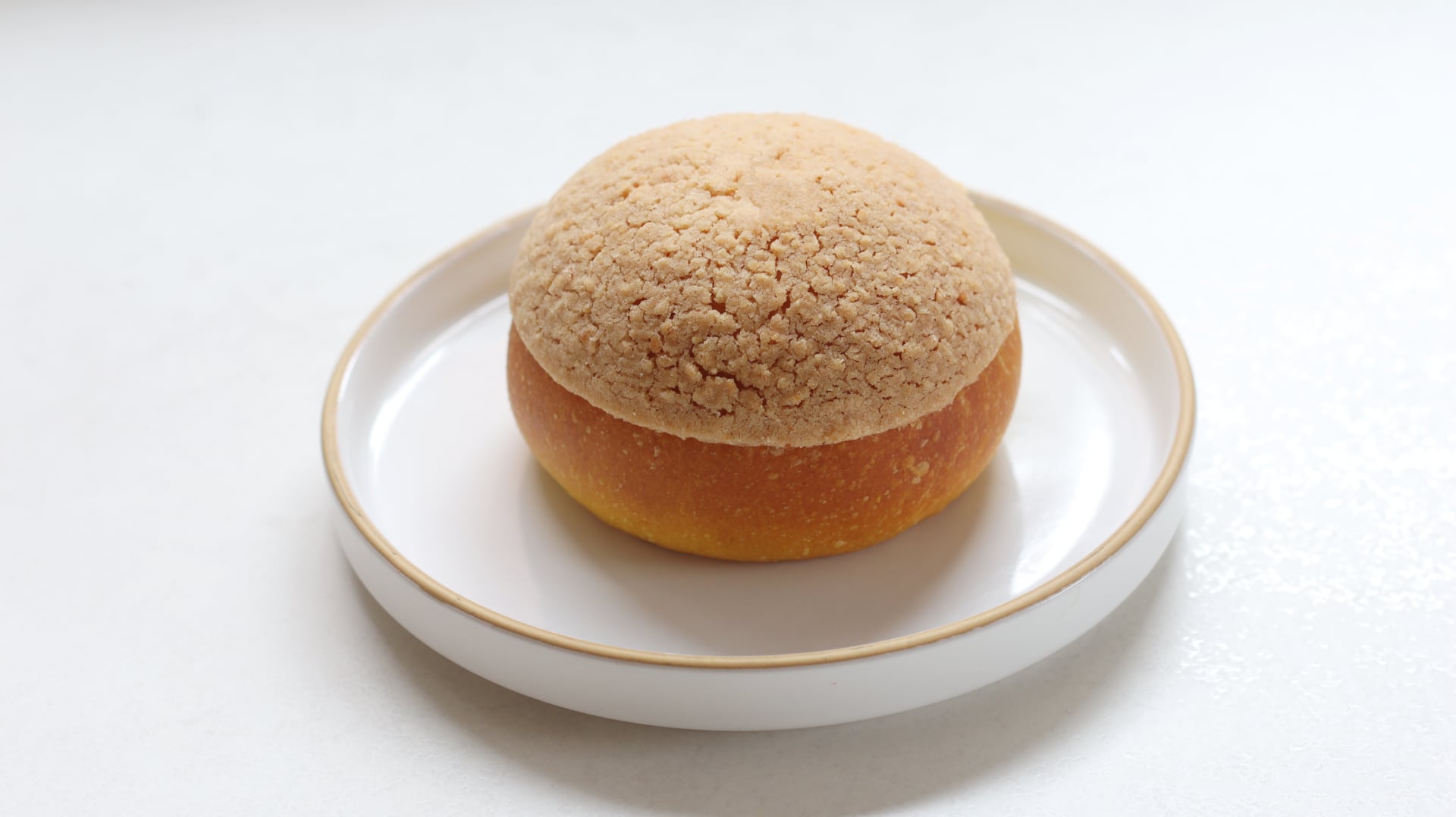
Brioche au Craquelin
TIER 2
Brioche Au Craquelin
In Tier 2 we follow the same technique for the dough as Tier 1. Then, similar to a concha, we top this brioche with a crisp craquelin layer (one we’ve made plenty of times during choux pastry month!). Just like with choux, it adds a sweet, crunchy texture while also helping control the bake, giving you a neat, professional finish. I show you how to fill the brioche with a simple raspberry compote, but feel free to get creative with your fillings!
14-16
INDIVIDUAL BRIOCHE
Ingredients
Makes 14-16 Individual Brioche
Yudane
50g Boiling Water
50g Strong White Bread Flour
Brioche Dough
150g Whole Eggs
100g Whole Milk
420g Strong White Bread Flour
12g Fine Sea Salt
40g White Sugar
6g Instant Dry Yeast or 12g Fresh Yeast
140g Unsalted Butter, Cubed (Remove from the fridge 15 minutes before)
Craquelin
75g Plain/All-Purpose Flour
75g Caster/White Sugar
75g Ground Almonds
85g Unsalted Butter, Cold & Cubed
1g Fine Sea Salt
Raspberry Compote
400g Raspberry Puree
40g Caster/White Sugar*
8g Pectin NH
10g Fresh Lemon Juice
Special equipment
Stand mixer
Silicon mats
7cm cookie cutter
Digital thermometer (optional)
Piping bag
Long cream filling piping tip
Method
Dough
1. Into a small bowl, add 50g of strong white bread flour. Boil the water and pour this over the top, stirring it together to form a paste. Cover this and set aside to cool for 1 hour (or 20 minutes in the fridge)
- 50g Strong White Bread Flour
- 50g Boiling Water
2. Into the bowl of a stand mixer, add the cooled Yudane (above) with the wet ingredients on top.
- 150g Whole Eggs
- 100g Whole Milk
3. Add the remaining dry ingredients on top and with the dough hook attached, knead for 8-10 minutes on a medium speed. The dough should be more cohesive in consistency, but the gluten will not have fully developed, so it will not be completely smooth.
- 420g Strong White Bread Flour
- 12g Fine Sea Salt
- 40g White Sugar
- 6g Instant Dry Yeast or 12g Fresh Yeast
4. Add the cubed butter, a few pieces at a time, waiting around 20 seconds in between each addition.
- 140g Unsalted Butter, Cubed
5. Once all the butter has been incorporated, knead for a further 1-2 minutes. By which point the dough should feel very smooth and elastic.
6. Remove the dough from the mixer and lift it onto your work surface. Shape it into a smooth ball, and lift it into a medium bowl which has been lightly oiled.
7. Place a sheet of cling film directly on the surface of the dough, and another around the bowl. Refrigerate the dough overnight. 12-16 hours.
Craquelin
1. Add all of the ingredients into the bowl of a stand mixer, and beat using the paddle attachment until it forms a smooth paste.
- 75g Plain/All-Purpose Flour
- 75g Caster/White Sugar
- 75g Ground Almonds
- 85g Unsalted Butter, Cold & Cubed
- 1g Fine Sea Salt
2. Scoop the mixture out and place it in between two large silicon mats (or pieces of parchment paper). Using a rolling pin, roll the dough to around 2-4mm thick. Place it in the freezer for at least 30 minutes.
3. Remove the dough from the freezer and working quickly, peel off the silicon mats/parchment paper and cut discs, using a 7cm/2.75” cookie cutter. Cut as many discs as possible and lift these onto a baking tray lined with a silicon baking mat. Place them back in the freezer until you need them.
4. You will need to re-roll the scraps of dough and then repeat steps 2-3 to cut enough discs. You will need around 16 in total.
Dough Continued
1. The next day, remove the dough from the fridge and cut it into 50g pieces.
2. Place the smooth side of dough down on the work surface and flatten it slightly. Fold the edges towards the centre, to create a dumpling-like shape.
3. Flip the dough over and with your hand cupped around in it in a ‘C’ shape, rotate the dough underneath your palm, to create tension, and a smooth ball.
4. Lift each dough ball onto a lined baking tray – you will need 2-3 trays. Depending on the size of the tray, you should be able to fit 6 per tray (or 8 if you have large baking trays) Ensure they have enough space to proof.
5. Place the trays into the oven, switched off, and place a small pot of boiling water in the corner, changing it every 30-45 minutes.
6. The dough will take 2-3 hours to proof. It is ready when it has doubled in size.
Raspberry Compote
1. Into a small bowl, whisk together the sugar and pectin and set aside.
- 40g Caster/White Sugar*
- 8g Pectin NH
2. Add the raspberry puree into a medium saucepan, and heat it to around 45C (or just until it is slightly warm), then tip in the sugar/pectin mixture.
- 400g Raspberry Puree
3. Whisk until the mixture comes to a boil, then remove it from the heat and whisk in the lemon juice.
- 10g Fresh Lemon Juice
4. Pour the mixture into a bowl, cover the surface with clingfilm, and refrigerate until needed. It will need a few hours to cool, so do this while the dough is proofing. Note – the amount of sugar will depend on the sweetness of your raspberries, so if you find the mixture is not sweet enough as it is cooking (have a little taste!), then you can add more.
Baking & Assembly
1. Just before the dough has finished proofing, remove the trays from the oven and preheat it to 185C/365F non-fan assisted (170C/340F fan-assisted). You may not be able to bake all the trays at once which is fine, just cover one of the trays with a tea towel while the first two trays bake.
2. Remove the discs of craquelin from the freezer and place them into the centre of each bun.
3. Bake them in the oven for 20 minutes. The craquelin should be an even golden brown colour on top.
4. Remove the trays from the oven and lift them straight onto a wire cooling rack, to cool for at least 30 minutes.
5. Once cooled, quickly whisk the raspberry compote together to smooth it, and place it into a piping bag with a long “cupcake filler” nozzle.
6. Pierce a hole in the base of the bun, and pipe some compote in. Flip the buns back over and serve.
Shop the Equipment





Sesame Bloomer
TIER 1
Sesame Bloomer
The Tier 1 dough is relatively low hydration so simple to work with – by hand or in your mixer. The great technique here is lightly soaking the dough and then coating it in sesame seeds. It is a technique I use to get perfect coverage of seeds over the loaf, rather than spilling seeds everywhere! This is a slightly softer loaf than Tier 2 so great for sandwiches. Feel free to swap out sesame seeds for poppy seeds too.
1
LOAF
Ingredients
Makes 1 Loaf
12g Fresh Yeast/6g Instant Dry Yeast
12g Fine Salt
400g Strong White Bread Flour
100g Wholemeal Bread flour
325g Tepid Water
15g Sesame Seeds + Extra To Coat
20g Unsalted Butter, Soft
5g White Sugar
Special equipment
Stand mixer
Bread scorer
Digital thermometer (optional)
Method
1. Add all of the ingredients for the dough into the bowl of a stand mixer.
2. Attach the dough hook and knead on a medium speed for around 6-7 minutes until the dough pulls away from the sides of the bowl and appears smooth. It should pass the windowpane test, which is when you stretch a small piece of dough out and it forms a windowpane without tearing.
3. Lift the dough onto your work surface, and perform a few slap and folds with the dough, then use your hands to shape it into a smooth ball shape.
4. Lift the dough into a lightly oiled bowl and cover it with clingfilm – the dough needs to proof for about an hour at room temperature or until doubled in size. This may take longer if your room is cold.
5. Just before it is ready, soak a tea towel and ring out any excess water. Set this next to a baking tray lined with parchment paper.
6. Lightly toast a tray of sesame seeds for about 10 minutes at 180C/355F. They just need to be a light golden brown – not too dark!
7. Lightly flour your work surface, and scoop the dough, smooth side down, onto the flour.
8. Gently flatten the dough with lightly floured hands into a large circle. Stretch the left side out slightly and fold it toward the center. Then stretch the right side and fold it in to overlap the first fold.
9. Reshape the dough into a tidy rectangle. Starting from the top edge, roll the dough tightly towards you, using your thumbs to press the dough firmly inward with each turn to create a taut log.
10. Once fully rolled, pinch the seam closed by using your fingers to stitch it together.
11. Working quickly, tilt the dough side to side on the wet tea towel, then transfer it to the toasted sesame seeds, tilting it to cover the entire loaf.
12. Flip the dough over and place it seam side down onto your baking tray.
13. Cover the dough with a tea towel to proof for about an hour at room temperature. The dough should almost double in size.
14. Meanwhile, preheat the oven to 230C/445F non-fan assisted and place a small tray on the bottom shelf.
15. Once the dough is proofed, take a razor blade and slash the dough. I used multiple diagonal slashes across the top of the dough, but you can slash it any way you prefer.
16. Splash a cup of boiling water onto the preheated tray and immediately place the bread on the middle shelf of the oven.
17. Immediately drop the oven temperature to 190C/375F non-fan assisted and bake for around 50 minutes – the dough should be a golden colour, and a digital thermometer inserted into the centre should reach 90C/195F or just above it.
18. Lift the baked loaf onto a wire rack and cool for at least an hour before slicing.
Shop the Equipment


Multigrain Bloomer
TIER 2
Multigrain Bloomer
In Tier 2 we are looking at the importance of soaking seeds in dough. Seeds suck up a lot of moisture so it’s important to pre-soak them before they go into the dough to ensure they don’t draw out moisture from the bread itself, making it dry. The final loaf is proofed in a banneton basket, and then baked in a cast iron dutch oven which gives a really rustic, bakery style finish. This bread is heartier and is great for toast and eggs!
1
LOAF
Ingredients
Makes 1 Loaf
Poolish
150g Strong White Bread Flour
150g Water
1.5g Fresh Yeast / 0.75g Instant Dry Yeast
Soaker
10g Rolled Oats
5g Poppy Seeds
35g Mixed Seeds (Pumpkin, Linseed, Sunflower)
60g Boiling Water
Dough
120g Wholemeal Flour
230g Strong White Bread Flour
1g Fresh Yeast/0.5g Instant Dry Yeast
12g Salt
15g Unsalted Butter. Room Temperature
120g Water
Special equipment
Stand mixer
500g Wood Pulp Banneton Basket
Bread scorer
Cast Iron Dutch Oven
Digital thermometer (optional)
Method
Poolish
1. Into a small bowl, add the water and yeast. Stir this until the yeast has completely dissolved.
2. Tip in the flour and mix to form a smooth paste. Cover the bowl and leave it at room temperature for 12 hours, by which point it should be very bubbly on top.
Soaker
1. Add all the seeds into a bowl and pour the boiling water over the top. Set it aside at room temperature for 12 hours.
Dough
1. Into the bowl of a stand mixer, add the poolish, soaked seeds, and remaining dough ingredients.
2. Attach the dough hook and knead on a medium speed for around 6-7 minutes until the dough pulls away from the sides of the bowl and appears smooth. It should pass the windowpane test, which is when you stretch a small piece of dough out and it forms a windowpane without tearing.
3. Lift the dough onto your work surface, and perform a few slap and folds with the dough, then use your hands to shape it into a smooth ball shape.
4. Lift the dough into a lightly oiled bowl and cover it with clingfilm – the dough doesn’t have a lot of yeast, so it will need 2.5-3 hours to rise at room temperature, until doubled in size.
5. Once proofed, lightly flour your work surface, and scoop the dough, smooth side down, onto the flour.
6. Gently flatten the dough with lightly floured hands into a large circle. Stretch the left side out slightly and fold it toward the center. Then stretch the right side and fold it in to overlap the first fold.
7. Reshape the dough into a tidy rectangle. Starting from the top edge, roll the dough tightly towards you, using your thumbs to press the dough firmly inward with each turn to create a taut log.
8. Roll the sealed dough lightly in some flour, then lift it into your floured banneton basket. Pinch the seam together when it is in the basket if needed.
9. Lightly flour the top of the dough and cover the basket with a tea towel. Proof for another 2.5-3 hours. It should puff up above the rim of the basket – see the video as a visual cue!
10. 45 minutes before the dough is ready, pre-heat the oven to 230C/445F non-fan assisted, with a cast iron pan (with the lid on) in the centre.
11. When the dough is proofed, carefully flip it out onto a circle of parchment paper, and then use a razor blade to score the dough lengthways.
12. Remove the cast iron pan from the oven and being very careful, lift the dough into the pan. Drop a few small ice cubes at the side of the pan, place the lid back on top, and get it straight into the oven.
13. Bake for 20 minutes, then remove the lid of the cast iron pot and lower the oven temperature to 190C/375F and bake for a further 15 minutes. It should be a golden brown colour, and a digital thermometer inserted into the centre will read 90C/195F or just above.
14. Remove it from the cast iron pan and lift it onto a wire rack to cool completely, at least an hour before slicing it.
Shop the Equipment


Pandoro
TIER 2
Pandoro
In Tier 2 we are really stepping things up with a Pandoro – the iconic 8 pointed star Italian bread. This is a challenging dough that requires a high protein flour to handle the high levels of fat and sugar in the dough. Similarly to the Kugelhopf , this dough is flavoured with lemon and orange zest, with a beautiful enriched yellow crumb once baked. There is a lot of fermentation and proofing in this recipe, so really set aside some time to tackle this!
2
750G LOAVES
Ingredients
Makes 2 750g Loaves
1st Dough
615g Manitoba Flour (or Pannetone Flour)
0.8g Fresh Yeast/0.4g Instant Dry Yeast
340g Whole Eggs
125g Unsalted Butter, Cubed & Slightly Soft
Butter Mixture
150g Unsalted Butter, Soft
105g Caster Sugar
10g Honey
Zest ½ Lemon
Zest 1 Orange
Beans from 1 Vanilla Pod
2nd Dough
170g Manitoba Flour (or Pannetone Flour)
125g Caster/White Sugar
45g Whole Milk
8.5g Fine Sea Salt
85g Egg Yolks
19g Fresh Yeast/9.5g Instant Dry Yeast
Butter Mixture (Above)
Special equipment
Stand mixer
Dough scraper
Pandoro tins
Digital thermometer
Method
1st Dough
Note – this dough needs a long proof so it is best to do it at night so that it can proof overnight, then you’ll be ready to make the 2nd dough the next day.
1. Into a stand mixer, add the eggs and yeast, and whisk to combine.
2. Add in the flour and attach the dough hook. Mix on a medium low speed, until the flour has completely absorbed the wet ingredients. Once it has absorbed them, continue to knead for a minute on a low speed.
3. While mixing on a medium low speed, add the cubed butter a few pieces at a time. Allow the butter to incorporate before adding the next few pieces.
4. As soon as the butter has all been incorporated, continue to knead for 1 minute. We are not looking to develop the dough too much so remove it from the mixer and gently work it on your work surface, shaping it into a rough ball.
5. Lift the dough into a large container or bowl, ideally with measurements on the side so that you can see how much the dough has risen.
6. Cover the bowl tightly and proof at room temperature for 12 hours or until the dough has tripled in volume.
Butter Mixture
1. The next day, add all the ingredients for the butter mixture into a stand mixer, and attach the paddle attachment. Beat on a medium speed until it is smooth and homogenous. Set this to one side at room temperature.
2nd Dough
1. Now that the 1st dough has tripled in size, it is ready to use.
2. Into a small bowl, whisk together the sugar and flour. Add the milk into a small jug too.
3. Into the bowl of a stand mixer, add half of the 1st dough, along with the yeast.
4. Add ¼ of the sugar/flour mixture and mix on a low speed. Drizzle in ¼ of the milk. Knead on a low speed until all the dry ingredients are completely absorbed.
5. Repeat this process, adding the sugar/flour mixture in increments along with the milk. Ensure that all the dry ingredients are incorporated each time.
6. Once you have a homogenous dough, add the remaining half of the first dough and knead on a low speed for a minute.
7. Add in the salt and knead for a minute.
8. With the mixer still on low, alternate adding the egg yolks and butter mixture (above) in about 4 additions per ingredient. You need to ensure that the egg yolks are completely incorporated before adding the butter, and the butter is incorporated before adding the next part of egg yolks. Be patient here, waiting about 45 seconds in between each addition.
9. Once these have been incorporated and there are no streaks of egg yolks or butter, increase the speed to medium, and knead for around 10 minutes or until the dough is completely smooth and passes the windowpane test (where you stretch a small piece of dough between your fingers and it creates a windowpane without tearing).
10. Lift the dough out of the mixer, shape it into a tight ball, and lift it into a lightly oiled bowl. Allow it to proof at room temperature for 30 minutes.
11. After 30 minutes, using a dough scraper, split the dough into two equal 750g portions (you might have a little extra dough).
12. Use a dough scrape to shape each piece of dough into a tight ball.
13. Ensure your 750g Pandoro tins are lightly buttered and floured, and carefully lift the dough balls into the tins, smooth side down (so the smooth, top side of the dough should be against the bottom of the tin).
14. Loosely cover the top of the tins with clingfilm, and proof them for 4-6 hours at room temperature or until the dough has risen to just below the lip of the tin.
15. Before they are ready, pre-heat the oven to 170C/340F Non-Fan Assisted.
16. When the dough has proofed, place the tins into the oven, and bake for 50-60 minutes. The dough needs to register a temperature of at least 95C/203F on a digital thermometer. After about 25 minutes of baking, cover the top with a sheet of foil to stop it from darkening too much.
17. Once at temperature, remove the tins from the oven and allow the Pandoro to cool for 30 minutes in the tin, before flipping them onto a wire rack to cool completely.
18. Dust with icing sugar to serve.
Shop the Equipment


Kugelhopf
TIER 1
Kugelhopf
This bread has ties to Germany, Austria and France and is a popular bread served around the holidays. Think of it like giant hot cross bun in a bundt tin! The dough is a soft, buttery brioche flavoured with soaked raisins that have been steeped in orange, lemon and vanilla. When the cake is finished it is soaked in melted butter and then coated in sugar. I have to say, this is one of the most delicious recipes I’ve made ALL year! I’ve used a Kugelhopf tin, but the dough can also be made in a classic bundt tin.
2
400G LOAVES
Ingredients
Makes 2 400g Loaves
Soaked Raisins
100g Sultanas
20g Sugar
150g Water
Peels of 1/2 Lemon
Peels of 1 Medium Orange
Brioche Dough
425g Strong White Bread Flour (13-14% Protein)
10g Salt
50g Sugar
17g Fresh Yeast or 8.5g Instant Dry Yeast
190g Eggs
65g Whole Milk
Zest of 1 Lemon
Zest of 1 Orange
210g Unsalted Butter, Slightly Cold & Cubed
To Finish
Melted Butter
Caster/White Sugar
Special equipment
Stand mixer
Dough scraper
Kugelhopf tin/Bundt tin
Digital thermometer
Method
Soaked Raisins
1. Into a small saucepan, add all the ingredients for the soaked raisins. Bring it to a boil and then pour the mixture into a tupperware. Cover and refrigerate for a minimum of 6 hours, ideally overnight.
Brioche Dough
1. For the brioche dough, add all the ingredients, except the butter, to the bowl of a stand mixer fitted with the dough hook.
2. Mix for 10 minutes on a medium speed, scraping down the sides of the bowl occasionally.
3. After 10 minutes, add the butter slowly, a few cubes at a time. It helps to squeeze the cold butter in between your fingers gently just before you add it into the mixer.
4. Once all the butter has been added, continue to mix the dough until it is pulling away from the sides of the mixer and the dough passes the windowpane test.
5. Right at the end, drain the soaked raisins and briefly mix these in. We don’t want to knead them for too long or it will discolour the dough.
6. Scoop the dough out of the bowl, and shape it into a round ball using a dough scraper before lifting it into a lightly oiled bowl.
7. Allow the dough to proof for 2 hours at room temperature. It should double in size.
8. While it is proofing, lightly butter your Kugelhopf tin and coat the inside with flour, before tipping out the excess.
9. Once the dough has proofed, remove it from the bowl, knocking out the air.
10. Cut it into two equal 400g pieces of dough.
11. Carefully shape each piece into a ball, then with one of the dough balls, use your fingers to press a hole in the middle, creating a donut shape.
12. Confidently lift it into the greased tin and cover the tin with cling film.
13. With the other piece of dough, simply shape it into a ball and place it back into the bowl. Cover the surface of the dough and the bowl with cling film. Place both the tin and the bowl in the fridge overnight.
14. The next day, leave the tin at room temperature and proof for 2-3 hours, while leaving the other dough in the fridge.
15. Before baking, preheat the oven to 170C/355F Non-Fan Assisted.
16. Once proofed, the dough should have doubled, to just below the top edge of the tin. Bake the dough for around 35 minutes, it should be a golden colour and register 95C/203F when a digital thermometer is inserted in the middle.
17. Allow it to cool in the tin for 5 minutes, then flip it out and use a pastry brush to cover the entire dough in melted butter, before rolling in sugar.
18. Allow to cool before serving.
19. You can now remove the second dough from the fridge, and re-use the tin. Shape it into a donut again by piercing a hole in the centre and lift it into a the lightly greased tin.
20. Cover the tin with a tea towel and allow it to rise again until doubled – about 2-3 hours at room temperature. Bake as per step 16/17.
Shop the Equipment


Bagels
TIER 1
Bagels
This dough starts with a poolish, which is a type of pre-ferment – a little like a sourdough starter – that adds a real depth to the flavour of the bread. The dough is then shaped and poached to get that iconic bagel texture. You can go to town on the toppings here, my favourite is Everything Bagel seasoning, which you can either buy online or make yourself!
8
BAGELS
Ingredients
Makes 8 Bagels
Poolish
290g Water
3.5g Instant Dry Yeast/7g Fresh Yeast
185g Strong White Bread Flour
Dough
315g Strong White Bread Flour
10g Fine Sea Salt
20g Diastatic Malt Powder (Optional)
Poaching Liquid
3 Litres Water
1 ½ Tbsp Barley Malt Extract
1 Tbsp Baking Soda
Pinch of Salt
Bagel Seasoning To Finish
Special equipment
Stand mixer
Method
Poolish
1. Into a small bowl, add the yeast and water. Stir it together to dissolve, then add in the flour. Whisk this through with a hand whisk to create a wet batter with no lumps of flour.
2. Cover the bowl with a sheet of cling film and leave it at room temperature for 3 hours. After 3 hours you should see lots of bubbles on the surface and the mixture will have puffed up.
Dough
1. Into the bowl of a stand mixer, add the poolish that has bubbled up, and the remaining ingredients. It is ideal to use diastatic malt powder here to help with the flavour and the colouring of the bagels. You can leave it out, or add a little bit of barley malt syrup instead (2 tsp) as a replacement.
2. Attach the dough hook and mix on a medium speed for 10-12 minutes, until the dough is smooth and when you take a small piece of dough and stretch it between your fingers, it passes the window pane test.
3. Shape the dough into a ball, and then place it into a lightly oiled bowl. Cover the bowl and chill the dough for 30 minutes in the fridge.
4. Once chilled, cut the dough into 100g pieces, and roll them into tight balls.
5. Place them onto a baking tray lined with parchment paper, and lightly spray the top with cooking oil. If you don’t have cooking spray you can very lightly brush them with any type of neutral oil.
6. Cover the surface with cling film and refrigerate again for 30 minutes.
7. Take the chilled dough, and use your finger to press a hold in the centre. Then place both index fingers in the hole and spin them around, to create a large hole in the centre of the bagel. The hole needs to be bigger than you think as it will shrink as it proofs and bakes.
8. Place the donuts back onto a tray, lightly oil and cover them with cling film again. Proof for 30 minutes at room temperature, before placing them in the fridge overnight or for 12 hours.
9. The next day, prepare a large baking tray with your chosen bagel toppings. Preheat the oven to 220C/430F Non-Fan assisted.
10. Take a large pot and add the water, malt extract, baking soda and salt. Bring this to a gentle simmer.
11. Working in batches, poach the bagels in the liquid, for 60 seconds on each side (I do two batches of 3 bagels, then a final batch of 2 bagels).
12. Immediately remove them from the liquid using a slotted spoon, and lift them directly onto a wire rack to drain briefly.
13. Next, working quickly, lift them into your bagel seasoning. Flip the bagels to ensure they are evenly coated in the seasoning. Lift the coated bagels onto a baking tray lined with a sheet of parchment paper.
14. Bake the bagels for 20-22 minutes, or until they are a deep golden brown colour. Note – you’ll probably only be able to fit 6 bagels on your baking tray at a time, so I bake 6 bagels first, leaving the remaining 2 bagels in the fridge, before poaching and baking them. Alternatively, you can bake all 8 at once on two separate trays, ensuring you swap the trays over halfway through the bake.
15. Remove them from the oven and allow them to cool or serve slightly warm. These are best stored in an airtight container and eaten within 48 hours but may need to be heated up slightly if left for over a day.
Shop the Equipment


Vienna Bread
TIER 2
Vienna Bread
This is more of an enriched dough, which makes the bread really soft. It’s like a hybrid between a Japanese milk bread and a French brioche. The shaping technique is what makes this recipe a little more tricky, so make sure to watch the video so you can follow my step-by-step instructions. Slashing the dough gives these loaves their classic Viennese style, and I’d recommend adding some sesame seeds to the top to finish them off.
8
MINI LOAVES
Ingredients
Makes 8 Mini Loaves
500g Strong White Bread Flour
10g Fine Sea Salt
40g Caster Sugar
20g Fresh Yeast or 10g Instant Dry Yeast
75g Whole Eggs
225g Whole Milk, Cold
125g Unsalted Butter, Cold & Cubed
Toppings of choice to finish (optional)
Special equipment
Stand mixer
Razor blades
Perforated baguette mould (optional)
Method
1. Into the bowl of a stand mixer fitted with the dough hook attachment, add all of the ingredients, except the butter.
2. Knead the dough on a medium-low speed for 5 minutes, scraping down the sides occasionally to ensure nothing is sticking to the edges.
3. After 5 minutes, add the cold cubed butter a few pieces at a time, waiting about 10 seconds in between each addition.
4. Once you have added all the butter, knead for 5 minutes and then turn your stand mixer off for 5 minutes. This will help with the development of the gluten and make it easier to knead. After 5 minutes, knead for a further 7 minutes, or until the dough appears smooth, and a small piece of dough passes the windowpane test. This is where you take a small piece of dough and stretch it out between your fingers. The dough shouldn’t tear, and you should be able to see through the dough. Scrape down the sides of the bowl as needed.
5. Scoop the dough onto your work surface and give it a brief knead and smooth it into a round ball.
6. Very lightly oil a large bowl and lift the dough into it. Cover the bowl with a sheet of cling film and refrigerate the dough overnight/12 hours.
7. Once chilled, remove the dough from the fridge and cut it into 80g pieces. This will give you ‘demi baguette’ size loaves. If you want large loaves, almost like a large baguette, you can do 160g pieces.
8. Shape the dough into rough balls, and cover them with a tea towel and allow to rest for 5 minutes on the work surface.
9. Once rested, flip the dough over so the seam is facing up, and use a rolling pin to roll the dough out into a rough oval shape. You will need a little bit of flour to stop it sticking as you roll but avoid using too much otherwise it will be difficult to seal them.
10. Take the oval and with the long edge in line with your body, fold one third of the dough towards the centre, and firmly seal it to the dough with the heel of your hand.
11. Rotate the dough 180 degrees, and fold the top ⅓ of the dough into the centre and seal it with the heel of your hand.
12. Then fold the top edge of the dough all the way over to meet the bottom edge. Seal it again firmly with the heel of your hand.
13. Then just lightly roll the sealed dough back and forth under both hands.
14. The buns can be left plain or covered in seeds. If you want to cover them in a topping, simply brush some water over the bun, then coat it liberally with your topping.
15. The vienna bread has an iconic slashed design, so using a very sharp razor blade, make slashes at a slight angle across the entire loaf. Slash deeper than you may think.
16. These are traditionally baked in perforated baguette moulds – they create a perfect shape for the vienna bread and allow for even air flow. Alternatively you can simply place them on a tray lined with a baking sheet.
17. Lift them onto the tray, evenly spaced and proof at room temperature, covered with a tea towel, for 2 hours. They should have doubled in size.
18. Just before they have proofed, pre-heat the oven to 200C/390F Non-Fan Assisted.
19. Once proofed, splash a small amount of water into the bottom of the oven, and then place them into the centre, baking for around 18-20 minutes or until golden in colour.
20. Remove them from the oven, and allow to cool slightly before serving. These are best stored in an airtight container and eaten within 48 hours.
Shop the Equipment


Chocolate Babka
TIER 1
Chocolate Babka
I love the design of this Babka! It’s such a showstopper and so unbelievably tasty. This recipe teaches you the foundations of enriched dough, which we fill with a super easy chocolate filling. It’s just the braiding that requires a bit more brain power, but watch the video and I’ll walk you through it step by step – I promise it’s easier than it looks!
2
BABKAS
Ingredients
Makes 2 Babkas
For the dough
750g White Bread Flour
150g Caster Sugar
15g Instant Dry Yeast
225g Whole Milk
165g Whole Eggs
9g Salt
1 Tsp Vanilla Bean Paste
150g Unsalted Butter, Cold + Cubed
For the chocolate filling
240g Unsalted Butter
160g Caster Sugar
80g Cocoa Powder
Pinch of sea salt flakes
For the egg wash
2 Egg Yolks (35g)
Splash of Water
For the sugar syrup
100g Caster Sugar
100g Water
Special equipment
Stand mixer
2 x 2lb loaf tins
Method
1. Into the bowl of a stand mixer, add the milk and eggs followed by the strong white bread flour, the sugar, salt and yeast. Lastly, add the vanilla bean paste. Knead together on a medium-low speed (speed 3 on a KitchenAid) for 8 minutes.
2. Next, slowly add the butter a few pieces at a time (waiting 20-30 seconds between each addition), and keep kneading until smooth. You may need to scrape down the sides of the bowl to make sure all the butter is incorporated. This will take about 10-12 minutes.
3. Once your dough is ready, lift it out of the bowl and shape it into a tight ball. Place the dough into a lightly greased bowl and lightly grease the top of the dough (I use an oil spray but alternatively, you can put some oil on your hands and gently rub the dough). Cover the surface of the dough directly with cling film, and the top of the bowl. Chill in the fridge overnight (minimum 12 hours).
4. Just before you’re ready to roll your dough, make the chocolate filling.
5. In a saucepan, melt the butter over a medium heat
6. In a separate bowl, add the sugar, cocoa powder and salt
7. Once your butter has melted, pour it over the dry ingredients and whisk until combined
8. Allow the mixture to cool at room temperature for about 15 minutes, stirring with a spatula occasionally until it becomes the consistency of soft butter. It may take longer if your room temperature is a little warmer. To speed it up, just pop it in the fridge and stir every few minutes.
9. Once your Babka dough has chilled, lightly flour your surface and place the dough on top. Flour the dough and roll it out to roughly 18”x24” (roughly the width of your two loaf tins placed side by side). The dough should be nice and thin.
10. Next, spread your chocolate filling all over the top of the dough, right to the edges.
11. Using your hands, starting with the edge closest to you, roll the dough into a tight log, then place it in the freezer for 10 minutes (you can bend it slightly to make sure it fits!).
12. Once your dough has chilled, cut off any rough ends and then cut the dough lengthways directly down the centre. Next, place one half of the log over the top of the other half in a cross shape. Starting with one side of the cross, braid the dough into a tight plait, then repeat with the other side.
13. Line the bottom of your loaf tins with a piece of parchment paper. Place one of your tins next to the dough, cut the dough to the same length as the tin, then place it in your tin. Repeat with the other tin. You’ll likely have a little dough remaining.
14. Cover the tins with a tea towel and leave to proof for 2 hours. If you’re in a particularly cold kitchen, you can put your tins in the oven and add a small cup of boiling water to the bottom of the oven. Replace this every 30 minutes or so to speed up the proofing process slightly.
15. Preheat the oven to 160C/320F Non- Fan Assisted just before the time is up.
16. Once your Babkas have proofed, mix together the egg wash ingredients and paint it over the Babkas.
17. Just before adding your Babkas to the oven, add some boiling water to a tray and place this on the bottom shelf of your oven. Add the Babkas to the middle shelf and bake for 60-70 minutes. To check they are cooked in the middle, probe the centre of the Babkas with a digital thermometer – they should be over 90C/195F.
18. Whilst the Babkas are baking, make your sugar syrup. Add the water and sugar to a saucepan and stir over a medium heat until it’s gently simmering and all the sugar has dissolved.
19. Once baked, remove the Babkas from the oven and lightly run a knife around the outside of the tins to loosen them. Tip them onto a wire rack and use a pastry brush to soak them in the sugar syrup. Wrap the Babkas in cling film and leave to cool for 1 hour. It’s important to leave them for an hour to allow the middle of the Babkas to completely set.
20. Once cooled, your Babka’s are ready to serve! They’re best eaten straight away (or within a few hours) as they have the tendency to dry out a little, but if you want to serve them later I’d pop them in the oven for 5-7 minutes before serving.
Shop the Equipment


French Baguette
We would love to see your Bake It Better creations!
Show off your skills by sharing your desserts
#BakeItBetter

Pain De Mie
We would love to see your Bake It Better creations!
Show off your skills by sharing your desserts
#BakeItBetter

Pain De Campagne
We would love to see your Bake It Better creations!
Show off your skills by sharing your desserts
#BakeItBetter

Sourdough Country Loaf
We would love to see your Bake It Better creations!
Show off your skills by sharing your desserts
#BakeItBetter

Sourdough Focaccia
We would love to see your Bake It Better creations!
Show off your skills by sharing your desserts
#BakeItBetter

Brioche Feuilletée
We would love to see your Bake It Better creations!
Show off your skills by sharing your desserts
#BakeItBetter

Japanese Milk Bread
We would love to see your Bake It Better creations!
Show off your skills by sharing your desserts
#BakeItBetter